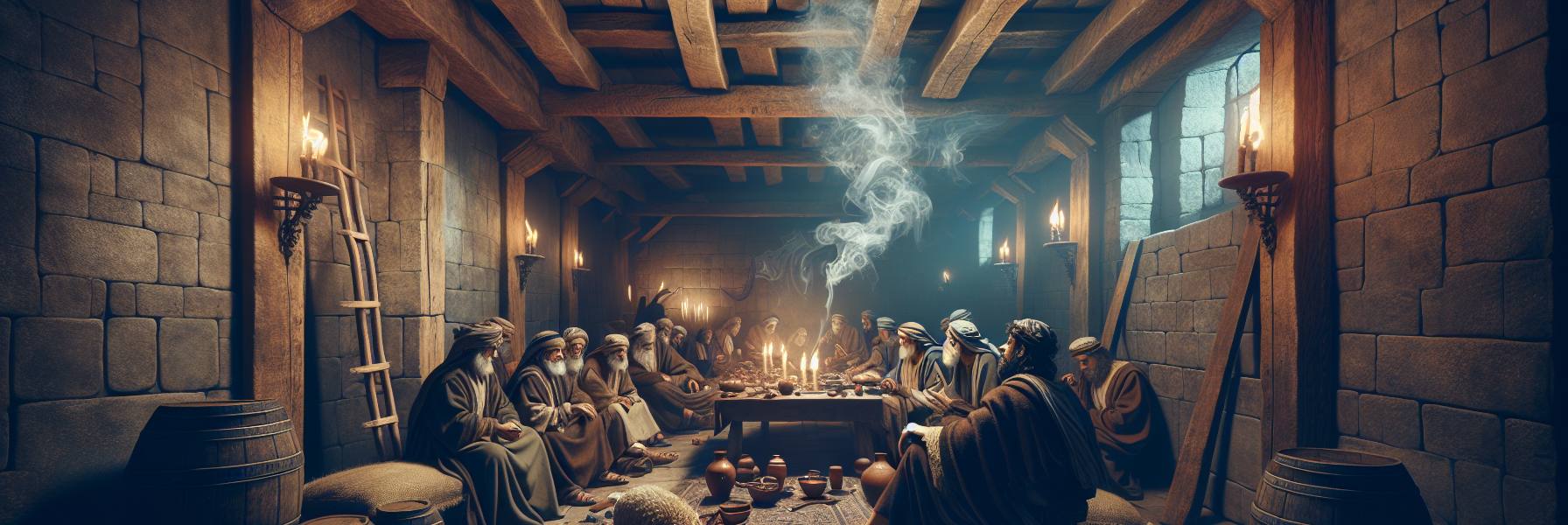

The room held the close, warm scent of roasted lamb, wine, and worn leather. Smoke from the oil lamps drifted lazily toward the ceiling beams, staining them a deeper brown. The talk had been strange all evening—talk of betrayal, of departure. A heavy silence had settled after Judas hurried out into the Jerusalem night, a silence that felt like a held breath.
Peter, ever restless, shifted on the cushion, the coarse wool of his robe scraping against the floor tiles. He’d just made his bold declaration—*I will lay down my life for you*—only to have it gently, devastatingly, undone. *Will you lay down your life for me? Truly, truly, I tell you, the rooster will not crow until you have denied me three times.*
The words seemed to hang in the air, thickening it. It was into that bruised quiet that Jesus spoke again, but his voice changed. The edge of sorrowful prophecy softened, replaced by a tone so steadying it felt like a hand on a shoulder.
“Do not let your hearts be troubled.” He said it slowly, letting the words find each man in his own private worry. “You trust in God; trust also in me.”
Thomas, practical to his core, his brow permanently furrowed from years of fixing fishing nets and assessing tangible problems, leaned forward. His voice was rough with confusion. “Lord, we don’t know where you are going. How can we know the way?”
Jesus looked at him, and there was no frustration in his gaze, only a profound, encompassing certainty. “I am the way,” he said, and the simplicity of it was staggering. “And the truth, and the life. No one comes to the Father except through me. If you really knew me, you would know my Father as well. From now on, you do know him and have seen him.”
Philip, who had a scholar’s longing for clear revelation, couldn’t help himself. The longing of centuries—of Moses begging to see God’s glory—burst from him. “Lord,” he said, a hint of pleading in his voice, “show us the Father and that will be enough for us.”
A sadness, deep and patient, touched Jesus’s eyes then. Not anger, but the sorrow of being profoundly misunderstood after so much time. “Have I been with you all this time, Philip, and you still do not know me?” The question hung, gentle but piercing. “Anyone who has seen me has seen the Father. How can you say, ‘Show us the Father’? Don’t you believe that I am in the Father, and the Father is in me? The words I say to you I do not speak on my own authority. Rather, it is the Father, living in me, who is doing his work. Believe me when I say that I am in the Father and the Father is in me; or at least believe on the evidence of the works themselves.”
He paused, letting the truth of it sink in—the healings, the stilled storm, the bread broken for thousands. All of it, a portrait. Then he continued, his voice dropping into a more intimate register, a promise spoken for the future they couldn’t yet imagine.
“Truly, truly, I tell you, whoever believes in me will do the works I have been doing, and they will do even greater things than these, because I am going to the Father.”
Greater things? John, listening with his soul wide open, felt the impossibility of it. Greater than Lazarus stumbling from a tomb?
“And I will do whatever you ask in my name, so that the Father may be glorified in the Son. You may ask me for anything in my name, and I will do it.”
It wasn’t a blank cheque for wishes; it was a principle of alignment. To ask in his name was to ask as his representative, with his character, for his purposes. The room seemed to hum with the potential of it.
“If you love me,” Jesus said, and the condition was tender, not harsh, “keep my commands. And I will ask the Father, and he will give you another Advocate to be with you forever—the Spirit of truth.”
Another. One like himself. The idea began to dawn on them, a slow sunrise in their gloom. He was leaving, but not abandoning.
“The world cannot accept him, because it neither sees him nor knows him. But you know him, for he lives with you and will be in you.”
*In you.* The preposition shifted everything. God with them, around them, was now to be God within them. The temple of their own hearts.
“I will not leave you as orphans; I will come to you.” He spoke of a coming not at the end of the age, but soon. A coming in presence and spirit. “Before long, the world will not see me anymore, but you will see me. Because I live, you also will live. On that day you will realize that I am in my Father, and you are in me, and I am in you.”
The intertwining was beautiful, incomprehensible. A vine and its branches, a head and its body. A mutual indwelling.
“Whoever has my commands and keeps them is the one who loves me. The one who loves me will be loved by my Father, and I too will love them and show myself to them.”
Judas (not Iscariot) found his voice, thin with confusion. “But, Lord, why do you intend to show yourself to us and not to the world?”
Jesus’s answer was patient. “Anyone who loves me will obey my teaching. My Father will love them, and we will come to them and make our home with them.” The home was no longer a upstairs room in Jerusalem, but the human spirit. “Anyone who does not love me will not obey my teaching. These words you hear are not my own; they belong to the Father who sent me.”
He drew a slow breath, looking at each of them—at Peter’s defiant shame, at Thomas’s pragmatic doubt, at Philip’s yearning, at John’s aching devotion.
“All this I have spoken while still with you. But the Advocate, the Holy Spirit, whom the Father will send in my name, will teach you all things and will remind you of everything I have said to you.”
A teacher for the road ahead. A memory for the dark days.
“Peace I leave with you; my peace I give you. I do not give to you as the world gives.” The world’s peace was the absence of trouble, fragile and circumstantial. His was different—a deep river flowing beneath the storm. “Do not let your hearts be troubled and do not be afraid.”
He reminded them of his departure again, but now it was framed not as loss, but as necessary journey. “If you loved me, you would be glad that I am going to the Father, for the Father is greater than I.” It was a statement of economic order, not of essence. The sent one returning to the sender.
“I have told you now before it happens, so that when it does happen you will believe.”
He stood then, the conversation winding to its close. The night outside was fully dark. “I will not say much more to you, for the prince of this world is coming. He has no hold over me, but he comes so that the world may learn that I love the Father and do exactly what my Father has commanded me.”
He moved toward the door, preparing to lead them out into the Garden where the night’s true weight would descend. But his final words lingered in the lamplit room, a warmth against the coming cold.
“Come now; let us leave.”
And in the space between his words and their movement, a strange, unshakable peace had begun to root itself, tangled with grief, yet alive. They did not understand it all. Not yet. But they trusted the voice that spoke it.