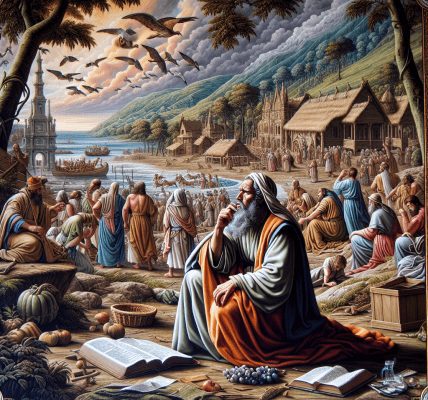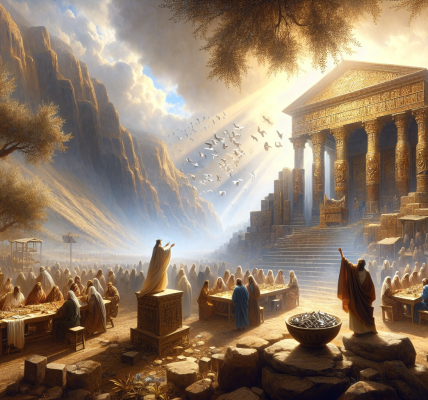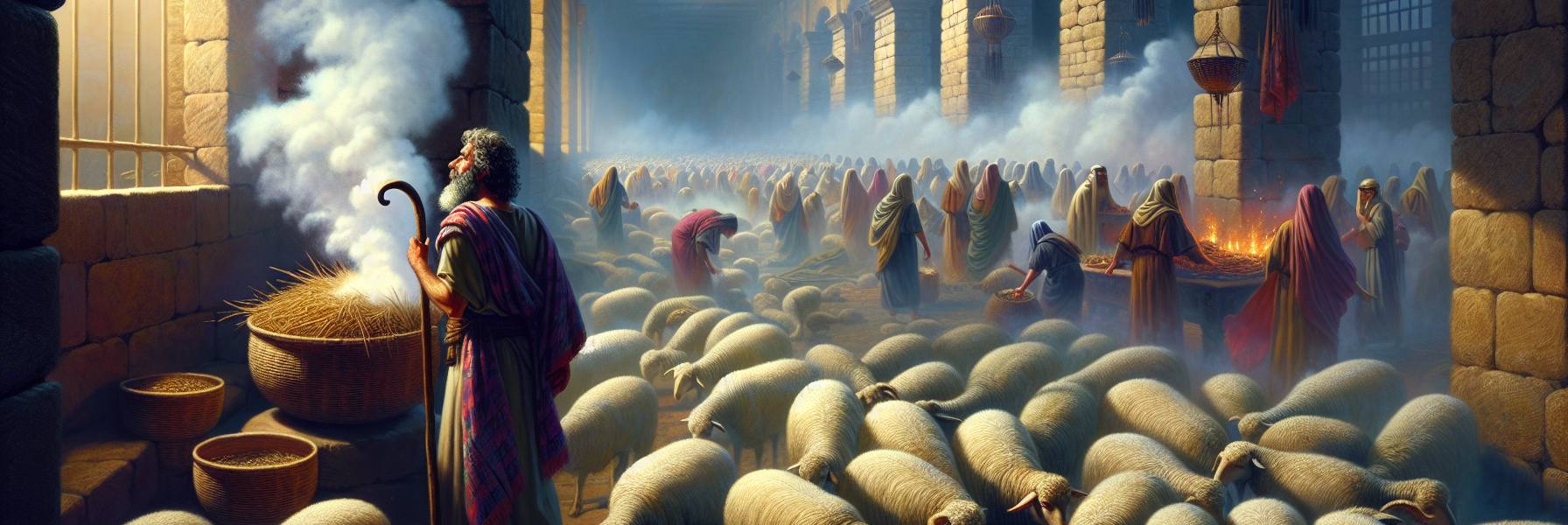

The air in Bethel was thick with the smoke of sacrifices. It clung to the robes of the merchants and the perfumed hair of the wealthy women who came from Samaria, a sweet, heavy scent meant to mask other odors. Amos stood at the edge of the marketplace, his shepherd’s frame leaning on a staff worn smooth by his own palm. He watched the priests of the royal sanctuary move with practiced ease, receiving the fat lambs brought by the matrons of Bashan—women who, in their idleness, called out to their husbands for more wine, more luxury, while the bones of the poor grew brittle under the weight of their greed.
He remembered the visions—the locusts, the fire—but this message was different. It was not a future terror, but a chronicle of mercy ignored. The words formed in his chest like a bitter herb.
“Listen,” his voice cut through the market hum, not a shout, but low and carrying, like stone grinding on stone. A few faces turned, curious. “You who crush the needy and say to your masters, ‘Bring, that we may drink!’ Hear this word.”
He began to speak, and his words were not poetry, but a damning ledger. “I gave you cleanness of teeth in all your cities,” he said, and an old woman selling lentils paused, her hand going to her own toothless mouth. She remembered the famine three years past, the way the merchants had hoarded grain until the price was beyond reach, the way the wealthy still held their feasts while children’s bellies swelled with hunger. “Yet you did not return to me,” Amos declared, his eyes sweeping over the well-fed priests. “Declares the Lord.”
He took a step forward, his sandals dusty on the paving stones. “I also withheld the rain from you when there were yet three months to the harvest.” A vineyard keeper, his skin like leather, nodded grimly. He recalled watching his grapes wither to black raisins on the vine, the cisterns yielding only mud. The great houses had bought water, carted it in from distant springs at a price that broke a man’s back. “I would send rain on one city, and send no rain on another city,” Amos continued, his tone almost weary. “One field would have rain, and the field on which it did not rain would wither. So two or three cities would wander to another city to drink water, and would not be satisfied.”
He saw the memory flicker in their eyes—the desperate travel, the begging at strange gates, the humiliation. “Yet you did not return to me.”
The list went on, a divine litany of gentle corrections turned harsh by stubbornness. “I struck you with blight and mildew,” he said, and the farmers in the crowd winced. They could still smell the rotten figs, see the pale fungus on the wheat. “Your gardens and your vineyards and your fig trees and your olive trees the locust devoured.” The sound of a million chewing jaws seemed to echo in the pause he left. “Yet you did not return to me.”
He spoke of plagues “like those of Egypt,” and young men died in their prime, their horses captured, the stench of death rising even to their fortified nostrils. “I overthrew some of you, as when God overthrew Sodom and Gomorrah.” His voice dropped. “And you were as a brand plucked from the burning.” A murmur went through them. Everyone knew someone who had been in Admatha when the wall fell, or in Gath-Hepher when the fire swept through the lower quarter. They had spoken of it as luck, or their own cunning.
“Yet you did not return to me.”
The climax of his accusation was the most intimate, the most chilling. “Therefore thus I will do to you, O Israel; because I will do this to you, prepare to meet your God, O Israel!” The title ‘God’—*Elohim*—he loaded with terrifying weight. Not the familiar, domesticated god of their state rituals, but the One who forms the mountains, creates the wind, declares to man what is his thought, who makes the morning darkness, and treads on the high places of the earth. The Creator, unbounded by their temples or their politics.
The market was silent now. The smoke from the altar seemed acrid, pointless. Amos looked at their faces, from the sleek priest holding a silver bowl to the gaunt potter whose fingers were stained with clay. He saw not fear, but a kind of numb incomprehension. The warnings had been so ordinary—drought, crop failure, disaster. They had seen them as bad luck, the natural turns of a difficult world. They had never connected the dryness of their wells to the dryness of their souls.
He turned and walked away, leaving the noise of the market to slowly swell again behind him. They would go back to their sacrifices tomorrow, he knew. They would bring their tithes every three days, their thank offerings of leavened bread, their loud freewill offerings, just as they loved to do. They would proclaim and publicize their piety. And the One who treads the high places would hear it all as noise.
Amos walked out toward the hills, to where the air was clear. Behind him, Bethel lay under a haze, a city sick with a blessing it had twisted into a curse, awaiting a meeting it no longer knew how to have.