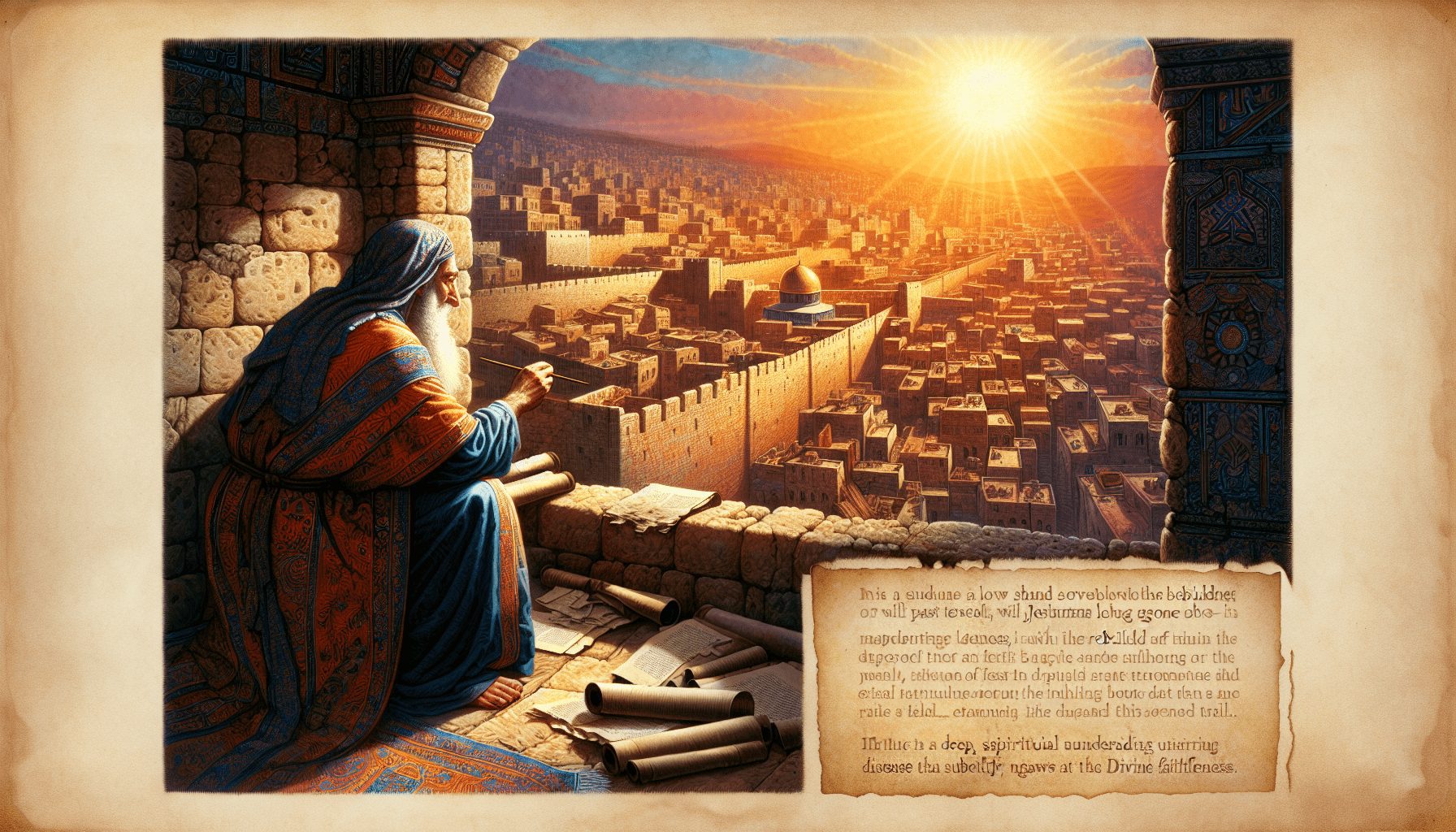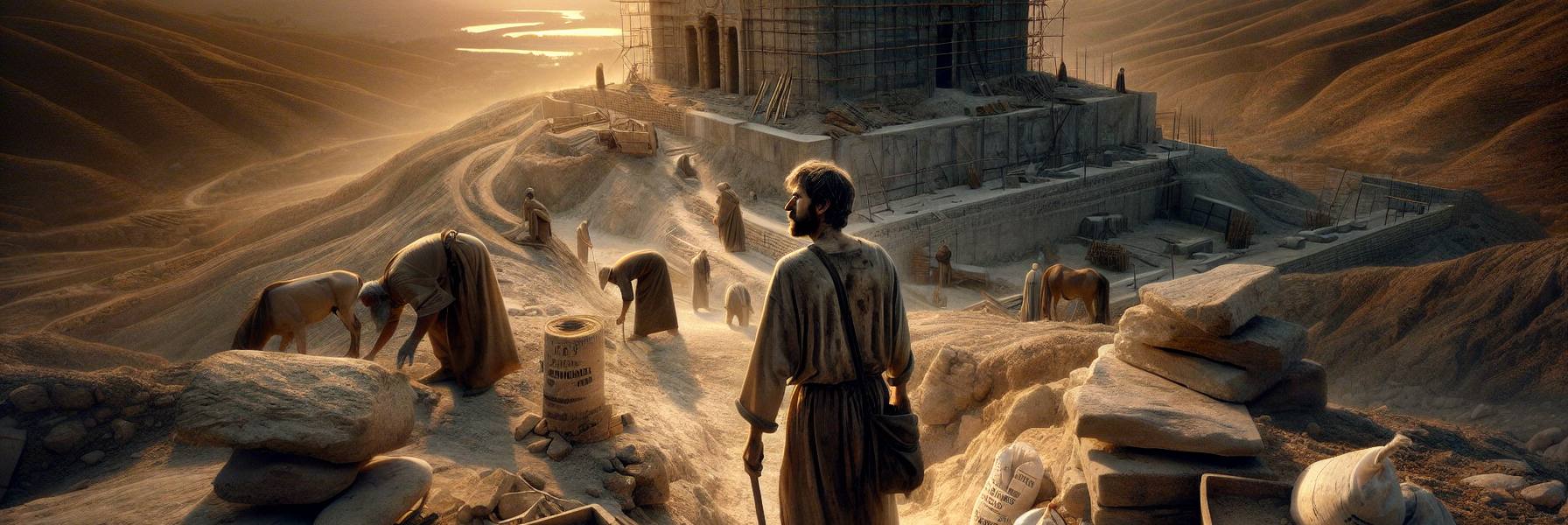

The ache in my shoulders was a dull, familiar companion. It was the ache of stones hauled, of mortar mixed, of a city being coaxed, piece by painful piece, from its own ashes. I, Zechariah, stood in the twilight of the building site they called the Temple. It was a pitiful thing, a foundation and a few courses of stone that seemed to huddle against the Judaean hills as if ashamed. The old men, the ones who remembered Solomon’s glory, would sometimes weep quietly as they worked, their tears cutting tracks through the dust on their faces.
The wind carried the scent of cold earth and crushed limestone. I turned from the site, the weight of the day and the prophet’s mantle heavy upon me. Sleep, when it came, was not restful, but a sinking into a different kind of awareness.
Then I was no longer in my bed.
I stood in a place of distilled silence, a space without dimension yet profoundly present. Before me, solid and yet wrought of pure gold, was a lampstand. It was not like the one Bezalel had hammered out for the Tabernacle, though it echoed its form. This was something more fundamental, as if the very idea of ‘lampstand’ had been made manifest. Its central stem was strong, and from it branched seven lamps, each crowned with a shallow, graceful bowl. But here was the wonder: above each lamp was not one, but seven spouts—tiny, delicate pipes awaiting the flame. Seven times seven. The mathematics of it hummed in the air, a geometry of divine completeness.
And it was not empty. From a single, hidden source, golden oil flowed through two channels of beaten gold that ran like gentle streams to either side of the stand, feeding it without ceasing, without a hand to pour.
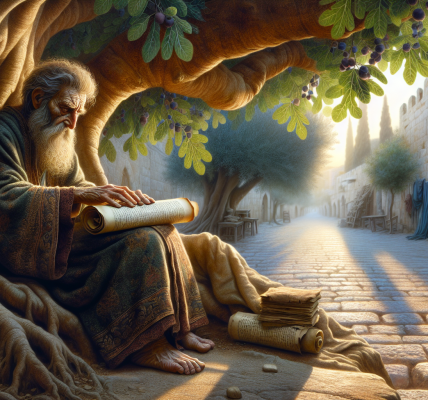
My eyes, straining in the visionary light, followed the channels upward. There, flanking the lampstand, were two olive trees. They were not rooted in any soil I could see. They were ancient and vigorous, their leaves a shimmering silver-green, their boughs heavy with fruit that gleamed like onyx. And from these trees, from somewhere near their very heartwood, the golden oil issued forth. It was a closed circuit of grace: tree to channel, channel to lamp, lamp to light—all sustained by the living trees.
A voice, not in my ear but within my mind, spoke. “What do you see, Zechariah?”
I stammered out a description: the gold, the seven-and-seven lamps, the two trees, the perpetual oil. The words felt clumsy, inadequate for the symbol unfolding before me.
Then the voice, which I now knew belonged to the interpreting angel who stood like a patient scholar beside me, said, “This is the word of the LORD to Zerubbabel: ‘Not by might, nor by power, but by my Spirit,’ says the LORD of Hosts.”
The sentence landed in my spirit not as a slogan, but as a tectonic shift. In the gloom of our efforts, we measured success by the strength of our arms, the depth of our purses, the favor of the Persian court. We looked at the ‘great mountain’ of rubble, opposition, and despair that stood before Zerubbabel the governor, and we saw only an engineering problem. We grumbled about the ‘day of small things,’ this pathetic beginning.
But the lampstand spoke of a different economy. It needed no servants to trim its wicks, no priests to haul heavy jars of oil. Its light was independent, sustained from a source outside of human administration. The might of armies? Useless here. The power of royal decree? Irrelevant. Only the silent, relentless flow of the Spirit, like that golden oil, could accomplish this.
“Who are you, O great mountain?” the angel continued, his tone almost dismissive. “Before Zerubbabel you shall become a plain.” It was not a prediction of a miraculous earth-flattening event, but a declaration of perspective. The mountain was only a mountain if you tried to climb it by might. Before the steady, Spirit-empowered work of obedience, it would lose its imposing stature. It would become manageable, a gentle slope.
And then the climax, which struck me with the force of a personal commission: “He will bring forth the top stone amid shouts of ‘Grace, grace to it!’”
I saw it. I heard it. Not the grunts of labourers, but a spontaneous, collective cry of wonder. The final stone, the capstone, set not with grim determination, but with jubilant recognition. It would be grace from first to last. Grace that called us back from exile. Grace that moved Cyrus’s heart. Grace that provided the oil when our own reserves were dust.
My gaze returned to the two trees. “What are these, my lord?” I asked, pointing to the olive trees that poured out their essence.
“These are the two anointed ones who stand by the Lord of the whole earth.”
The answer was deliberate in its brevity. They were not named. Joshua the high priest? Zerubbabel the royal descendant? Perhaps. But they were more than men; they were offices, channels. The twin streams of priestly mediation and kingly authority, both dry for so long in exile, now restored and overflowing with the Spirit’s unction. They stood *by* the Lord, in service to His cosmic rule, their sole purpose to fuel the light that was meant to shine in the darkness.
The vision faded, not with a snap, but like a dawn mist slowly burned away by the rising sun. I found myself on my pallet, the real dawn a grey smear on the horizon. The ache in my shoulders remained. The pile of stones outside was unchanged.
But everything was different.
I rose and walked back to the site. The workers were gathering, their faces etched with the same weary resolve. I saw Zerubbabel speaking with a mason, pointing at a stubborn foundation stone.
I looked at him, and I no longer saw just a governor in a faded Persian tunic. I saw a man flanked by an invisible olive tree. I saw the mountain of opposition not as an immovable object, but as a future plain. I heard, beneath the clink of chisels and the foreman’s calls, the echo of a future shout: “Grace! Grace to it!”
The work was still ours to do. The stones still had to be laid. But the power to do it, the light that would fill this house and make it more than a building—that would come on a different current. Quiet, persistent, and golden. Not by might. Not by power. But by the Spirit. The work would be finished. Because it was His work, all along.