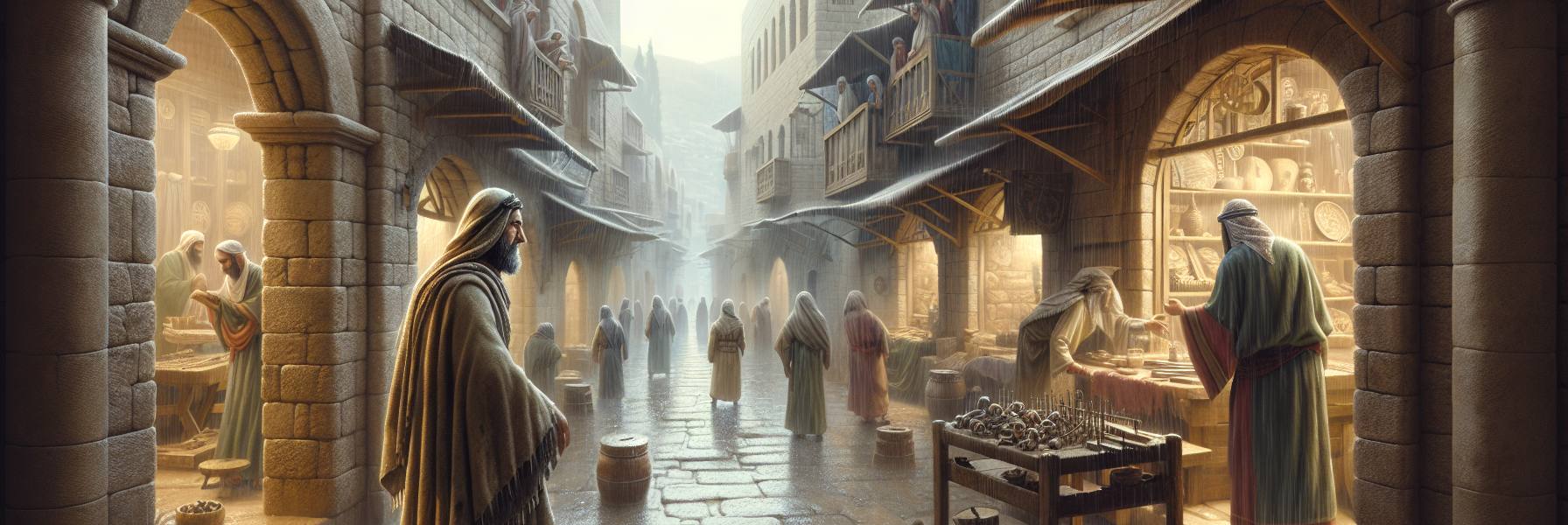

The rain had finally come to Jerusalem, a slow, whispering drizzle that settled the dust in the streets and left the air smelling of wet stone and damp earth. Baruch, the scribe, felt it on his face as he walked, a relief after the long, tense dryness. But the relief in the city was of a different kind, brittle and feverish. He could hear it from the open-fronted workshops in the Tyropoeon Valley—the tap-tap-tap of mallets on metal, the hiss of solder, the murmured incantations of the craftsmen.
He was looking for his master, Jeremiah. He found him not in the temple courts, nor by the king’s gate, but standing utterly still in the mouth of an alley, watching a particular workshop. The prophet’s cloak was dark with moisture, his face a landscape of weary sorrow.
“Baruch,” Jeremiah said, without turning. “Come. See the fear of a nation.”
Together they watched a master craftsman, a man with forearms corded with muscle and a fine layer of silver dust clinging to his beard. He was putting the final touches on a statue. It was a form of the celestial god, a figure meant to be Hadad or perhaps a local Baal, crowned with a crescent moon. The man worked with exquisite care, smoothing the silver sheeting over a wooden armature with a polished agate burnisher. His apprentices scurried about, feeding the charcoal furnace, bringing nails of iron from Tarshish.
“See the process,” Jeremiah whispered, his voice barely audible over the rain and the workshop din. “The tree is cut from the forest, from the oaks of Bashan or the cedars of Lebanon. It is shaped by the axe. A beautiful form emerges, but it is dead wood. Then comes the smith. With his measuring line, he marks it. With his chisel, he carves it. He gives it a human shape, the shape of a king, or a warrior, or a lover. But it cannot stand. It must be nailed to a base, fixed in place so it does not topple.”
The craftsman, his work done, stepped back. The apprentices lifted the gleaming silver form—a man striding forward, one hand raised in blessing. They carried it with reverence to a plinth at the back of the shop. The master craftsman then took up a small bag of blue and purple dyes and began to paint the eyes, to stain the lips.
“Then comes the gilder,” Jeremiah continued, a bitter irony now coloring his words. “He overlays it with gold, hammers out silver plates for adornment. Finally, the drapers come. They clothe it in violet and purple, rich robes stolen from a king’s wardrobe. They seek to give it majesty. And there it stands. A masterpiece of human terror.”
Baruch understood. This was not mere commerce; it was an industry of dread. The New Year festivals were approaching, a time when the gates of heaven were believed to be open, when the fates were written. The king and the people were afraid—of the drought that had just broken, of the sickness in the lower city, of the rumble of Babylon far to the east. They sought a handle on the divine, something they could see, dress, control, and appease.
That evening, in the chamber where they worked, the smell of rain still fresh, Jeremiah was agitated. The sight had ignited something in him. He paced, then sat, then stood again.
“Write this, Baruth. Write what the Lord says.”
Baruch took his papyrus and stylus, the lamp flickering.
“Do not learn the way of the nations,” Jeremiah began, his voice low and urgent, dropping into the rhythmic cadence of prophecy. “Do not be terrified by the signs of the heavens, though the nations are terrified by them.”
Baruch’s stylus scratched quickly. He painted the contrast with the words his master gave him.
“For the customs of the peoples are worthless. They cut a tree from the forest. A craftsman shapes it with his chisel. They adorn it with silver and gold. They fasten it with hammer and nails so it will not totter.”
Jeremiah paused, and in the silence, Baruch could almost hear the hollow tap-tap from the valley below.
“Like a scarecrow in a melon patch,” Jeremiah said, his voice thick with a contempt that was also a profound sadness, “their idols cannot speak. They must be carried because they cannot walk. Do not fear them; they can do no harm, nor can they do any good.”
Then the prophet’s tone changed. It deepened, widened, like the sky after rain. He was no longer describing human folly, but portraying divine reality.
“There is none like you, O Lord. You are great, and your name is mighty in power. Who would not fear you, O King of the nations? This is your due.”
Baruch felt the hairs on his arms stand up. The room seemed to shrink around the words.
“For among all the wise men of the nations, and in all their kingdoms, there is no one like you. They are all senseless and foolish. Their instruction is but a wooden idol, beaten silver from Tarshish, gold from Uphaz. They are the work of skilled hands, clothed in blue and purple—all the products of skilled workers.”
Jeremiah’s eyes were closed now, seeing a different workshop, a different making.
“But the Lord is the true God. He is the living God, the eternal King. When he is angry, the earth trembles; the nations cannot endure his wrath.”
Baruth wrote, the letters flowing: *‘Tell them this: “These gods, who did not make the heavens and the earth, will perish from the earth and from under the heavens.”’*
A profound quiet filled the room after the final word was spoken. The only sound was the gentle drip of water from the eaves outside. Jeremiah sat heavily, the fire gone from him, replaced by a deep, resonant grief.
“They exchange the truth for the lie, Baruch,” he said, not looking at his scribe. “They exchange the one who formed all things for a thing they themselves have formed. And in the day of reckoning, what will they hold onto? A nailed-down post. A dressed-up log. It will be fuel for the fire.”
Baruch looked down at the papyrus. The words were stark, the argument inescapable. On one side: the frantic, beautiful, deadly work of human hands, born from fear and ending in ash. On the other: the silent, unmanipulatable, world-shaking reality of the Living God, who speaks and it is, who is not a resident of a shrine but the architect of the storm.
The next morning, the rain had ceased. A clean, pale light washed over Jerusalem. As Baruch walked to the temple, he passed the same workshop. The master craftsman was showing the newly finished idol to a wealthy merchant from Anathoth. The silver figure gleamed in the sun, its purple robes brilliant.
But Baruch saw it differently now. He didn’t see a god. He saw a tree, cut down. He saw nails. He saw a thing that needed to be carried. And for a moment, lifting his eyes to the vast, washed-blue dome of the sky, he felt a terror far greater, and a peace far deeper, than anything the silver god could ever provide. It was the difference between holding a painted doll and standing before the ocean. One you could pretend to command. The other commanded you, spoke to you in every crashing wave and silent depth, and demanded not your decoration, but your awe.