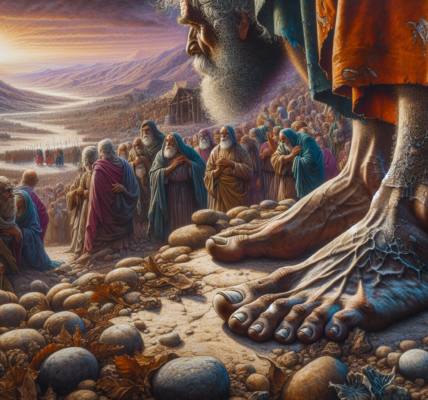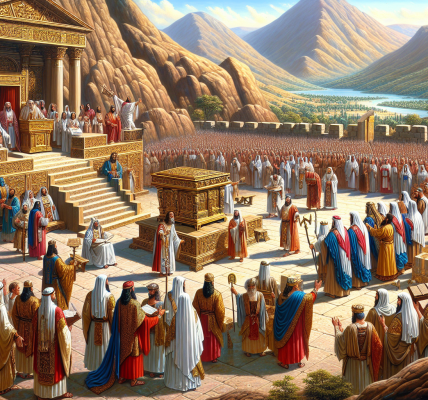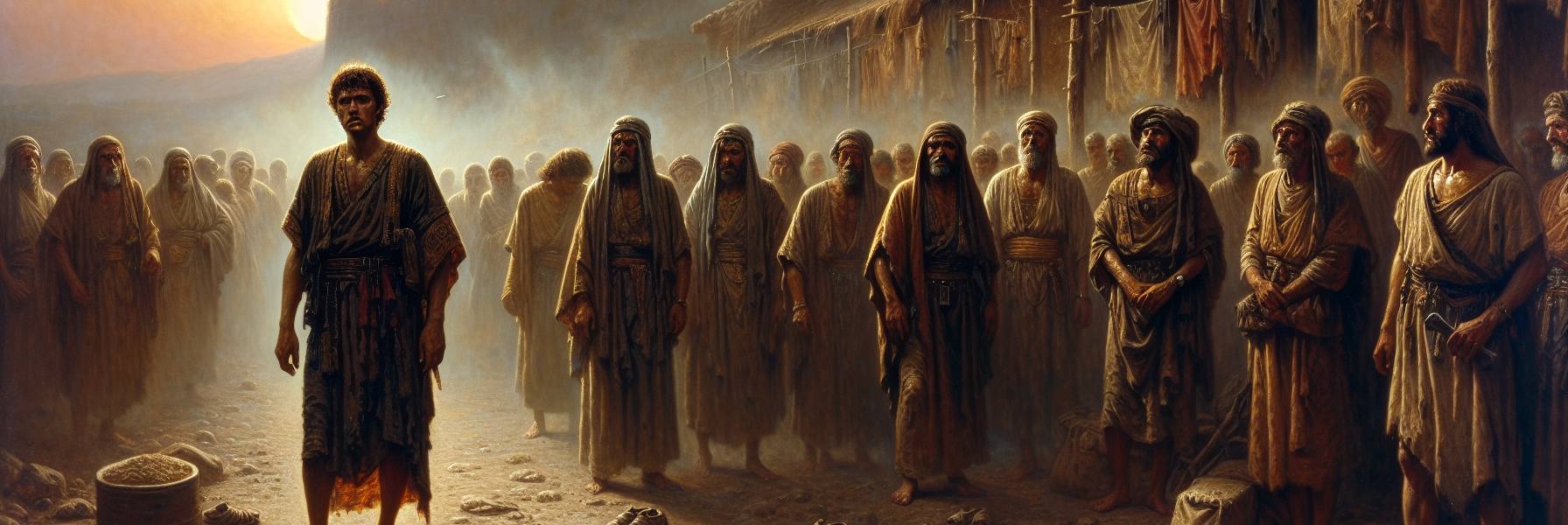

The heat in Mizpah was a dry, clinging thing. It wasn’t the fierce sun of midday that pressed upon them now, but the stale, suffocating warmth of a land holding its breath. Dust coated the sandals of the men who gathered outside the house where Jeremiah the prophet stayed. It was not a proud assembly. Johanan, son of Kareah, stood at their front, his shoulders squared with a burden of leadership he hadn’t asked for. Beside him was Jezaniah and all the army officers, their weapons a dull gleam in the hazy light, and with them, every last soul who had been left in the land—from the least to the greatest, as the record puts it. They were the remnants, the overlooked fragments of Judah, clinging to the cracked earth after Babylon’s whirlwind had passed.
Gedaliah, the governor Babylon had set over them, was dead, murdered by Ishmael’s treachery. The brief, hopeful calm had shattered like a clay jar on stone. Now fear, a colder and more pervasive thing than the heat, moved among them. Whispers of Babylonian vengeance swirled like eddies of dust. They imagined the imperial envoys asking, “Where is the man we set in charge?” and finding only a bloodstain and a fugitive people. Flight seemed not an option, but a necessity.
Johanan led them inside. The room was dim, cooler, smelling of aged clay and oil. Jeremiah stood before them, an old man whose eyes held the weariness of a lifetime of delivering words no one wanted to hear. The formalities were brief, edged with desperation.
“Please,” Johanan began, his voice rough, “hear our petition. Pray for us, for all this remnant. What you see is all that’s left of us. Once we were many; now we are few. Pray that the Lord your God—for He is *our* God too—will show us the way. Where should we go? What should we do?”
The request hung in the quiet. It sounded pious. It sounded right. Then they made the vow, the words falling from their lips with a fervor born of terror. “May the Lord be a true and faithful witness against us if we do not act according to everything the Lord your God sends you to tell us. Whether it is favorable or unfavorable, we will obey the voice of the Lord our God, to whom we are sending you. *So that it may go well with us.*”
That last phrase, Jeremiah noted. *So that it may go well with us.* It was the key that unlocked the true chamber of their hearts. They desired prosperity, safety, a good outcome. Obedience was the proposed price. He looked at their faces—gaunt, anxious, determined. He saw the fear in their eyes, and the unspoken destination already forming there: Egypt. The granary of the ancient world. The place of old slavery, and old refuge.
“I have heard you,” Jeremiah said, his voice low but clear. “I will pray to the Lord your God as you have requested. And every word He gives, I will tell you. I will keep nothing back.”
They thanked him, a murmur of tense gratitude, and left him to his solitude. For ten days, Jeremiah sought the Lord. Ten days of silence for the people, an eternity of uncertainty. They watched the horizon for Babylonian scouts. They packed their meager belongings by stealth. They argued in low voices about the best routes to the Nile Delta. The vow they had made began to feel like a ceremonial thing, a ritual to sanctify a decision already nearly made.
On the tenth day, the word of the Lord came to Jeremiah. He called Johanan and all the officers and people together. The crowd was larger now, more restless. Jeremiah stood before them, and the spirit of prophecy settled upon him, not with fire, but with a terrible, quiet clarity.
“Thus says the Lord, the God of Israel, to whom you sent me to present your plea,” he began. “If you will indeed remain in this land, then I will build you up and not tear you down; I will plant you and not pluck you up. For I relent of the disaster I have brought upon you. Do not fear the king of Babylon, of whom you are afraid. Do not fear him, declares the Lord, for I am with you, to save you and to deliver you from his hand. I will grant you mercy, that he may have mercy on you and let you remain in your own land.”
The promise was staggering in its simplicity and its challenge. *Stay. Be still. Trust.* The Lord painted a picture of reversal: planting, building, mercy from the very conqueror they dreaded. He spoke to their deepest fear—the king of Babylon—and commanded them not to fear him. But then the divine voice turned, as it always did with Jeremiah, to the stark alternative.
“But if you say, ‘We will not remain in this land,’ disobeying the voice of the Lord your God, and if you say, ‘No, we will go to the land of Egypt, where we shall not see war or hear the sound of the trumpet or be hungry for bread, and there we will dwell’—then hear now the word of the Lord, O remnant of Judah.”
The prophet’s voice did not rise to a shout. It deepened, becoming the voice of the courtroom of heaven, pronouncing sentence. “Do not go to Egypt. Know for a certainty that I have warned you this day. You have deceived yourselves, for you sent me to the Lord your God, saying, ‘Pray for us… that it may go well for us,’ yet you are resolved to go to Egypt. The sword you fear shall cling to you there. The famine you dread shall follow you there. And there, in Egypt, you shall die. Not one of you shall survive or escape the disaster I will bring upon you.”
He spoke of the wrath that would be poured out, like the wrath upon Jerusalem. Egypt would be no refuge, but a furnace. They would become an execration, a horror, a curse, and a taunt. They had seen the abominations of Jerusalem with their own eyes; they would commit worse in the land of Pharaoh, forgetting their own vows, their own identity. The word was final, absolute, a clear fork in the road: life in the abandoned land, or death in the sought-after refuge.
When Jeremiah finished, the silence was complete. Then it broke into a low, angry rumble. Johanan and Jezaniah and all the proud men looked at each other, and then at the prophet. The fear on their faces had hardened into something else: defiance, wounded pride, the bitter conviction of the practical man.
“You are lying!” Jezaniah finally spat, the vow of ten days before ashes in his mouth. “The Lord our God did not send you to say, ‘Do not go to Egypt to live there.’ It is Baruch, son of Neriah, who is inciting you against us, to deliver us into the hand of the Chaldeans, that they may kill us or take us into exile in Babylon!”
The accusation hung, ugly and desperate. They rejected the clear, costly command for a conspiracy theory that fit their panic. They chose the narrative of betrayal over the call to faith. They took the entire remnant—the men, the women, the children, the royal daughters, every person Jeremiah had labored to save—and they turned south toward the Negev, toward the road to Egypt. They forced Jeremiah and Baruch to come with them, a talisman perhaps, or a hostage to their own doomed decision.
And so they went, carrying the blessing they had begged for and then despised, walking directly into the curse they had been promised. The last glimpse of the hills of Judah faded behind them in a haze of dust and disbelief. The prophet walked among them, a prisoner of their certainty, bearing the heaviest word of all: the one they had sworn to obey, and would now die disobeying.