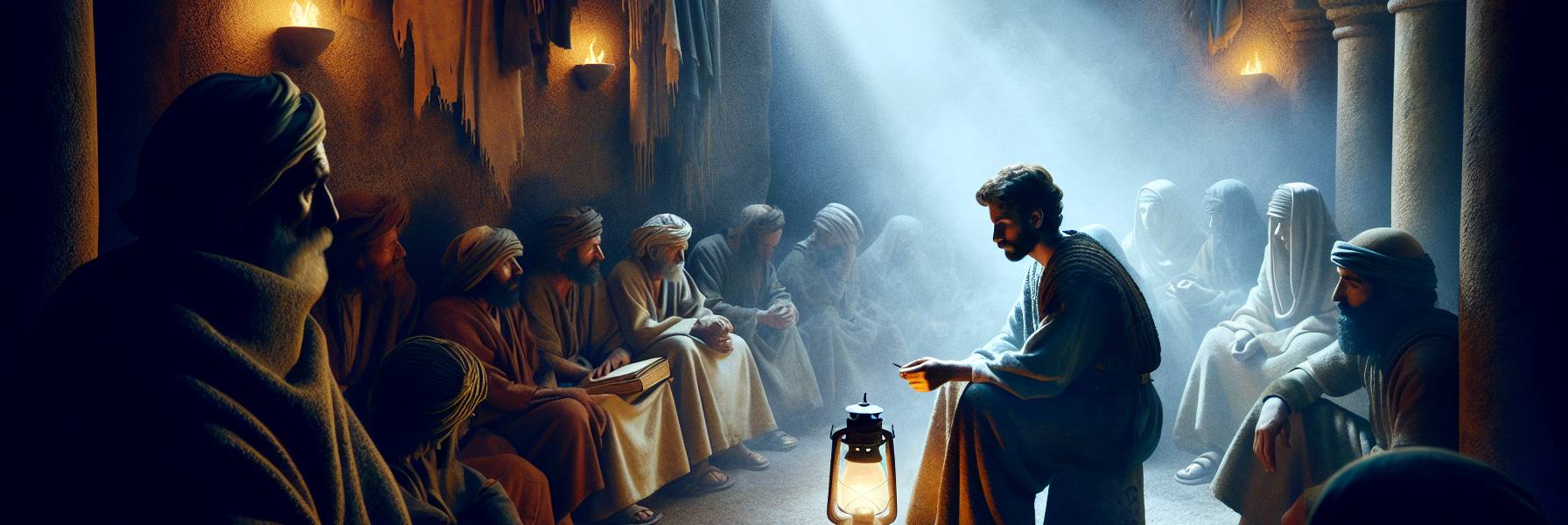

The air in the hall was thick with the smell of old parchment, damp wool, and the lingering scent of last night’s rosemary oil from the lamp. Eliah ben Samuel sat on a low stool, his back to the rough limestone wall, feeling the coolness seep through his tunic. Before him, a circle of faces, young and old, caught in the flickering light of a single clay lamp. The rains had come early, a persistent drizzle that whispered against the hide stretched over the doorway, and the unseasonable chill had driven them indoors, away from the evening chores.
“You ask about the seventh year,” Eliah said, his voice a dry rustle, like wind through barley stalks. “And the one that comes after seven sevens.”
It was young Micah who had asked, his fingers still stained dark from the olive press. He was eager, impatient with the rhythm of things. He wanted to know why his father had refused to plant the northwest field this season, letting it lie fallow, a blanket of wild mustard and mallows turning gold and soft.
Eliah didn’t answer directly. He closed his eyes, not for dramatic effect, but because the memory he sought was visual, tactile. “I was about your age, Micah,” he began, his words slow, searching. “It was a year of locusts. Not a great swarm from the south, but a mean, lingering plague that ate the edges of everything. The wheat was thin. The grapes were sour little things. My father, Samuel—your great-grandfather—he stood at the boundary stone of our land, the one with the chisel mark of a dove. And he said to me, ‘This year, we will be poor. We will eat what the un-tilled earth gives freely.’ I was afraid. I saw hunger in my mother’s hands.”
He paused, swallowing against the dryness in his throat. A dog scratched at fleas in the corner, the sound loud in the quiet.
“We foraged. We gathered the volunteer grains, the fallen fruit from orchards gone wild. We ate things we would have scorned in a fat year. And it was hard. But a strange thing happened. In our lack, old Zadok from the next valley, who my father had quarreled with over a stray goat, he came. He brought a skin of wine, not good wine, but drinkable. ‘The land rests,’ he said, ‘and so should our quarrels.’ We shared a meal. It was the land that fed us, not our own striving. That was the Shabbat of the land. A ceasing. To remember the earth is not a slave, and we are not its masters, but tenants in the house of the Most High.”
He opened his eyes. The children were listening now, not just the adults. The concept was settling on them.
“But the forty-ninth year…” Micah prompted, leaning forward.
“Ah.” A smile touched Eliah’s cracked lips. “The Jubilee. The *Yovel*. The sending out. I have seen two in my life. The first, I remember the sound.” He cupped a hand behind his ear. “Not a shofar blast from the Temple mount—we were too far to hear that. No. It was the sound of a man, Reuben bar Jacob, weeping. Great, heaving sobs that shook his shoulders. He had been bond-servant to old Nathan for twenty years. A good man, but fortune had turned against him after a fire. He worked Nathan’s land to pay his debt. He lived in Nathan’s house. His children were born there.”
Eliah shifted on the stool, his joints complaining. “The proclamation went out. ‘You shall consecrate the fiftieth year and proclaim liberty throughout the land to all its inhabitants.’ And on that day, Nathan, who was not a cruel man but a practical one, he took Reuben to the boundary of the ancestral land—the strip of stony ground that had been his family’s. Nathan placed a clod of earth from that field into Reuben’s hands. ‘The land returns,’ Nathan said. ‘And you return with it.’ That’s when Reuben wept. It was the weeping of a stone breaking after a long frost. He was not just free of debt. He was *re-placed*. Put back into the story of his family. The land remembered him.”
The narrative was taking its own path now, winding like a goat track. Eliah saw a flaw in his telling. “It is not magic,” he cautioned, holding up a knotted finger. “It is law. Hard, inconvenient, disruptive law. If you sold a field in distress, the price was not for the field, but for the harvests until the Jubilee. You were always selling a lease, not a possession. ‘For the land is mine,’ says the Lord. ‘You are but strangers and sojourners with me.’ We are all… tenants. Passing through. The Jubilee cuts the roots of greed. It prevents the great mound of earth from being owned by one man, and the next man having only dust. It is a reset. Not of harvest, but of hope.”
He sighed, a long, weary exhalation. “The second Jubilee I saw… it was quieter. Less weeping. More accounting. Scrolls were brought out. Deeds of sale, records of service. Men haggled, not over price, but over how many harvests had truly passed. There was grumbling. ‘An imprudent law,’ some said in the market. ‘It stifles enterprise.’ But I saw Shallum, a man who had lost everything to a Roman tax levy, walk back to his father’s vineyard. It was overgrown, choked with thorns. But he began to clear it. The work was his own. The promise was his own. That is the sound of Jubilee too: the scrape of an iron hoe against a long-silent stone.”
The drizzle had stopped. A fresh, wet smell came through the door. The story was done. It wasn’t a neat parable. It was uneven, like life itself—full of fear, locusts, weeping, accounting, and the slow, stubborn clearing of thorns.
“So we let the field lie, Micah,” Eliah said, fixing his gaze on the young man. “Not just so it can gather strength. But so we can remember we do not hold the title. And when the trumpet sounds, if it sounds in our days, we must be ready to release what we cling to, and to return to what we have forgotten. It is a law of memory. And of mercy.”
He fell silent. There was no grand conclusion. Just the sputtering lamp, the settled understanding in the room, and the vast, quiet law of God hanging in the damp night air, as real and as challenging as the untilled earth outside.