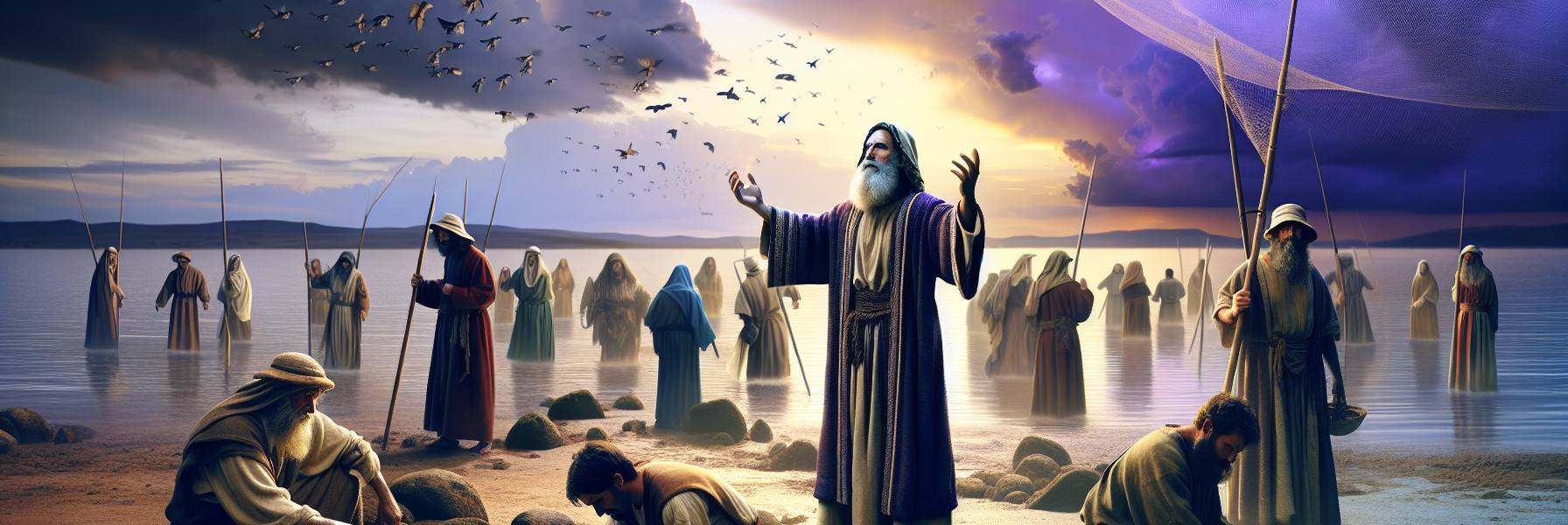

The smell of salt and fish, and the ache in my hands from the nets. That’s what I remember of those years. The dawns were a gray smear over the water, the evenings a slow bruise of purple and gold. We were men of calluses and weather, our faith something we wore like a worn tunic—familiar, practical, often unnoticed.
He was different. Not in the way you might think. He ate with the same appetite, got just as tired on the long roads, his feet dusty and sore. But the light… it came from within him. You’d be mending a net, listening to him talk about the Father, and you’d look up and for a moment, the ordinary afternoon air would seem thin, like a veil, and behind it was a brilliance that both warmed and unnerved you. We saw it. Our hands touched his. We heard the gravel in his voice when he was weary. We were there.
After he was gone, the light didn’t vanish. It fractured, like sun through storm clouds, and settled in the strangest places. In the quiet of an upper room where the air was still thick with his promise. In the fiery courage of tongues on Pentecost. And in the letters that began to travel from the old ones to the new, fragile churches.
John’s letter found us in Ephesus. It was read aloud one evening as a damp wind came off the sea. We’d gathered, a mixed lot: old Judean fishermen like me, Greek merchants with quick minds, a few former priests of Artemis still shaking off the old shadows. There was a tension among us. A disagreement about sin, about how pure a community must be, had turned into a cold thing, a division in the fellowship.
The brother reading had a good voice. It filled the room.
*That which was from the beginning, which we have heard, which we have seen with our eyes, which we have looked upon and touched with our hands, concerning the word of life…*
I closed my eyes. I wasn’t in Ephesus anymore. I was on a hillside near Capernaum, the grass dry and prickly. He’d just finished speaking, and a child, laughing, had run straight into his arms. He lifted her up, and she put a grubby hand right on his cheek. He’d looked at us then, his disciples, with that child in his grasp. *Look,* his eyes seemed to say. *This is real.* The memory was so sharp I could smell the thyme in the air.
The letter pulled me back. *…that which we have seen and heard we proclaim also to you, so that you may have fellowship with us; and indeed our fellowship is with the Father and with his Son Jesus Christ.*
Fellowship. The Greek word echoed in the room: *koinonia*. A sharing, a partnership. It was more than a meal together. It was the shared memory of the touch, the shared burden of the message, the shared, bewildering privilege of the Spirit. This was what was cracking among us.
Then came the words that cut through the intellectual arguments like a hot knife. *This is the message we have heard from him and proclaim to you, that God is light, and in him is no darkness at all.*
Light. Not an idea. A environment. A reality. I thought of the morning he walked on the water. It wasn’t a ghostly glow. It was the first, fierce slash of sun over the Golan heights, turning the waves into molten lead and the terror on our faces into something stark and clear. God is *that*—utterly revealing, with no shadowy corner, no hidden motive.
The logic that followed was inescapable, a trap for the soul. *If we say we have fellowship with him while we walk in darkness, we lie and do not practice the truth.*
One of the Greek brothers, a man named Linus who argued most fiercely for a perfectionism that bordered on pride, shifted uncomfortably. To claim fellowship with that absolute light while clinging to our own intellectual or moral shadows was not just error. It was a lie. A lived lie.
But then, the breathtaking turn. The remedy wasn’t to claim we had no shadow. *If we say we have no sin, we deceive ourselves, and the truth is not in us.* That was the other error, just as deadly. To deny the lingering pull of the old life, the secret envy, the quick anger, the pride in our own purity. To deny that was to make God a liar. His light showed the dust in the corner we’d swept over.
The true path was a rhythm, as natural as breathing, yet it required a courage that felt like dying. *If we confess our sins, he is faithful and just to forgive us our sins and to cleanse us from all unrighteousness.* Confession. Not a general murmur of unworthiness, but naming the thing. Bringing it, shame and all, into the very light we feared would destroy us. And finding there not condemnation, but a faithfulness that wipes the slate, and a justice—a strange, merciful justice—that scrubs us clean.
The letter ended. The room was silent, but it was a different silence. The contentious air had been scoured out. The fire in the brazier popped.
Linus stood. He didn’t look at any of us. He stared into the low flames, his face working. When he spoke, his voice was rough.
“My brothers,” he said. “I… I have walked in darkness. I have loved the sound of my own arguments more than the sound of your voices. I have claimed a purity I do not possess. Forgive me.”
It was like a dam broke. One by one, in simple, halting sentences, we spoke. Not grand theological failings, but the small, cold darknesses: a withheld kindness, a judgmental thought, a fear that choked out trust. We spoke them into the light of the brazier, and into the greater Light the letter proclaimed. And as we did, the fellowship—that *koinonia*—didn’t just return. It deepened, grounded now in a shared honesty instead of a shared pretense.
We were not ghosts. We were not ideas. We were men and women with salt-stung skin and messy hearts, who had heard, and seen, and touched. And the message was this: walk in the Light. Not as those who are already made of light, but as those who are continually, gratefully, being cleansed by it. The darkness is real, but it cannot claim you. Not if you keep turning your face, and your failures, toward the dawn.