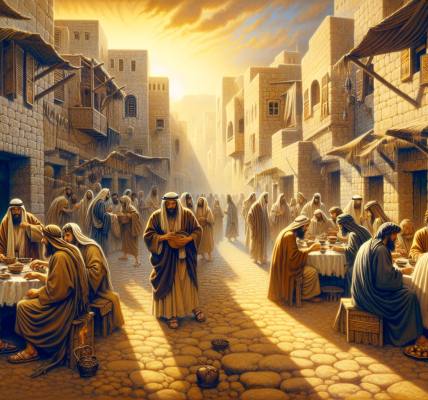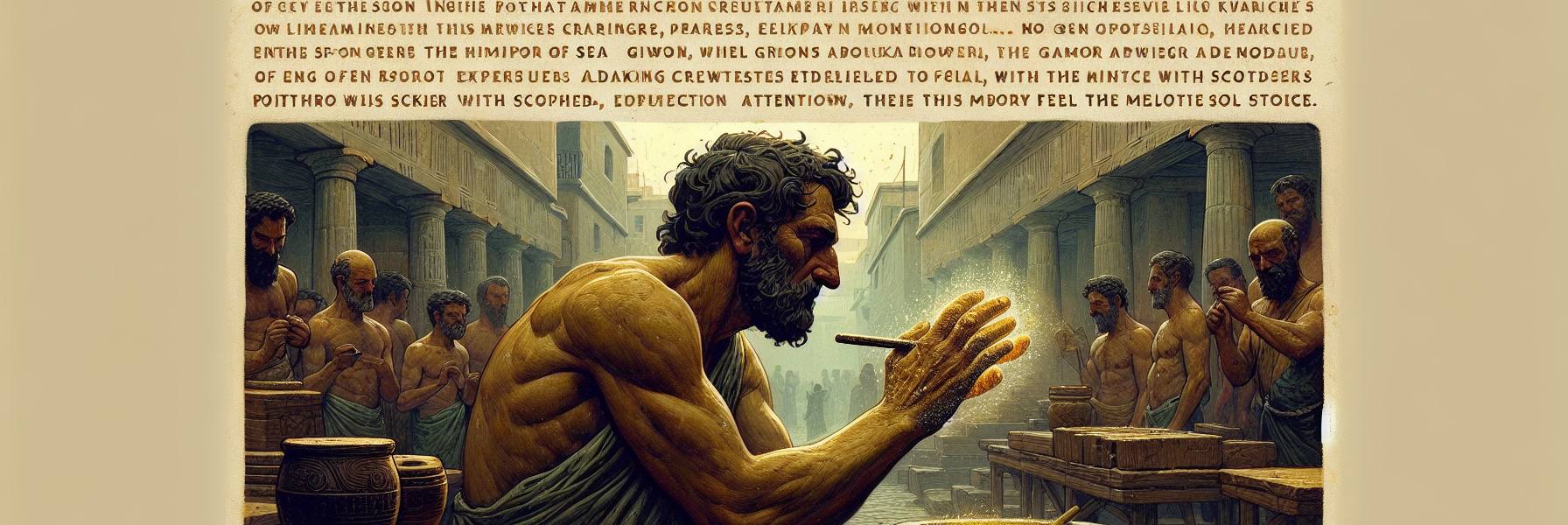

The air in the Corinthian workshop was thick with the smell of sawdust and hot olive oil. Paul of Tarsus wiped his hands on a coarse leather apron, the grit of the day’s labor etched into the lines of his knuckles. Outside, the city thrummed—a marketplace of ideas as much as goods. Stoic philosophers held court beside Egyptian mystics; Alexandrian rhetoricians dazzled crowds with phrases polished to a blinding sheen. You could almost taste the ambition in the dust.
He had arrived here, to this strategic port, with a tremor in his gut that had nothing to do with the sea voyage. He remembered the fever pitch of Athens, the Areopagus, the curious, dismissive faces. He had spoken there of the “Unknown God,” had woven poetry with argument. Some listened, most scoffed. The memory was a cold stone in his belly. Here, in Corinth, raw and hungry and new, something in him had fractured. Or perhaps settled.
“A speech, Paul?” asked Prisca, later that evening, as they shared a simple meal of bread and fish in the back room of the leatherworker’s home that served as their gathering place. Her husband, Aquila, nodded slowly, his eyes kind but questioning. “The synagogue leaders expect a certain… presentation. A demonstration. They are used to sophistication.”
Paul broke off a piece of bread, chewing slowly. The lamplight flickered, painting moving shadows on the mud-brick wall. “I know what they expect,” he said, his voice rougher than he intended. “I was trained to give it to them. Gamaliel’s pupil, remember? I could construct a syllogism that would pin their ears back. I could quote Philo until the stars came out.”
He fell silent for a long moment, listening to the distant clatter of the city. “When I came to you,” he began again, quieter now, “I didn’t come with a ladder of clever arguments, each step perfectly carved. I didn’t come with a symphony of persuasive words. I came to you… weak.” The word hung in the air, stark and unadorned. “Terrified, if I’m honest. My hands wouldn’t stop shaking. My voice felt like a rusted gate.”
Aquila leaned forward. “We remember. You spoke of Yeshua, the Messiah. And the execution stake.”
“Just that,” Paul whispered. “Him, and the horror of the cross. Nothing else. I stripped it all away. Because I had decided, while walking from Athens, my soul sick with my own failure… I decided to know nothing. Nothing except Yeshua the Messiah, and him crucified.”
Prisca’s eyes gleamed in the low light. “It was that very plainness, brother. That vulnerability. It didn’t feel like a performance. It felt like a man handing us a bleeding heart and saying, ‘This is the truth that remade me.’ We could feel the weight of it.”
Paul nodded, a profound exhaustion and a deeper peace mingling in him. “It wasn’t a human strategy. It was a surrender. My speech, my message—they weren’t the slick, winning words of human wisdom. They were a demonstration of the Spirit’s raw power. Why? So your faith wouldn’t rest on the cleverness of a man, on a well-turned phrase. So it would rest on the solid, unsettling power of God.”
He pushed his plate aside, his thoughts turning to the deep, hidden things. “We do speak a wisdom,” he said, almost to himself. “But it’s not the wisdom of this present age, or of the rulers of this age, who are being rendered obsolete. We speak God’s hidden wisdom, a mystery. A reality kept in silence for long ages but now, staggeringly, unveiled.”
He looked at their faces, simple tradespeople, a former tentmaker, a woman who ran a shop. Not many wise by human standards, not many powerful, not many of noble birth. “The powers that run this world,” he continued, “if they had understood this wisdom, they would never have crucified the Lord of glory. They saw a peasant rabbi from Galilee. They saw a threat to order. Their wisdom is blindness.”
He picked up a scroll from the floor, but didn’t unroll it. “It is written: ‘No eye has seen, no ear has heard, no mind has conceived what God has prepared for those who love him.’ But,” and here a smile, weary but genuine, touched his lips, “God has revealed it to us by his Spirit. The Spirit searches everything, even the deep things of God. Who knows a person’s thoughts except their own spirit? In the same way, no one knows the thoughts of God except the Spirit of God.”
The room felt charged, quiet. “And we,” Paul said, spreading his work-roughened hands, “we have not received the spirit of the world. We have received the Spirit who is from God, so that we may understand what God has freely given us. This is what we speak about. Not in words taught us by human wisdom, but in words taught by the Spirit, explaining spiritual realities to those who are spiritual.”
He sighed, the weight of the dichotomy pressing down. “The person without the Spirit doesn’t accept the things that come from God’s Spirit. To them, it’s foolishness. They can’t understand it, because it is discerned only through the Spirit. But the spiritual person makes judgments about all things, yet is not subject to merely human judgment. For, ‘Who has known the mind of the Lord so as to instruct him?’”
Paul let the question hang. The lamp sputtered. “But we… we have the mind of the Messiah.”
Outside, a group of drunk sailors passed by, singing a bawdy song in a mix of Latin and Greek. The world’s wisdom. The noise of the age. In the small, dusty room, smelling of leather and humble food, sat a mystery vaster than the sea they sailed on. It was not in the grand lecture hall. It was here, in the cracked vessel of a trembling man, in the hearts of ordinary people, illuminated by a quiet, searching flame that no darkness in Corinth could ever comprehend. The true demonstration had already happened, and it had nothing to do with eloquence. It had to do with a tomb that couldn’t hold its contents, and a Spirit that now whispered in the silence of surrendered hearts.