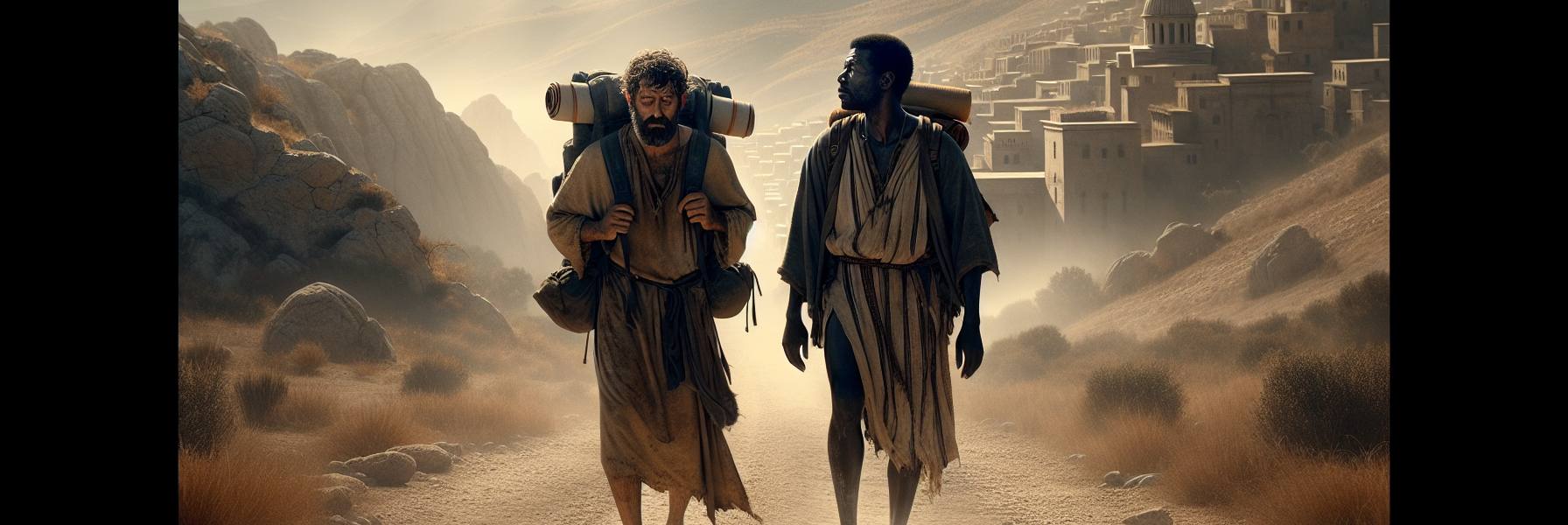

The road to Iconium was a pale, dusty ribbon under a merciless sun. Paul shifted the weight of his pack, the rough wool of his tunic scratching at the sweat on his shoulders. Beside him, Barnabas walked with a steadier pace, his eyes constantly moving from the rocky path to the distant smudge of the city ahead. They were bone-tired, their bodies still remembering the sharp stones and shouted accusations of Pisidian Antioch. But the news, the good news, was a fire they carried in their chests, and it burned hotter than the Anatolian heat.
Iconium, when they reached it, was a city of uneasy alliances, where Greek colonnades cast long shadows over older, Phrygian stones. They found their way, as always, to the Jewish synagogue. The air inside was cool and thick with the smell of parchment and aged wood. Paul spoke, his voice finding its familiar rhythm of prophecy and fulfillment, of a promise kept not in power, but in a cross and an empty tomb. The words divided the room as surely as a drawn line in the dust. Some Jews believed, alongside a great number of Greeks. But others, their faces hardening like clay in a kiln, stirred up the Gentiles, poisoning their minds against the brothers.
They stayed for a long time, nonetheless. Days bled into weeks, months. They spoke boldly, leaning on the Lord, who bore witness to the word of his grace by allowing signs and wonders to be done through their hands. Paul remembered the look in a young mother’s eyes when her fever broke at his prayer, a clean, cool clarity returning where before there had only been glassy fear. The city split, faction against faction. A rumor reached them, a plot taking shape in the shadows: a mob violence, a stoning meant to end their testimony. With a quiet urgency, they gathered their few things and slipped away, their departure as quiet as their entrance had been.
Their flight carried them southeast, to the Lycaonian towns of Lystra and Derbe, and the surrounding countryside. Lystra felt different. It was a backwater, a military outpost lacking Iconium’s sophistication. The gods here were older, closer to the soil.
It was there, at the city gates, that it happened. A man was listening, his body contorted, his legs utterly useless from birth. He had never walked. Paul, mid-sentence, saw him. It wasn’t a strategic decision; it was a rupture of compassion, a sudden and complete focus. He stopped speaking and stared at the man, who looked back with the hopeless patience of a lifetime of mats and thresholds.
“Stand up on your feet,” Paul said, his voice loud and clear in the sudden silence.
And the man did. He didn’t stagger. He leapt. He walked. A great gasp went through the crowd, then a rising tide of voices, but not in Greek or the local Lycaonian patois. They were shouting in the old tongue, cries of raw, superstitious awe.
“The gods have come down to us in human form!” The shout went up, and was seized upon. They called Barnabas Zeus, for his bearing was noble, commanding. And Paul, because he was the chief speaker, they called Hermes. The priest of Zeus, whose temple was just outside the city gates, brought oxen and garlands to the gates, and the crowd, a joyous, chaotic tide, began preparing for sacrifice.
It took Paul and Barnabas a long, agonizing moment to understand. The cultural chasm was too wide. They hadn’t seen a miracle of God’s grace; they’d seen a visitation. Tearing their clothes in the traditional gesture of profound distress, the two men rushed into the crowd, not as honored guests, but as desperate interlopers.
“Men, why are you doing this?” Paul’s voice was ragged. “We are merely human, just like you! We bring you good news, telling you to turn from these worthless things to the living God, who made the heavens and the earth and the sea and everything in them.” He spoke of rains and harvests, of food and gladness, pointing past the oxen, past the temple on the hill, to the Creator who asks for trust, not slaughter.
With these words, and with great difficulty, they managed to restrain the crowd from offering sacrifice. The rejoicing died into a confused, deflated murmur. The festive mood curdled.
It was then that certain Jews arrived from Antioch and Iconium, tracking the scent of controversy across the miles. They saw the unsettled crowd, the deflated priest, the two foreign teachers who had spoiled a perfectly good divine appearance. The poison they carried found fertile ground. The adoration turned, on a coin’s flip, to murderous rage.
The same crowd that wanted to worship them with garlands now picked up stones. They seized Paul, dragging him out of the city. The rocks were not thrown from a distance; it was an execution. The blows were heavy, thudding against his back, his head, his legs. He crumpled into the dust outside the walls, and the world dissolved into pain and roaring noise. Then, silence. They thought he was dead.
The disciples—a few new, trembling believers—formed a tight, fearful circle around his broken body. As they stood there, weeping in the gathering twilight, Paul stirred. He groaned. With impossible, agonizing slowness, he pushed himself up. Leaning on them, every breath a knife, he walked back into the city that had just tried to kill him. The next day, bruised and swollen, he and Barnabas left for Derbe. There was no fanfare, no miracles recorded. They simply preached, and made many disciples.
But the road, Paul knew, looped back. It was the only way home. After strengthening the disciples in Derbe, they returned. To Lystra, where the stones still lay in the field. To Iconium, where the plotters waited. To Antioch, where it had all begun. In every place, they sought out the little clusters of believers, speaking with a new, hard-won gravity. “We must go through many hardships to enter the kingdom of God,” Paul told them, his own scars testimony enough. They appointed elders, prayed with fasting, and committed them to the Lord.
Finally, they made their way down to the coast, to Attalia, and sailed back to Syrian Antioch, the place that had sent them out. When they gathered the church, they reported not a story of triumph, but of faithfulness. They told of what God had done, and how he had opened a door of faith to the Gentiles. And of the rest—the stones, the plots, the fickle crowds—they spoke plainly. It was all part of the story. They stayed there a long time with the disciples, in the quiet, necessary work of recovery and resolve, the dust of Lycaonia still deep in the seams of their sandals.