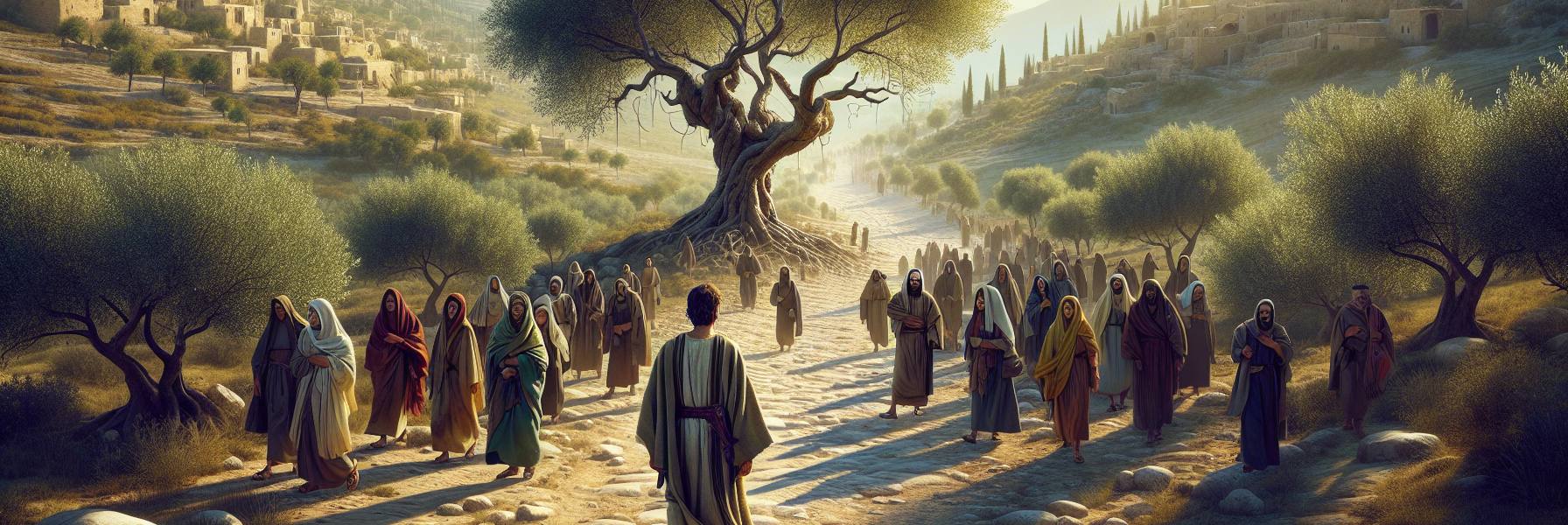

The road from Bethany was dust and stones, and the morning sun, still low, threw long, jagged shadows from the gnarled olive trees across the path. My feet ached. We all ached. There was a tautness in the air, a held breath, as our little band followed him up toward the city. He walked ahead, as he often did, but his silence was different today. Not peaceful. It was the quiet of a man who sees a thing clearly, a difficult thing, and is walking straight toward it.
We’d passed a small village, little more than a cluster of dwellings clinging to the hillside, when he stopped. Not for rest. His eyes were fixed on a fig tree by the path, its leaves a full, promising green against the pale earth. He went to it, not with the casual interest of a hungry traveler, but with a kind of deliberate scrutiny. We watched, puzzled. It wasn’t the season for figs. Everyone knew that. The first green knobs wouldn’t appear for another month at least. The leaves were a liar’s cloak.
He stood before it, and the silence around him deepened. Then he spoke, not to us, but to the tree itself, his voice flat and final. “May no one ever eat fruit from you again.” A simple sentence, but it chilled the morning. It felt less like a curse and more like a pronouncement, a sentence passed. Peter, always the first to react, blinked and opened his mouth, then closed it again. We moved on, the image of that leafy, barren tree sticking with us, a strange dissonance.
The noise of the city reached us first—a distant roar of commerce and pilgrimage, the bleating of sheep, the chatter of a thousand voices. Then the smell: incense, dung, sweat, and roasting meat. The Temple mount loomed, its white and gold gleaming brutally in the sun. As we crested the Mount of Olives, the whole spectacle sprawled below, magnificent and terrifying. He didn’t pause to admire it. His jaw was set.
We entered the outer court, the Court of the Gentiles. And here, the sacred dissolved into a cacophony. It wasn’t just prayer. It was a marketplace. A cattle pen. A money-changer’s row. The lowing of oxen waiting for purchase drowned out the murmured psalms from the inner courts. Coins clattered on tables where men argued exchange rates, levying a fee for the ‘impure’ Roman currency, profiting from the need for Temple shekels. The sellers of doves shouted their prices. The air was thick with the dust kicked up by hooves and the smell of anxious animals.
I saw his shoulders tighten. He said nothing at first, just looked. His gaze swept across the pens, the tables, the coils of rope, the heaps of dung. This was his Father’s house. A house of prayer for all nations. And they had made it a robber’s den.
Then he moved.
It wasn’t a frenzy. It was a terrible, controlled fury. He didn’t shout. He acted. He strode to the tables of the money-changers and with a single, sweeping motion of his arm, sent them crashing to the ground. Coins rang and rolled and spun across the stone pavers. He went to the stools of the dove-sellers and overturned them, the cages tipping, the birds bursting out in a flurry of panicked wings. He took cords, the ones used to tether animals, and began to drive out the sheep and the oxen, his voice a whip-crack of command that cut through the din. “Get these out of here! How dare you turn my Father’s house into a market!”
The chaos was absolute. Merchants scrambled for their scattering coins. Priests in fine linen robes appeared at the colonnades, faces flushed with outrage. But no one stopped him. There was an authority in him, a righteous violence that froze the guards and silenced the protests. For a few, shocking minutes, the court was a storm of noise and motion centered entirely on him. Then, as suddenly as it began, a space cleared. The animals were gone, the traders huddled at the edges, clutching what they could salvage. The only sounds were the cooing of doves settling on the high rafters and the sharp, angry whispers of the priests.
Into that sudden quiet, the blind and the lame came. They’d been there all along, pushed to the margins, begging. Now they shuffled forward, drawn to him. And he healed them. Right there in the scarred silence of the marketplace he’d just dismantled, he touched sightless eyes and strengthened withered legs. The children, who see everything, began to shout, their high, clear voices echoing off the stones. “Hosanna to the Son of David!” They’d heard the cry from days before and now they sang it again, a truth too pure to be silenced.
The chief priests and the teachers of the law saw it, their faces like stone. The healing. The children’s praise. This was worse than the overturned tables. This was a challenge to their very order. One of them, a tall man with a carefully trimmed beard, stepped forward, his voice icy. “Do you hear what these children are saying?”
He looked at them, his hands resting on the shoulder of a small boy whose legs had just been made straight. “Yes,” he said, his tone almost weary. “Have you never read, ‘From the lips of children and infants you, Lord, have called forth your praise’?” The scripture hung in the air, an answer that was also a condemnation. They had no reply. He turned and walked out of the Temple, the evening shadows beginning to stretch, and we followed, dazed and exhilarated and deeply afraid.
We didn’t go back to the city that night. The path back to Bethany was dark, the only light from a sliver of moon. We were all thinking of the Temple, the confrontation, the stunned faces of the powerful. But Peter, practical, worrying Peter, remembered the tree. “Rabbi,” he said, his voice loud in the quiet, “look! The fig tree you cursed has withered.”
He stopped and turned. In the faint moonlight, we could all see it. It was a stark, dead thing. The leaves, so green and full that morning, were dry, brown, curled in on themselves. It wasn’t just wilted. It was dead from the roots up. A lifeless skeleton against the sky.
He looked at it, then at us, our faces pale circles in the gloom. “Have faith in God,” he said, and the words were quiet but immense, like a foundation stone being laid. “Truly I tell you, if anyone says to this mountain, ‘Go, throw yourself into the sea,’ and does not doubt in their heart but believes that what they say will happen, it will be done for them.” He wasn’t talking about gardening. He was talking about the Temple mount. About kingdoms. About every impossible thing. “Therefore I tell you, whatever you ask for in prayer, believe that you have received it, and it will be yours. And when you stand praying, if you hold anything against anyone, forgive them, so that your Father in heaven may forgive you your sins.”
We stood there on the dark road, between the dead tree and the sleeping city, under the vast and starry sky. The lesson was not in the cursing, but in the faith that could move mountains. Not in the cleansing, but in the forgiveness that must follow. We walked the rest of the way in a silence more profound than before, carrying a new and terrifying understanding: that his kingdom would not be built with gold or guarded by swords, but with a faith that could wither lies and a forgiveness that could shake the very foundations of the world.