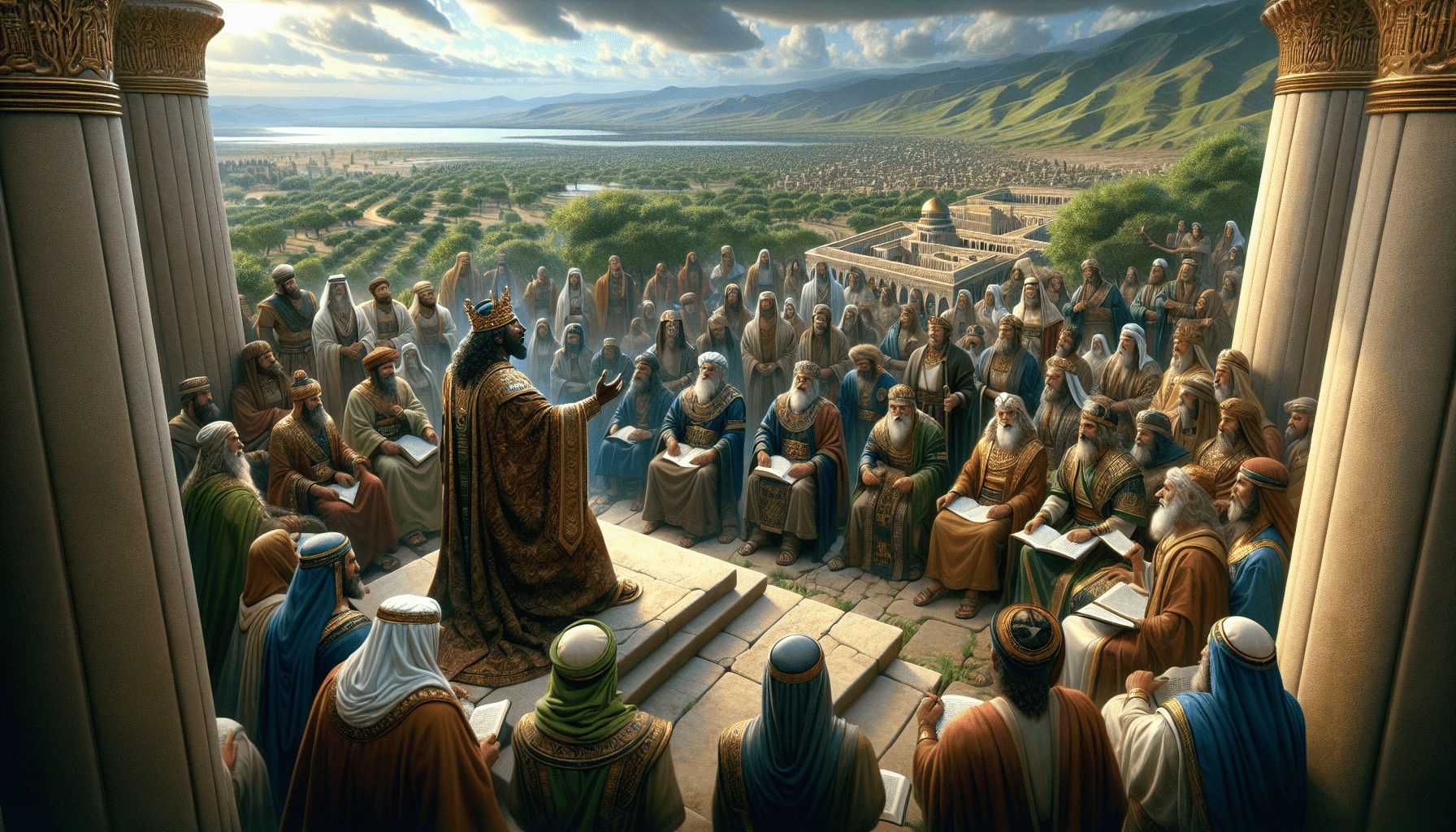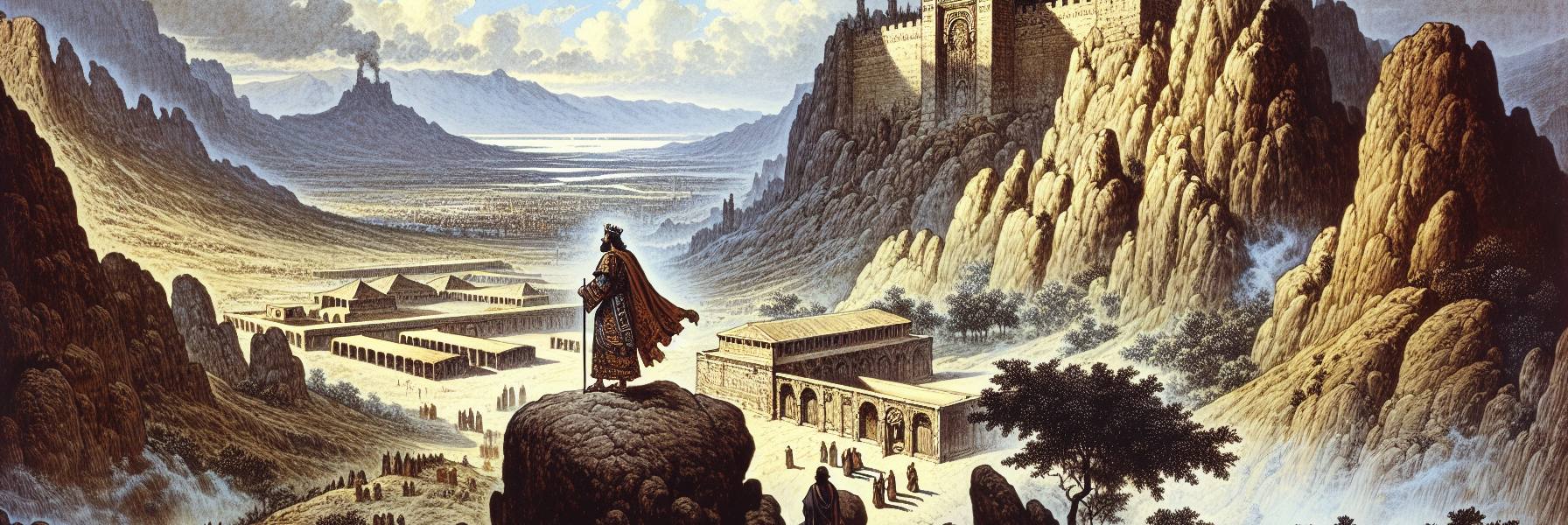

The air in Jerusalem hung thick with the smell of old incense and new dust. It was a smell Asa had come to know well in the ten years since the crown, heavy and cool, had first settled upon his brow. He stood on the palace parapet, looking not at the gleaming Temple his grandfather had built, but at the southern ridges where the road wound down towards Judah. There, hidden by the haze of distance, were the altars his father, Abijah, had left standing. The high places. They clung to the hills like stubborn, festering weeds.
Asa was not a man given to grand visions or thunderous pronouncements. His strength was a quiet, dogged thing, born more from a profound unease than from fiery zeal. The stories of his ancestors—Solomon’s dazzling wisdom curdling into idolatry, Rehoboam’s foolish pride splitting the kingdom—sat in his gut like undigested stones. He saw not a glorious inheritance, but a fragile vessel, cracked and leaking. The faith of David was now a patchwork of sanctioned worship in Jerusalem and chaotic, fearful offerings on every other hilltop. To the south, Egypt was a sleeping beast. To the north, the splintered kingdom of Israel was a nest of rival kings and golden calves. Judah felt less like a nation and more like a whispered promise everyone had forgotten how to hear.
So he began simply, with the tedious work of a steward, not a conqueror. His commands went out in the dry, legal language of scrolls and seals: the foreign altars were to be broken, not with fanfare, but with the systematic efficiency of masons. The standing stones, smooth and ancient, were to be smashed into gravel. The Asherah poles, their wooden forms already groaning in the wind, were to be cut down and burned. His officials, men with tired eyes and ink-stained fingers, travelled the territories of Judah and Benjamin, and even into the hills of Ephraim his father had taken. They reported not of revival, but of compliance. The people, Asa thought, were less passionate for the Lord than they were weary of uncertainty. They took down their household idols with the same resigned practicality with which they might clear a blocked irrigation ditch.
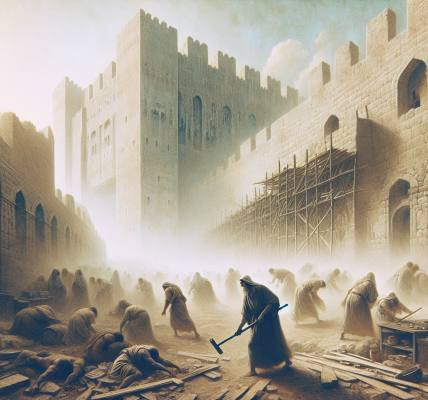
The land, in its own way, responded. With the strange, silent gods removed from the fields, a different kind of space opened up. Asa turned his mind to the soil and the stone. “Let us build,” he said to his captains, his voice rarely rising above a conversational tone. “Let us build because we do not know when the storm will come.” They fortified the cities: walls of quarried limestone rose where rubble had been, towers punctuating the skyline of towns like Geba and Mizpah. He raised a citizen army, not of mercenaries, but of every man who could hold a shield or draw a bow. Three hundred thousand from Judah, two hundred and eighty thousand from Benjamin. They drilled not in the valley of show, but in the broken lands near the fortresses, their movements pragmatic, their loyalty to the man who provided the walls that sheltered their families.
The peace that followed was not the dazzling peace of Solomon. It was a practical, hard-won quiet. The fields yielded their grain, the vineyards their wine, without the immediate threat of the sword. It was the kind of peace, Asa knew, that made men complacent. He fought that complacency with more digging, more building, more drilling. He stored grain, oil, and weapons until the storehouses bulged. He was, his advisors sometimes dared to whisper, preparing for a war only he seemed to see on the horizon.
Then the horizon bled.
The news came from breathless scouts, their faces grey with more than dust. From the south, from the deep desert beyond the Negev, an army was moving. Not a raiding party, not a rival king’s regiment. An immense, crawling force under Zerah the Cushite. A million men, the scout gasped, his voice breaking on the number. And chariots. Three hundred chariots, a sound like rolling thunder on the hard-packed earth.
A coldness settled in Asa’s chest, a coldness that had nothing to do with fear and everything to do with a grim, final clarity. All the storehouses, all the walls, all the drilled maneuvers—they were a child’s sandcastle before this tide. The numbers were absurd, catastrophic. He felt the eyes of his commanders upon him, waiting for the strategy, the clever deployment. He had none.
He ordered the army to muster at Mareshah, a fortified town in the Shephelah foothills. It was a defensible position, but against such a host, defense was a temporary illusion. The two armies drew up their lines in the Valley of Zephathah, near Mareshah. Asa stood before his ranks, looking at the faces of the farmers and shepherds he had armed. They looked past him, their eyes wide with a terror he understood perfectly. The Cushite host filled the valley like a locust swarm, a shifting, shimmering mass of spearpoints and painted shields. The sun glinted off the chariot wheels, and the low rumble of their movement was a physical vibration in the air.
This was the end. Not with a slow decline, but with a single, crushing blow. All his work, his quiet, diligent stewardship, was about to be erased in a single afternoon of blood and dust.
And in that moment, the cold clarity in his chest cracked open into something else. A desperate, silent cry. Not to his army, not to his own cunning, but upward, into the vast, silent blue sky over the valley. He stepped forward, his voice not a king’s roar, but a ragged, carrying thing, torn from the core of him.
“Lord!” he cried, and the word hung in the air, stark and simple. “There is no one besides you to help the powerless against the mighty. Help us, Lord our God, for we rely on you. In your name we have come against this vast horde. Lord, you are our God. Do not let mere mortals prevail against you!”
It was not a polished prayer. It was the confession of a man who had run out of plans. He admitted his powerlessness, he named the overwhelming might against him, and then he simply staked everything—his life, his people, his kingdom—on the character of the God whose altars he had torn down and whose laws he had tried, clumsily, to restore.
What happened next was not a supernatural spectacle. No angelic host appeared in the sky. Instead, a kind of fierce stability settled over Asa’s own spirit. The panic receded, replaced by a lucid command of the moment. He gave the order to advance. It made no military sense. It was an act of pure, terrible trust.
The armies clashed with a sound that tore the world apart—the scream of metal, the shriek of men, the thunder of hooves and wheels. The battle was a chaotic, swirling madness of dust and blood. But as the hours wore on, a strange momentum became clear. The Cushite lines, so impossibly vast, began to falter not at their edges, but in their spirit. A ripple of confusion became a rout. The mighty host turned in on itself, tripping over its own numbers. Zerah’s chariots, meant to be the spearhead, became traps in the press of their own fleeing infantry.
Asa’s men, fighting with the desperate strength of those who had already accepted death, found themselves not defending, but driving forward. They pursued the Cushites all the way to Gerar, a relentless chase that left the road littered with the abandoned wealth of an army that had come to plunder. They shattered the Cushites completely, until no strength remained in them. They fell on the settlements around Gerar, taking great plunder—herds of sheep, camels in great numbers, more tents and goods than they could easily carry.
The return to Jerusalem was not a parade of unblemished heroes. They were weary, bloodied, staggering under the weight of their own salvation and the spoils they dragged behind them. Asa walked among them, his royal robes stained with the valley’s dirt. The peace that settled over the land in the days that followed was different from the one before. It was not the quiet of preparation, but the profound, hushed stillness that follows a storm that has passed directly overhead, leaving everything both shattered and strangely, miraculously, intact. The silence was not empty anymore. It was full of the echo of a cry, and the undeniable, unsettling answer.