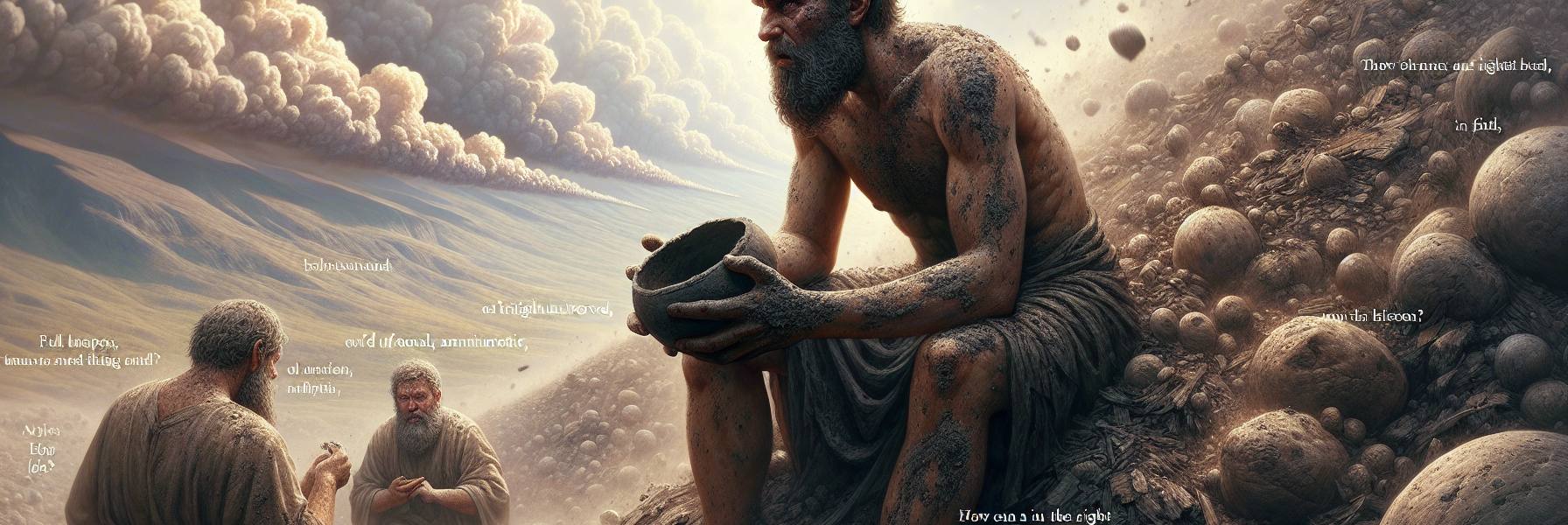

The air in the ash heap was still and thick, tasting of dust and despair. Job sat, the rough texture of the potshard in his hand a feeble anchor against the vertigo of his thoughts. His friends’ words—Eliphaz’s solemn certainty—hung in the heat like a distant buzz of flies. They spoke of cause and consequence, a tidy universe of moral arithmetic. But Job’s universe had shattered, and in the shards he saw not order, but a terrifying, beautiful chaos presided over by a God who would not be measured.
He shifted, a wave of pain from his sores a grim reminder of his fleshly prison. His gaze lifted to the horizon, where the vast bowl of the sky met the endless stretch of wilderness. That’s where it always began, with the sheer scale of things.
“How can a man be in the right before God?” The words scraped out, not as a question to his companions, but as a confession to the emptiness. “If one wished to contend with Him, one could not answer Him once in a thousand times.”
He saw it in his mind’s eye. God moving mountains, and they did not know it—they just were *elsewhere* in an instant, as if the foundations of the world were clay beneath a potter’s hand. He commands the sun, and it does not rise. A simple withholding of a command, and the morning star withholds its light. He seals up the stars as if rolling a scroll shut. Alone, He stretches out the heavens, a tent-maker of incomprehensible vastness, and treads on the high waves of the sea. The constellations—the Bear, Orion, the Pleiades—those fixed points that shepherds used for navigation, were His mere playthings, the work of His fingers.
A dry, bitter laugh escaped him. “He passes by me, and I do not see Him; He moves on, unnoticed.” It was the most dreadful thing. Not God’s absence, but His terrifying, intimate proximity. A movement so profound it was imperceptible, like the turning of the earth. “If He snatches away, who can restrain Him? Who can say to Him, ‘What are You doing?’”
How does one arraign the whirlwind? How does one serve a summons to the thunder? The memory of his children—the laughter, the feasts, the awful, silent end—rose like a tide. “God does not turn back His anger; the helpers of Rahab, the very pillars of the deep, cowered beneath Him.”
And here he was, a blistered man on a dung heap, picking at his wounds. “If it is a matter of strength, behold, He is mighty! If it is a matter of justice, who can summon Him?”
The logic of his friends was a tiny cage. They spoke of a God who rewarded the good and punished the wicked. But Job felt caught in a storm of a different magnitude. This was a God who crushed *both* the blameless and the wicked. The earth, handed over to the wicked, its judges blinded—if not He, then who? The world was not neatly moral; it was mysteriously, painfully under His sovereign sway.
“My days are swifter than a runner; they flee away, they see no good.” He looked at his own shrivelled hands. “They slip by like reed boats, like an eagle swooping on its prey.” His life was not a ledger to be balanced; it was a breath, a shadow.
He tried to imagine the argument. “If I say, ‘I will forget my complaint, change my expression, and smile,’ I would still dread all my pains.” The facade would be useless. He knew, in his bones, that he would still be found guilty. Not because of some specific, hidden sin Eliphaz imagined, but because he was *human*, and God was God. “For You will not hold me innocent. I am already accounted guilty. Why then should I labor in vain?”
A fit of coughing took him, a raw, physical punctuation to the spiritual despair. When it subsided, he whispered to the dust. “If I washed myself with soap and snow, and cleansed my hands with lye… You would plunge me into the pit, and my own clothes would abhor me.”
That was the heart of it. The gulf was not merely moral, but existential. He was not a slightly tarnished version of purity. He was of a different order of being. God was not a man, as he was, that they could meet in court. “There is no arbiter between us, who might lay his hand on us both.” No one to bridge the awful, glorious distance. No one to take God’s rod from him, or to still the dread that made his heart palpitate.
The silence deepened around him. His friends were quiet, perhaps stunned by the raw, unvarnished theology of anguish. Job’s argument wasn’t one of innocence, but of the impossibility of the trial itself. His final words were not a plea, but a statement of exhausted resignation.
“I am terrified of Him; when I consider, I am in dread of Him. God has made my heart faint; the Almighty has terrified me.” He paused, the truth settling like a weight. “For I am not silenced by the darkness, nor by the gloom which covers my face.”
Even in the covering dark, even in the ash, his voice remained. It was a broken, terrified voice, speaking not to a predictable judge, but to a dazzling and dreadful sovereign whose ways were past finding out. The story wasn’t about guilt or innocence anymore. It was about whether a speck of conscious dust could bear the gaze of the one who spun the galaxies, and still dare to speak. And in speaking, Job did the only thing left: he held his agony up before the very face of the God who seemed to have authored it, and in that terrible, faithful act, the conversation of the cosmos was changed.