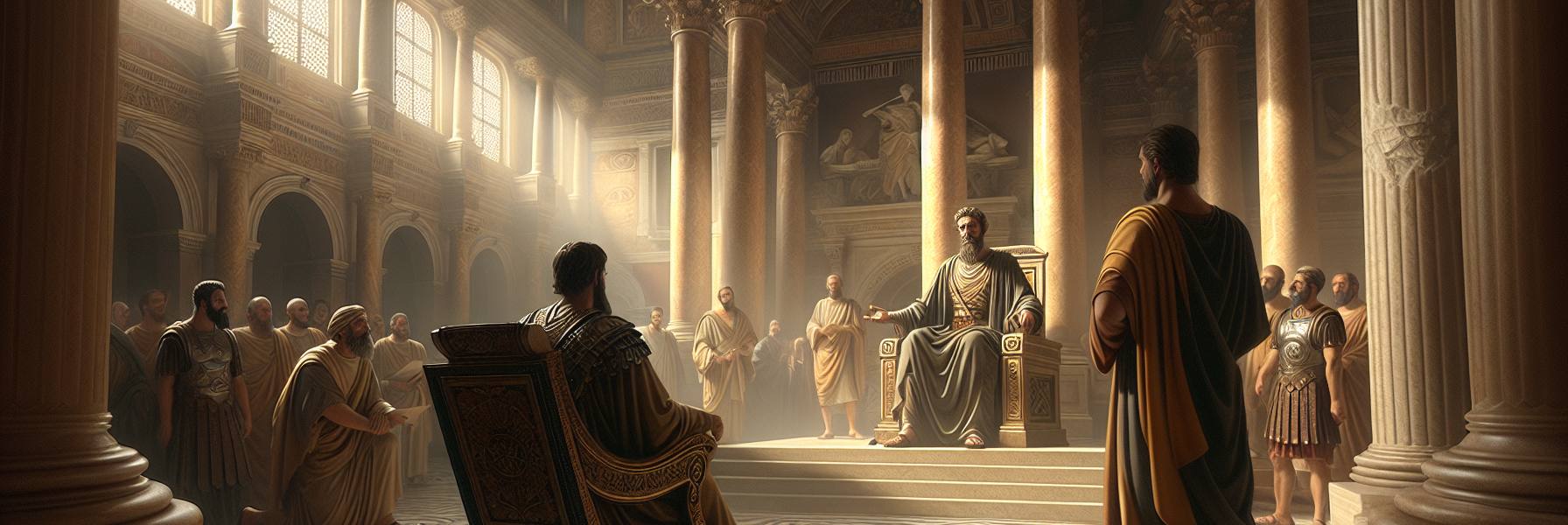

The air in Caesarea held the peculiar stillness of a place built to impress rather than to live. Sea-breeze, usually crisp off the Mediterranean, felt sluggish as it wandered through the grand marble porticos and administrative squares, carrying with it the scent of salt, dust, and slow bureaucracy. In the cool, shadowed hall of the Praetorium, the Roman governor Felix shifted on his ivory-inlaid chair. The hearing felt less like a dispensation of justice and more like a tedious piece of provincial housekeeping.
A man named Tertullus stood before him, a hired orator from Jerusalem. His voice was polished, oiled for the occasion. “Most excellent Felix,” he began, the flattery laid on thick as mortar, “we enjoy great peace through you, and reforms are brought to this nation by your foresight.” Felix, a freedman who had climbed to power through intrigue and his brother’s influence, listened with a face of carved stone. He knew the preamble for what it was.
The accusations against the prisoner, Paul of Tarsus, followed a familiar pattern. Tertullus painted him as a plague, a *pestis*—the Latin word hung in the air. A mover of sedition among all the Jews throughout the world, a ringleader of the sect of the Nazarenes, a profaner of the Temple. The speech was efficient, damning, and intentionally vague. It was the kind of accusation that asked a Roman governor to see a local religious squabble as a threat to the *Pax Romana*.
Then Paul was led forward. He was not an imposing figure. Older now, his hair thinning, his face bore the lines of miles walked and nights spent in open air or in cells. He carried himself not with defiance, but with a weary steadiness. He nodded respectfully to the governor, a small, human gesture after Tertullus’s polished performance.
“I cheerfully make my defense,” Paul began, his voice quieter but clear, cutting through the formal atmosphere. He acknowledged Felix’s long tenure as judge, a subtle point that grounded the proceedings in reality. Then, methodically, he unpicked the charges. He had been in Jerusalem only twelve days. He had come to bring alms and offerings. He was found in the Temple, purified, not disputing with anyone. “Neither can they prove the things of which they now accuse me,” he said, turning the legal burden back upon his accusers.
But Paul did not stop at a simple rebuttal. This was his moment, not just before a Roman, but before anyone who would listen. “But this I confess to you,” he continued, and the room seemed to lean in slightly. “That according to the Way, which they call a sect, I worship the God of our fathers, believing everything laid down by the Law and written in the Prophets, having a hope in God… that there will be a resurrection of both the just and the unjust.” He tied his faith inextricably to the ancestral hope of Israel, framing it not as novelty, but as fulfillment. “So I always take pains to have a clear conscience toward both God and man.”
The theological core of his statement hung in the quiet hall: a resurrection for all. It was a doctrine that unsettled both the powerful and the powerless. Felix, a man of pragmatic and often brutal governance, would have found the concept philosophically curious and politically inconvenient.
The governor, sensing the deeper currents, adjourned the hearing. He would wait for the arrival of the tribune Lysias, he said. It was a stalling tactic. He kept Paul in custody but with a surprising latitude—open to visits from friends, who could attend to his needs. It was not innocence, but a calculated hesitation. Felix, the historian Tacitus would later write, “exercised the power of a king with the mind of a slave.” He understood power, and perhaps he understood that this unassuming prisoner was a man who dealt in a different kind of currency altogether.
Days later, Felix sent for Paul, this time privately, with his Jewish wife Drusilla at his side. The setting was intimate: a sunlit room in the palace, away from the formality of the court. Felix was curious, in the way a man might be curious about a strange artifact from a conquered land. He wanted to hear, Luke tells us, about “faith in Christ Jesus.”
Paul did not offer a gentle philosophical discourse. Seated before the governor and the Herodian princess, he spoke of righteousness, self-control, and the coming judgment. The words, simple and terrible, were aimed with precision. Felix, a man who had seduced Drusilla away from her first husband, who had crushed revolts with merciless efficiency, who had enriched himself through graft and corruption, felt the sharp point of them. His curiosity curdled into discomfort. “Go away for the present,” he interrupted, his voice perhaps a shade too quick. “When I get an opportunity I will summon you.”
The opportunity came often. Over the next two years, Felix sent for Paul frequently, and they conversed. It became a peculiar ritual. The governor, trapped in his own web of ambition and fear, found something in the prisoner’s words that both attracted and repelled him. He was hoping, Luke notes with devastating simplicity, that Paul would give him money. The bribe was the language Felix understood best, the grease that smoothed all transactions in his world. But Paul offered only the unsettling, unbuyable commodities of righteousness and judgment. No money changed hands. Felix’s hope decayed into a habit, and the habit into a stalemate.
Two years. The sea outside Caesarea’s harbor changed its colors with the seasons. Ships came and went. Administrations shifted in Rome. And Paul remained in the limbo of protective custody, a man forgotten by the empire’s higher machinations but held fast by a provincial governor’s petty indecision. Felix left him in bonds, not out of conviction, but as a “favor to the Jews”—a final, cynical calculation on his way out of office, a bit of political capital to be spent as he departed under a cloud of disgrace.
The story ends not with a verdict, but with a transfer of files. A new governor, Porcius Festus, arrived. The case of the prisoner Paul was part of the unfinished business handed over. The narrative closes on an unresolved chord. But in that long, detailed interim—the formal charges, the personal testimony, the private conversations that led nowhere—we see the peculiar collision of two kingdoms. One operated through marble halls, polished rhetoric, and the cold calculus of power and bribery. The other advanced through the unshakable testimony of a weary man in a room, speaking of a resurrection and a judgment that made even a Roman governor afraid. The system of the world paused, equivocated, and ultimately kept him locked away, unable to either condemn or release the quiet, persistent voice of the hope he proclaimed.