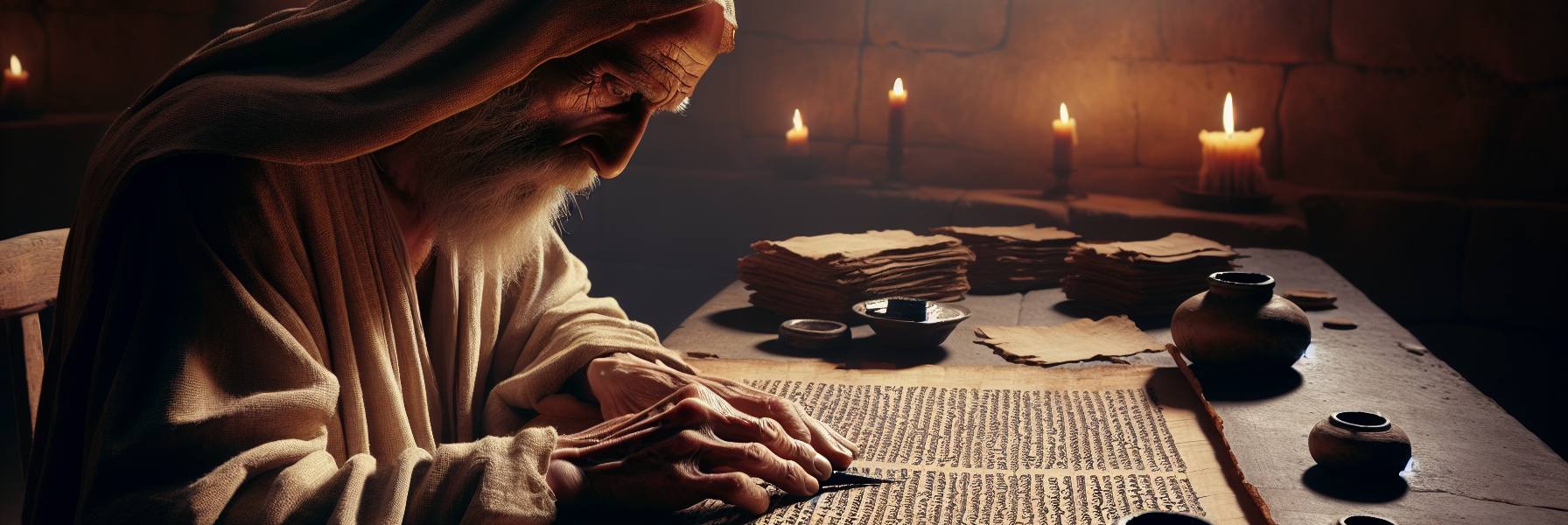

The air in the room was still, thick with the scent of aged papyrus and the faint, metallic tang of the inkwell I had just used. My hand ached, a dull, familiar throb from wrist to knuckle. I was old, older than the scrolls I tended, and the vision of the Prophet Ezekiel often felt less like a divine blueprint and more like a map of a country my bones were too weary to ever walk.
Yet, the command remained. To copy, to preserve. And today, it was the forty-eighth chapter.
It began, as these things often did, without fanfare. Just names and measures. *Dan, one portion… Asher, one portion…* I could hear the other scribes in the adjacent chamber, the soft murmur of debate over a disputed line in Leviticus. My own task seemed, on the surface, administrative. A divine land registry. But as my stylus moved, tracing the boundaries, something else began to stir.
It wasn’t the tribes that gripped me first—it was the strip of land. A sacred district, set apart in the very heart of the inheritance. I saw it not as lines on parchment, but as a place. Five and twenty thousand reeds in breadth, a perfect square. They say a reed is about six cubits; a man’s height and a half. I tried to fathom it. A territory vast and solemn, laid out in the center of the Promised Land like a beating heart protected by the ribs of the tribes.
My mind drifted from the cramped scriptorium. I imagined the light there. Not the dusty, amber shafts that fell through our high windows, but a clear, severe light, the kind that casts sharp shadows and makes colors sing. In the center of this square was another square: the sanctuary of the Lord. And around it, land for the priests, the sons of Zadok. They who kept my charge, who did not go astray. A reward written into geography itself. Their portion was first, adjacent to the holy ground, a place where the smell of incense would drift into their fields.
Then, flanking them, the Levites. Their portion was also a possession, but distinct. A reminder of service, not of lineage. The text was careful, precise. It allotted them cities to dwell in. I paused, thinking of the Levitical cities of old, scattered. Now, they were gathered, their holding a contiguous strip, a buffer of devotion around the core.
And then, the city. It lay south of the sacred district, a space for all Israel. *Five thousand broad, and five and twenty thousand long.* A rectangle of common life, nestled against the holy. Its gates were named for the tribes—three on the north, three on the east, three on the south, three on the west. I saw them not as openings in a wall, but as portals of identity. A man from Benjamin would enter by the gate bearing his ancestor’s name, stepping into the commonwealth. The city was for all, a place of homes and gardens, its workers drawn from all tribes to tend its soil. The produce of that soil, Ezekiel wrote, would be for food for those who served the city.
The beauty of it was in its ordinariness. The holy district did not float separate, aloof. It was embedded. The priest plowed his field a stone’s throw from the temple porch. The Levite’s child could look north and see the walls of the sanctuary. The city-dweller, tending his plot for the community, worked land that bordered the Levites’ portion. Holiness and community, sanctuary and street, were woven together in one grand, geometric tapestry.
My stylus moved to the outer tribes. Judah was south of the sacred district. Reuben south of him. And so on, mirroring north. The prince’s land was on either side of the holy district, his portion not cutting through it, but abutting it. A check against power. Even the prince’s inheritance was framed by the sacred; his authority sprang from his proximity to it, but was hemmed in by it.
Finally, the portions for the rest were listed, stretching out to the coasts—Gad, Naphtali, Asher. The land, from north to south, was a series of parallel bands: tribe, tribe, prince, holy, priest, Levite, city, prince, tribe, tribe… It was symmetry, but not a cold one. It was the symmetry of a well-ordered body, each limb in its place, each organ functioning for the whole, with the sanctuary as its central, animating spirit.
I finished the final line. *And the name of the city from that day shall be, The Lord is There.*
A shiver passed through me, unrelated to the chill of the stone room. It wasn’t the grand architecture that undid me. It was the name. The entire elaborate design, the careful measurements, the apportioning of fields and cities—all of it culminated in a name. A declaration. Not “The Lord is *Here*,” in this temple or that mountain, but *There*. In that specific, configured, communal place. A geography of grace.
I leaned back, the ache in my hand now a companion rather than a nuisance. Outside, Jerusalem was noisy, fractured, its tribal identities long blurred by exile and return, its priesthood contested, its prince a distant satrap’s puppet. Ezekiel’s vision was not our reality. Perhaps it never would be, not in the way we measure reeds and cubits.
But as I looked at the drying ink, I saw it was never merely about land. It was a portrait of God’s desire. A people ordered around His presence. A society where sacred and secular weren’t at war, but in relationship. Where identity was both tribal and united. Where service was rewarded with a place near the heart of things. It was a promise, written in the language of surveying, that disorder is not final. That exile ends. That one day, the name of every city, of every life, will be a testament: *The Lord is There.*
I blew gently on the scroll. The scent of ink and hope filled the air. It was enough, for now, to have written it down.