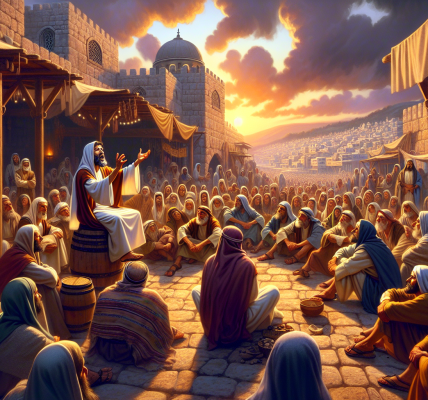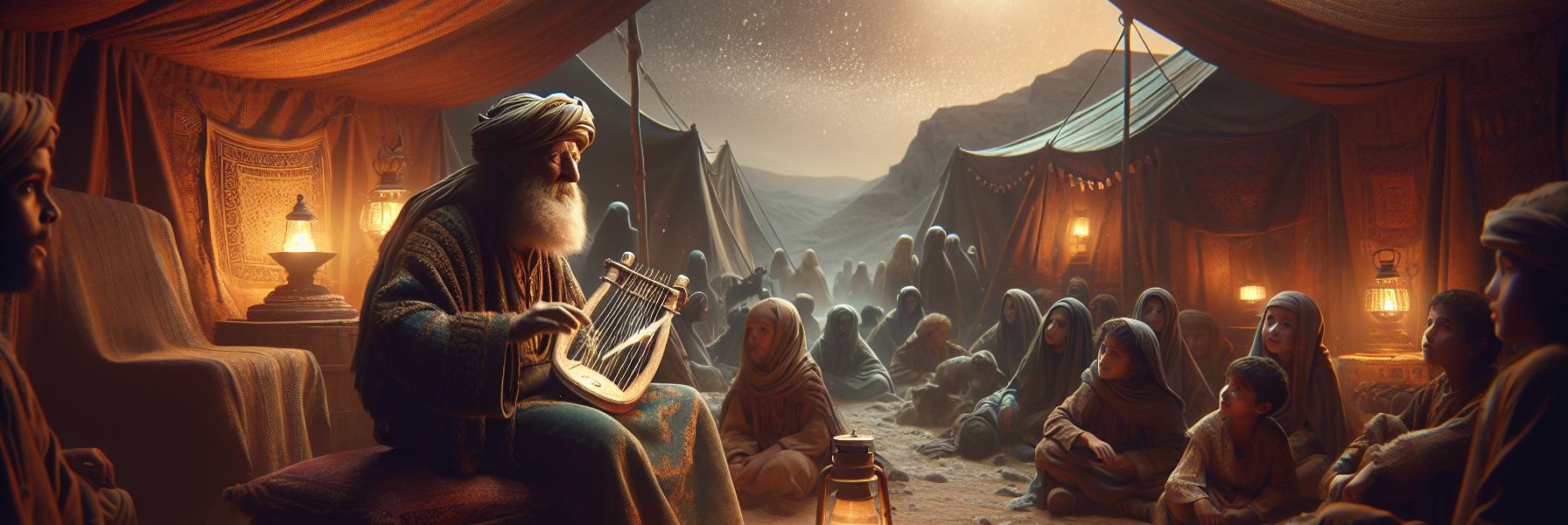

The heat in the tent was a living thing, thick and drowsy with the smell of goat hair and dust. Old Eliab shifted on his cushion, his fingers tracing the worn wood of his lyre. Before him, the children of the tribe had gathered, their eyes wide in the lamplight, impatient for the story. They had heard the laws, the lists of rules, but now they craved the song, the blood and thunder of their own becoming.
He cleared his throat, a sound like gravel, and began not with a king, but with a man.
“Before there was a nation,” he said, his voice low and weaving, “there was a single pair of feet, walking away from everything he knew. His name was Abram. And the promise given to him was not written on stone, but whispered on the wind, a covenant as vast as the night sky. ‘To your offspring,’ the Voice said, ‘I will give this land.’ Think of it. One man, childless, staring at a country of strangers and thorns, told it would belong to his children’s children. That is how our story starts. Not with an army, but with a trust so fragile it was like a single flame in a great desert.”
A boy fidgeted. “But how did we get *here*, from there?”
Eliab’s fingers found the strings, a low, plucking rhythm like a heartbeat. “The flame did not go out. It was shielded. When famine clawed at the land, a boy named Joseph was sent ahead, though his brothers meant it for evil. Sold, betrayed, forgotten in a pit of despair.” He closed his eyes, seeing the scenes in the dark behind his lids. “They threw him into a hole in the earth, cool and terrible. Then they pulled him up only to sell him for silver. He was carried to a land of strange tongues and towering idols, to a prison where the walls drank hope.”
He paused, letting the silence press in. “But the Lord was with him. He gave Joseph a gift—to understand the secret language of dreams, the nightmares of a king. Pharaoh saw towering sheaves of grain that swallowed the thin, sun-scorched ones. He saw seven fat cows devoured by seven gaunt and ugly beasts from the river. The wise men of Egypt scratched their heads, their charms and incantations useless. But Joseph, the prisoner, stood before the golden throne, unshackled, and spoke the truth: a feast was coming, and then a famine that would crack the world. And because he spoke with the wisdom granted by the God of his fathers, he was set over all the house of Pharaoh.”
Eliab’s melody changed, becoming stately, processional. “So it was that Jacob, our father, an old man with a limp and a heart full of sorrow for a son he thought dead, heard the impossible news: ‘Joseph is alive, and he is lord of all Egypt.’ And the whole clan, seventy souls in the dust, turned their faces south. They went down, small and frightened, into the jeweled heart of the empire. And they were given the best of the land, the rich pastures of Goshen, because of the one they had despised.”
For a time, the only sound was the soft crackle of the lamp wick. Then Eliab’s voice hardened. “But kingdoms have short memories. A new king rose who knew nothing of Joseph. He saw our people, once a family, now a nation within his nation, and fear curdled in his heart. ‘They are too many,’ he said. So he set taskmasters over them, with whips of cruelty. He made their lives bitter with hard service, with mortar and brick, with every field labor under the scorching sun. He sought to break them, to grind them back into the dust from which they came.”
The children were still now, caught in the tale.
“But the more they were oppressed, the more they multiplied. So the enemy turned to a darker horror. He commanded the midwives, then all his people, to cast every newborn son into the Nile, to let the river god swallow the promise.”
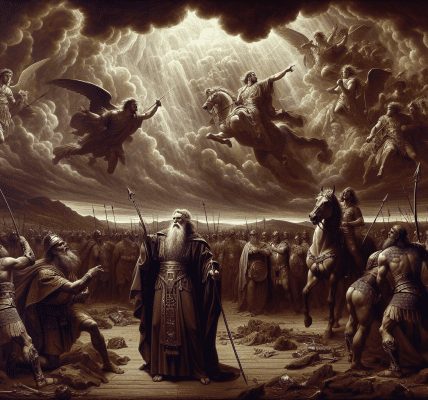
Eliab leaned forward, the firelight carving deep lines in his face. “And here is where you must understand. Our God is not a distant watcher. His word does not return empty. He sent a man, Moses, plucked from the very reeds meant to be his grave. He sent Aaron, his brother. They stood before that proud king with nothing but a shepherd’s staff and the terrible Name on their lips. They did not negotiate. They declared. And when Pharaoh’s heart grew hard as granite, the Lord laid bare the hollow gods of Egypt.”
He described it not as a list, but as an unraveling. The life-giving Nile turning thick and foul, a river of death. Clouds of frogs invading the palaces, the very bedrooms. The dust becoming gnats, a shimmering curse on the air. Swarms of flies that ignored the land of Goshen, a clear line drawn in the sand. The cattle, stiff and still in the fields. Boils on man and beast. Hail, fire, and ice mingled in a storm that shattered trees and hope. Locusts in a living, devouring blanket that blotted out the sun. A darkness you could feel, a weight on the chest for three days. And finally, the midnight cry, the awful silence in Egyptian homes where the firstborn slept forever.
“Their gods of river, and field, and sky, and family,” Eliab whispered, “were shown to be nothing. Stone and story. And Israel, laden with silver and gold given freely by broken neighbors, walked out. Not as fleeing slaves, but as a people dismissed with honor, because terror had fallen upon all who held them.”
He plucked a final, clear note. “He brought them out with joy, his chosen ones with singing. He spread a cloud for a covering by day, and a pillar of fire for a light by night. He split the rock in the wilderness, and water gushed out like a river, flowing in the dry places. All because he remembered his holy promise, the one he made to that one man, Abram, walking under a sky full of stars.”
Eliab set the lyre down. The story was told. It was not a neat parable. It was messy, full of betrayal, despair, and terrible wonder. It was their story. The children sat, the weight of it settling on them, the heat of the tent now feeling like the desert sun, the lamplight like the pillar of fire, a reminder that the same hand that guided through the past was upon them still, a promise-keeping, a people-shaping, a story-writing God.