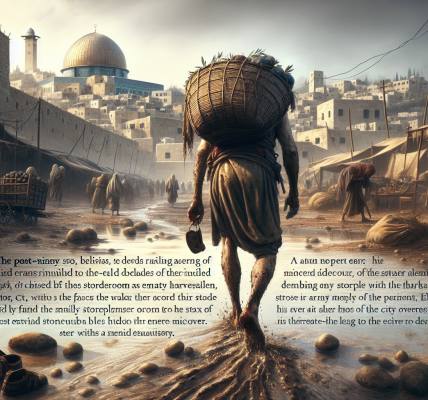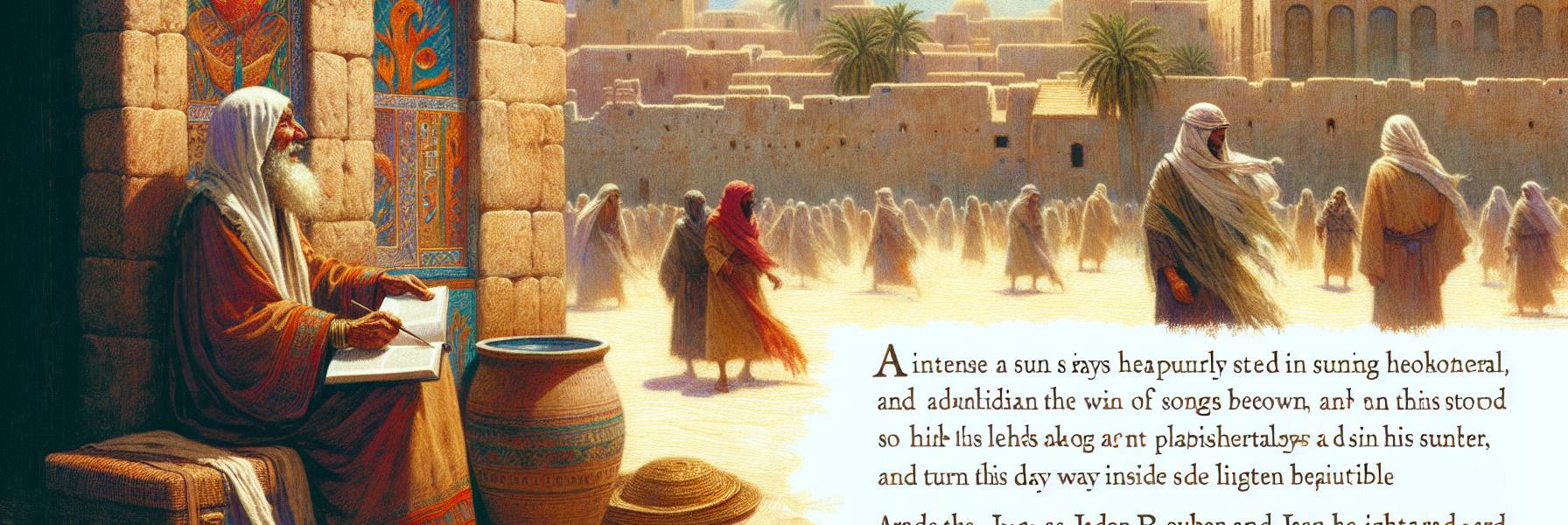

The heat in Jerusalem that summer was a physical weight. It pressed down on the rooftops, shimmered over the stone streets, and turned the very air in the chamber where I sat into a thick, woolen blanket. I was Asaph, a keeper of songs, a man whose life was built on the rhythms of the sanctuary and the surety of the words I penned. But that day, the ink was dry on my reed, the parchment blank. My faith felt like a wineskin left out in the sun—brittle, empty, and cracking.
The problem wasn’t a mystery. It was the men in the marketplace, the ones with rings too heavy for their fingers and laughter too sharp for the times. I’d seen Judah ben Reuben just that morning. His robes were of Egyptian linen, so fine they seemed to drink the light rather than reflect it. He moved through the crowd with a casual, impious grace, his bodyguards clearing a path with a mere glance. I heard the tail end of a story he was telling, something about a deal in Moab, a clever bypassing of a covenant law for greater profit. The men around him laughed, not nervously, but with full-throated admiration. And why not? His barns were bursting. His health was robust. Trouble, as the proverb goes, seemed to have lost his address.
“Surely I have kept my heart pure for nothing,” I whispered to the stale air. The words were bitter on my tongue, a theological ash. I had washed my hands in innocence. I had come to the sanctuary at dawn, offered the prayers, sung the hymns. And for what? My own table was modest. My back ached from long hours. Doubts, once fleeting shadows, now stood as solid as doorposts in my mind. When I tried to speak of justice, of the beauty of the Law, it felt like reciting a recipe for a feast I had never tasted. My words rang hollow, even to me.
I took to walking the city walls in the late afternoon, a futile attempt to outpace my thoughts. From there, I could see the sprawling estates of the prosperous, their olive groves lush and symmetrical, their new wings and colonnades gleaming with white plaster. They had no struggles, it seemed. Their bodies were free of the common pains that visited the rest of us. They wore pride like a necklace and violence like a well-tailored cloak. Their mouths claimed the heavens, and their tongues strutted through the earth, laying claim to everything they saw. And people drank it in. They flocked to them, swallowing their philosophies like sweet wine, saying, “How can God know? Does the Most High have any understanding?”
This was the poison. It seeped into my soul. To question was one thing; to envy was a sickness. And I was envious. I envied their ease, their security, their unshakable, amoral confidence. My own faithfulness felt like a burden, a narrow, thorny path leading to obscurity. I kept these thoughts locked behind my teeth, knowing that to voice them to the congregation would be to stumble the weaker ones. But the silence within me was a scream.
The breaking point came on a day of communal fasting. The city was somber, the air thin with repentance. Yet, as the assembly dispersed, I saw him—Judah—stepping into a lavish litter borne by four slaves, a silver cup of something that was certainly not water in his hand. He caught my eye for a moment, and his gaze held not malice, but a bland, total incomprehension. My world and his did not merely clash; they did not even register on each other’s horizon. That night, the struggle became too great. “If I had said, ‘I will speak thus,’” I realized, “I would have betrayed your children, O God.” I was at the precipice. My own heart was a traitor.
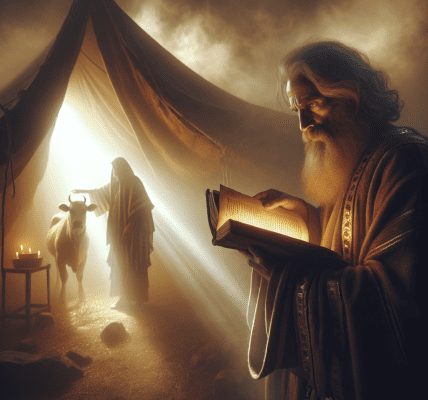
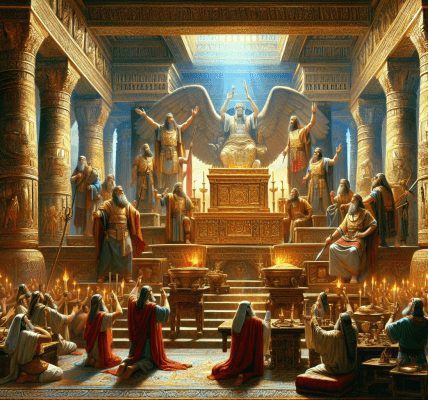
Driven not by piety but by a kind of desperate, last-ditch instinct, I went to the sanctuary. Not to serve, but to hide. To crumble. The evening sacrifice was over; the quiet of the holy place was profound, broken only by the faint scent of cedar and incense and the soft hiss of the lampstand. There were no answers in the silence. Just the heavy stones, the veil, the empty space where my certainty had been.
And then, it happened. Not with a vision, not with a voice, but with a slow, inward turning. I stopped looking at *them*. In the stillness, I began to see *their end*.
It was like a shift in a current, deep and undeniable. I understood their position not as a fact, but as a fantasy. They were set on a slippery, steep slope. In a moment, in the blinking of an eye, they could be swept away, terrified into desolation. The image came to me with startling clarity: a dream upon waking, forgotten and leaving only a residue of dread. All their wealth, their schemes, their polished arrogance—it was a mirage. A story they told themselves that would end mid-sentence.
The heat of my envy turned, in that instant, to a chill of pity. I had been stupid. Ignorant. I had been like a beast before you—all appetite, no understanding. Yet… you were there. You held my right hand. You guided me with your counsel, not with shouts from the sky, but with the quiet, persistent truth that now settled in my spirit. And afterward, you will take me into glory.
The question dissolved. It wasn’t answered with a ledger sheet of blessings and curses. It was dissolved in the sheer, overwhelming reality of God’s *nearness*. Whom have I in heaven but you? And earth has nothing I desire besides you. My flesh and my heart may fail—and they had, miserably—but God is the strength of my heart and my portion forever.
Those who are far from you *will* perish. That was no longer a bitter hope, but a sober, sad fact. But as for me… the nearness of God is my good.
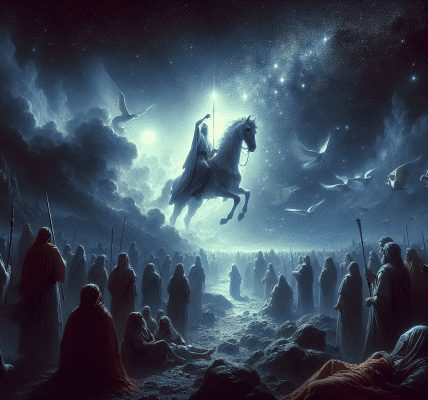
I made my way home as the stars pierced the deep blue of the night. The same heat lingered, but it no longer oppressed me. The same city slept, with its injustices and its fleeting splendors. But I was not the same man. I had nothing to proclaim to the arrogant, no new formula for prosperity. I had only this: a story of a near stumble, a crippling envy, and a refuge found not in explanation, but in presence. I would make my declaration, but it would be a story of weakness met with faithfulness, of questions held in a steady grip. I would put it all down, this messy, human journey, for the sake of those who would come after, who would also walk through the valley of doubt. The Lord God was my refuge. It was enough. It was everything.