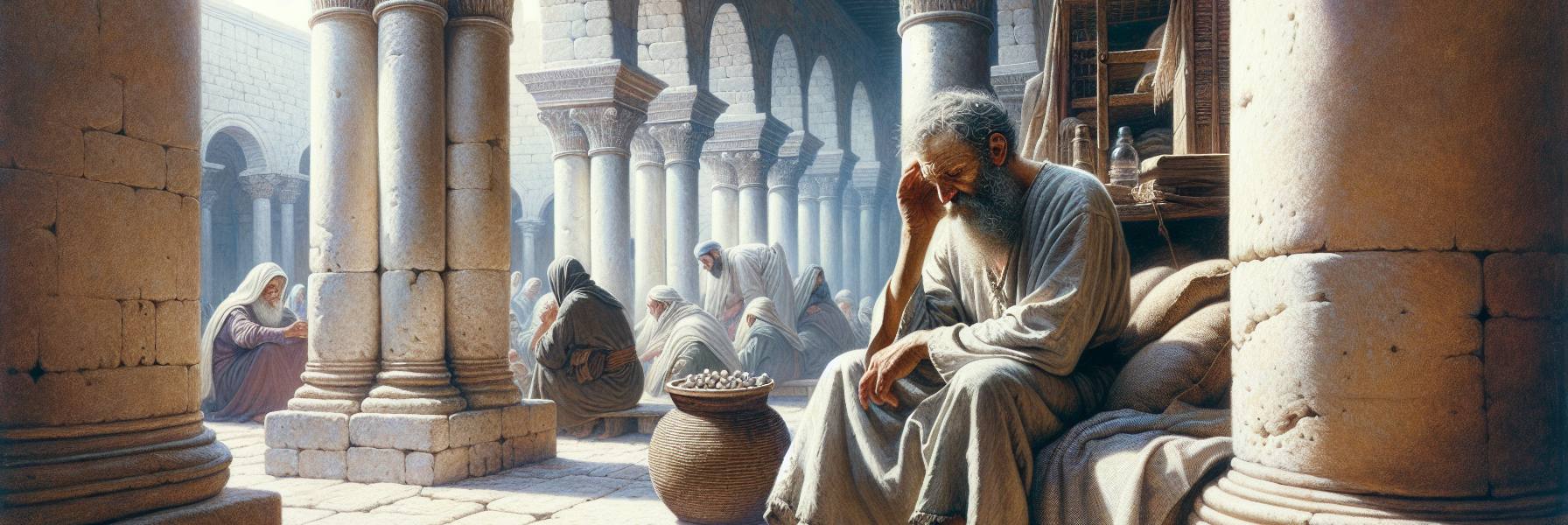

The sun baked the white stones of the synagogue courtyard, turning the air thick and sluggish. Elazar, a linen merchant whose forearms bore the faint, silvery scars from a childhood accident, wiped his brow with a sleeve. He’d come early, seeking a sliver of shade under the portico, his mind on a shipment of Egyptian flax delayed in Joppa. The gathering for prayer was thin at this hour—a few elderly men murmuring psalms, a young mother shushing a fretful child.
Then the gates clattered.
Two men entered, their arrival slicing through the drowsy atmosphere. The first was Gaius, a Greek God-fearer known throughout the city. His tunic was of the finest bleached wool, edged with a subtle purple border that spoke of wealth without ostentation. A heavy silver ring adorned his hand. The second man was Jorah. Elazar knew him by sight—a day laborer who repaired mud-brick walls, his hands permanently stained with clay, his cloak threadbare at the shoulders and patched clumsily at the hem. He smelled of dust and sweat.
Elazar watched as Shemuel, one of the synagogue elders, hurried forward. A wide, polished smile appeared on Shemuel’s face. “My dear Gaius! What an honor. Please, come, the best seat is saved.” He gestured extravagantly to a stone bench positioned perfectly for the breeze and the reader’s voice. Gaius gave a slight, dignified nod and was ushered forward.
Jorah stood awkwardly just inside the gate, his eyes downcast. Shemuel’s gaze swept past him, the smile still fixed for Gaius. “You there,” Shemuel said, not unkindly, but with the distracted air of a man directing a stray animal. “Stand over there, if you would. Or perhaps sit on the floor by the water jug.”
A cold clarity settled in Elazar’s stomach. He saw Jorah’s shoulders tense, then slump in a familiar resignation. The man shuffled to the spot indicated, lowering himself onto the sun-baked ground. The difference was a performance, a silent sermon in itself: one man elevated, the other diminished, based on nothing but the weight of their purse.
The scripture reading that day was from the Law. The words about loving your neighbor as yourself seemed to hang in the air, thick and challenging. Elazar found he could not concentrate. He kept seeing Jorah’s dusty feet, the careful way he held his patched cloak around him.
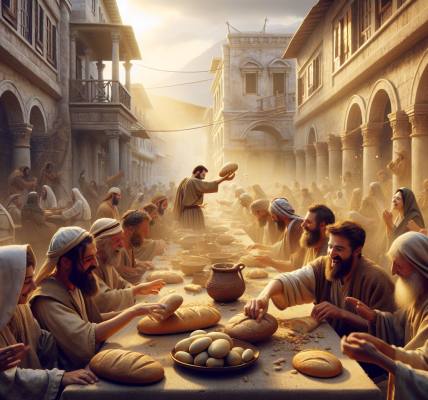
After the prayers, the community shared a simple meal. Gaius was surrounded, people laughing at his quiet jokes, asking after his business. Jorah took a piece of bread and a few olives and retreated to the periphery, eating alone. Elazar’s feet felt rooted to the stone. A voice within him, one that sounded suspiciously like his late father, chided, ‘*It is not your affair. Do not make a scene.*’
But another memory surfaced, sharp and unwelcome: his own sister, Miriam, last winter. Her husband had fallen ill, and the harvest had failed. They had come to him, their eyes hollow with hunger and fear. He had given them pious comfort. “Go in peace,” he had said, “be warmed and filled.” He had sent them away with a blessing and a handful of coins that wouldn’t last a week. He had not opened his storerooms. He had not brought them into his home. The shame of it, which he had buried under layers of busyness, now rose up, acrid in his throat.
He looked at Gaius, surrounded by respect, and at Jorah, isolated in his poverty. *Faith*, he thought. *We all have faith. We believe the Shema. We keep the feasts.* But what was that faith, here in this courtyard? It was like a body without breath. It was correct, but it was cold. It acknowledged God with the lips but made distinctions with the eyes.
Elazar did not make a grand speech. He simply stood, walked away from the circle around Gaius, and went to the water jug. He filled a clay cup, then walked to where Jorah sat. He offered the cup. “The day is hot,” Elazar said, his voice rough.
Jorah looked up, startled, then took the cup with a nod. After a moment, Elazar sat down beside him on the ground. The stones were hard and warm. He asked about the work on the city wall, about the new reservoir. Jorah spoke haltingly at first, then with more ease, his words painting pictures of cracked foundations and the stubborn patience of repair.
They spoke of nothing profound. They did not discuss the Law or the Prophets. But as they talked, Elazar felt a peculiar shift, as if an unseen balance in the courtyard was being righted. He was not performing charity. He was, in a small, stumbling way, acknowledging a brother. The faith that had moments before felt like a dead, polished stone in his chest began to stir, to seek the air of action.
Later, walking home, the image of his sister Miriam returned. This time, it was not accompanied by shallow guilt, but by a resolve that had texture and weight. Tomorrow, he would go to her. Not just with words. With his hands, with the key to his storeroom, with his time. The faith that justified, he was beginning to understand, was not the one that stayed on the tongue or in the seat of honor. It was the one that got up, crossed the room, and sat on the hard ground. It was the faith that, at long last, decided to work.