The chapter opens with a scene of desperate reversal. Seven women seize one man, offering to feed and clothe themselves if only he will take away their reproach by giving them his name. The chapter does not explain why the women are so numerous or the men so scarce, but the pressure is plain: the judgment that has swept through has left the city stripped of its male population, and the shame of childlessness now drives women to beg for a legal covering. The reader is not told how the man answers. The silence itself is part of the tension.
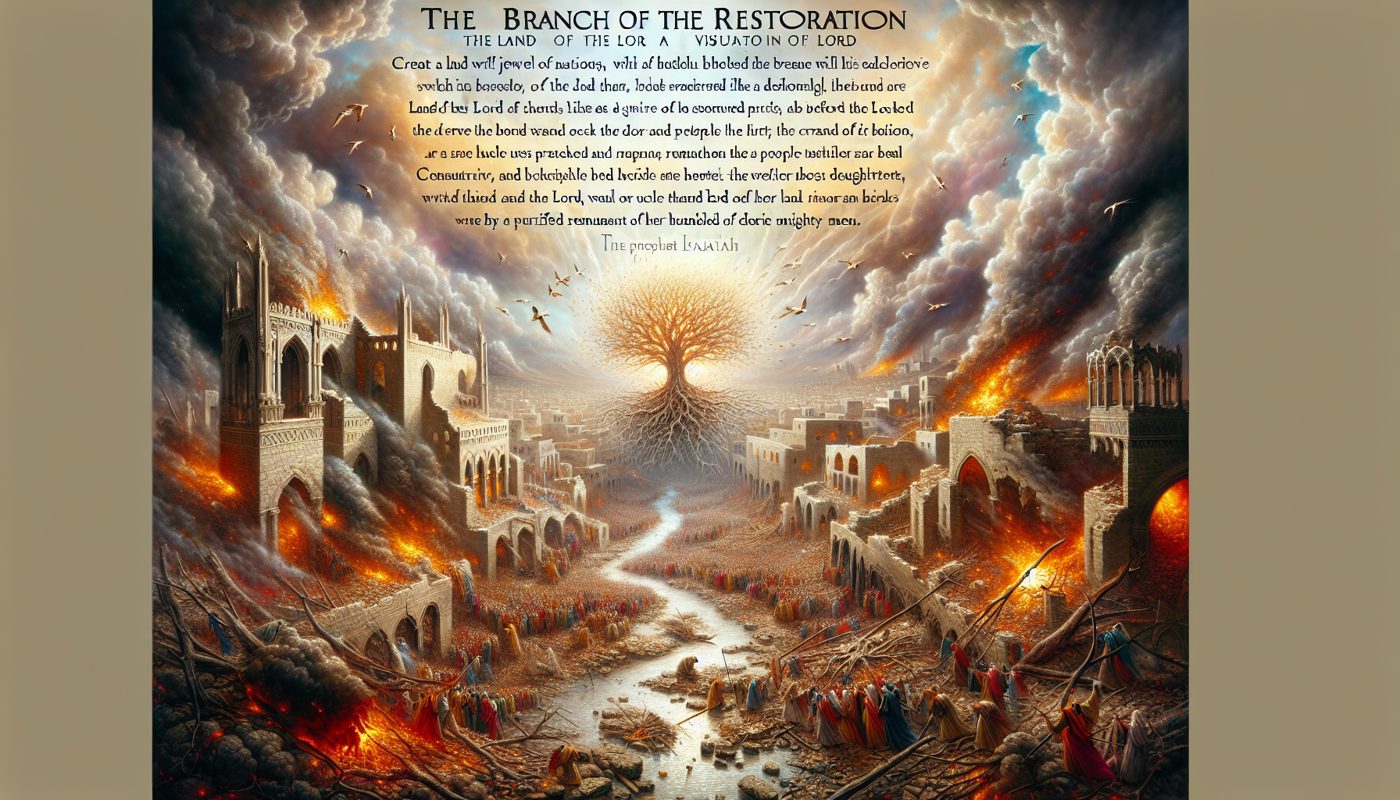
Then the chapter pivots. In that same day, the branch of the Lord shall be beautiful and glorious. The phrase is not explained as a title for a future king or a messianic figure; the chapter simply states that the branch belongs to the Lord and that it will be beautiful. Alongside it, the fruit of the land shall be excellent and comely for those who have escaped of Israel. The focus is not on a single ruler but on a transformed landscape and a purified people.
The ones who are left in Zion and remain in Jerusalem shall be called holy. The chapter does not say that all survivors are holy; it says that those who are written among the living in Jerusalem will be called holy. The implication is that a register exists, a divine census of those who belong to the city. The holiness is not a general blessing but a specific designation for the remnant that has been preserved through the judgment.
Before that holiness can be declared, the Lord must wash away the filth of the daughters of Zion and purge the blood of Jerusalem from its midst. The chapter names two agents for this cleansing: the spirit of justice and the spirit of burning. The language is not metaphorical in a soft sense; it is forensic and violent. The filth and the blood are real, and the removal is by fire and by judgment. The chapter does not soften this process or explain it away as a metaphor for inner renewal.
After the cleansing, the Lord creates over the whole habitation of Mount Zion and over her assemblies a cloud and smoke by day and the shining of a flaming fire by night. The imagery deliberately echoes the wilderness tabernacle, where the Lord led Israel by a pillar of cloud and fire. Here, the cloud and fire are not for guidance but for covering. The chapter says that over all the glory shall be spread a covering. The glory is not exposed; it is sheltered.
The final verse describes a pavilion, a shade from the heat by day and a refuge from storm and rain. The chapter does not say who built this pavilion or how it appears. It simply states that it will be there. The structure is a shelter, not a temple. The chapter does not mention priests, sacrifices, or worship. It ends with the image of a covered people, protected from the elements, dwelling under the visible presence of the Lord.
The chapter offers no timeline for these events. It does not say when the branch will appear or how long the cloud will remain. It does not name the man whom the seven women approach. It does not explain how the register of the living is kept or who writes the names. The chapter is a series of declarations, not a narrative. Each verse stands as a separate promise or description, linked only by the phrase in that day.
The effect is one of compression. The chapter moves from social collapse to divine beauty, from bloodguilt to cleansing fire, from exposed shame to covered glory. The reader is not given time to linger on any one image. The chapter forces a rapid shift from the desperation of the opening to the stability of the closing. The branch, the burning, and the cloud are not connected by a story but by the same day.
The chapter does not moralize. It does not tell the reader to hope or to repent. It simply reports what will happen when the Lord acts. The women will beg. The branch will appear. The filth will be washed. The cloud will settle. The pavilion will stand. The chapter trusts the images to carry their own weight.
Comments
Comments 0
Read the discussion and add your voice.
Members only
Sign in to join the conversation
We keep comments tied to real accounts so the discussion stays clean and trustworthy.
No comments yet. Be the first to add one.