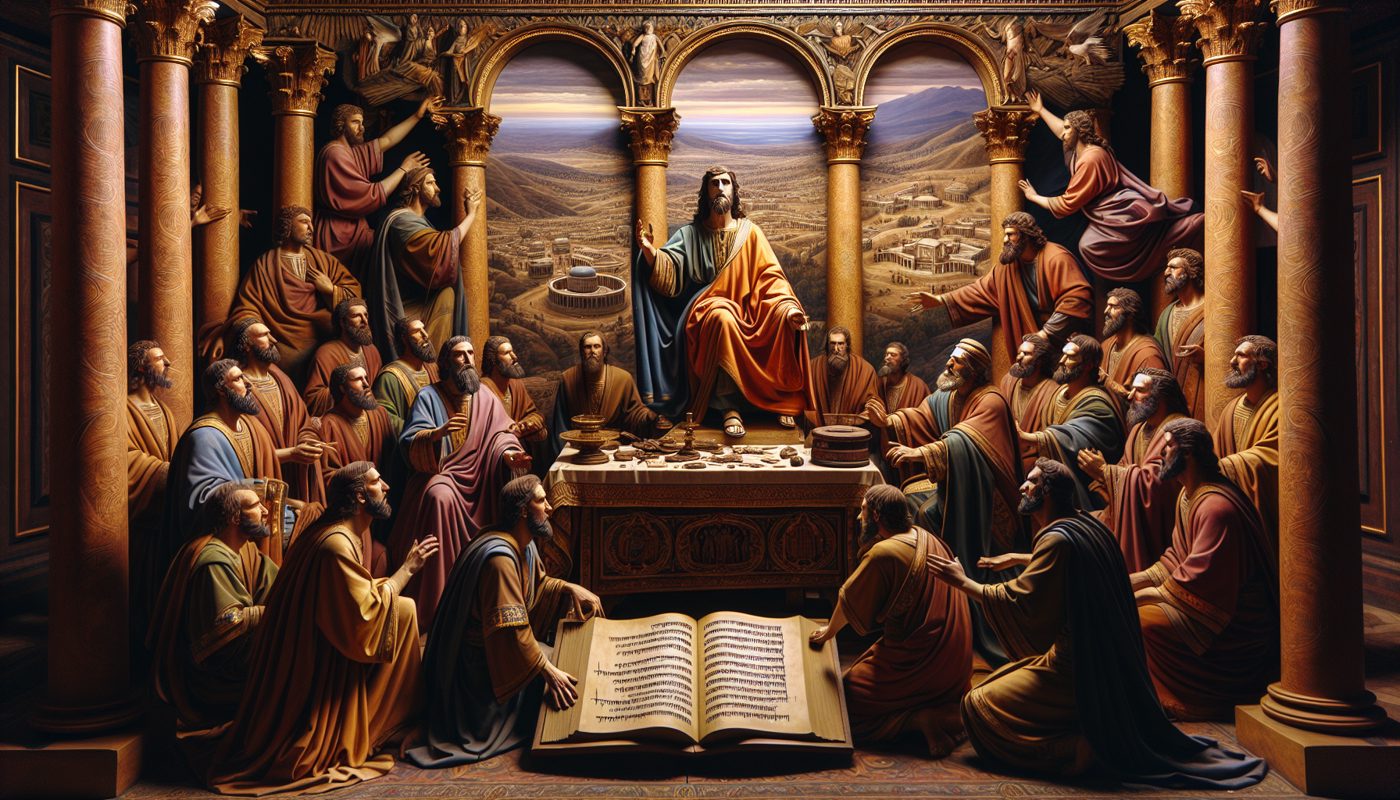
This chapter records a purely administrative act, but one that governed the sound of Israel’s worship for generations. David and the captains of the army set apart men from the families of Asaph, Heman, and Jeduthun for a specific task: to prophesy with harps, psalteries, and cymbals. The text does not call them singers or musicians in a casual sense. It says they prophesied. Their instruments were the medium, and the content of their playing was the word of the Lord.
The three family heads are named with distinct roles. Asaph’s sons served under his hand, and he himself prophesied according to the order of the king. Jeduthun’s sons prophesied with the harp, giving thanks and praising the Lord. Heman’s sons are listed in a long string of names—fourteen sons and three daughters given by God to this man, who is called the king’s seer in the words of God, to lift up the horn. The chapter does not explain what lifting up the horn means, but it ties Heman’s prophetic gift directly to the divine gift of a large family.
All these men, along with their brethren who were instructed in singing to the Lord, numbered 288 skilled workers. The number is precise, and it is the product of careful selection. They were not volunteers from the crowd. They were trained, evaluated, and counted. The text emphasizes that they were skillful—not merely willing, but competent in their craft.
The method of assigning their duties was the lot. They cast lots for their offices, and the text is explicit that this was done without favor: the small and the great alike, the teacher and the scholar, all stood on equal ground before the lot. The chapter then lists twenty-four turns of service, each assigned to a named leader with his sons and brethren, each group numbering twelve. The first lot fell to Joseph of Asaph’s line. The second to Gedaliah. The list continues through all twenty-four names, ending with Romamti-ezer.
Nothing in the chapter describes the content of their songs or the occasions of their playing. There is no mention of the ark, the temple building, or any festival. The focus is entirely on the structure: who served, under whose authority, with what instruments, and in what order. The king’s order is mentioned twice—once for Asaph and once for the three family heads collectively. David’s authority stands behind the entire arrangement.
The chapter does not call these men priests. They are Levites, but their work is distinct from the sacrificial system. Their prophesying with instruments is a form of service that runs parallel to the word spoken by prophets. The text gives no example of what they prophesied. It only records that they did it, and that it required organization.
Twenty-four courses of twelve men each produce the total of 288. The symmetry is deliberate, and it mirrors the priestly divisions that David also established. The lot ensured that no human preference determined who led worship on a given occasion. The Lord’s will, expressed through the casting of lots, set the order.
The chapter ends with the twenty-fourth lot. There is no narrative conclusion, no comment on how well the system worked, no note of a grand inauguration. The record simply states that these men were assigned, and that is enough. The worship of the house of the Lord was not left to spontaneity or personal inclination. It was built on a foundation of skill, family lineage, prophetic calling, and divine direction through the lot.
Comments
Comments 0
Read the discussion and add your voice.
Members only
Sign in to join the conversation
We keep comments tied to real accounts so the discussion stays clean and trustworthy.
No comments yet. Be the first to add one.