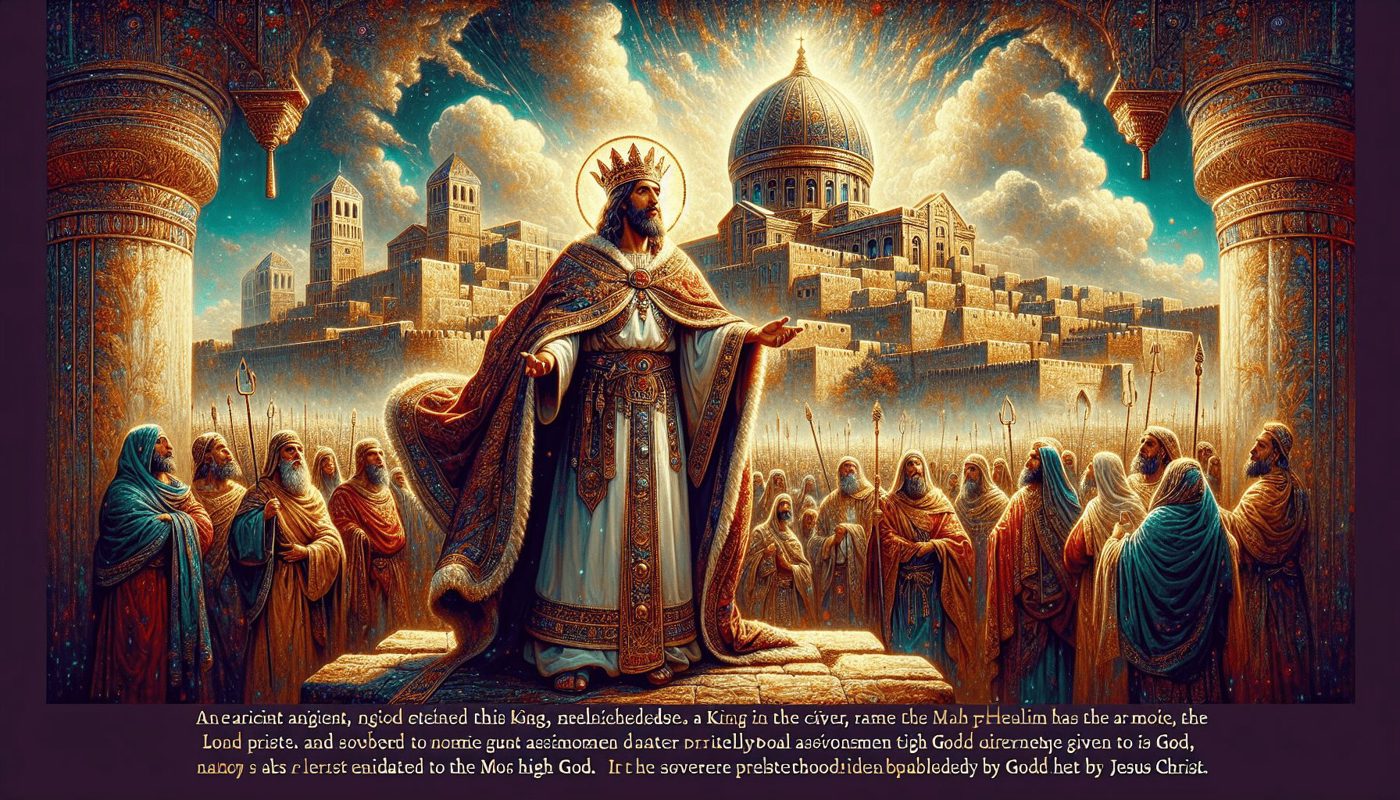
The writer of Hebrews presses a single argument through this entire chapter: the priesthood of Melchizedek is not a footnote to the Law of Moses. It is the thing that proves the Law itself was never final. The argument begins with a figure from Genesis who appears without ancestry, without a recorded birth or death, and who receives tithes from Abraham himself.
Melchizedek is introduced as king of Salem and priest of God Most High. The writer points out that his name means king of righteousness, and his title king of Salem means king of peace. But the crucial detail is that Scripture records no father, no mother, no genealogy, no beginning of days, and no end of life. He is made like the Son of God and remains a priest perpetually.
The writer then asks his readers to consider how great this man was. Abraham, the patriarch, gave him a tenth of the spoils from battle. Under the Law, the sons of Levi had authority to collect tithes from their fellow Israelites, who were also descendants of Abraham. But Melchizedek, who was not from the Levitical line, collected tithes from Abraham himself. And then he blessed Abraham, the man who held the promises from God.
The logic is blunt: the lesser is always blessed by the greater. Abraham received blessing from Melchizedek, which means Melchizedek held a rank above Abraham. And when Levitical priests collect tithes, they are men who die. But Melchizedek is witnessed as living. The writer even presses the point further: in a sense, Levi himself paid tithes to Melchizedek, because Levi was still in the loins of his ancestor Abraham when Abraham met Melchizedek.
If the Levitical priesthood had been able to bring perfection, there would have been no need for another priest to arise after the order of Melchizedek instead of after the order of Aaron. But the Law itself made nothing perfect. So the priesthood had to change, and with the priesthood came a change of the Law itself.
The writer then makes a direct claim about Jesus. The Lord sprang from the tribe of Judah, and Moses said nothing about priests coming from Judah. So when a priest arises in the likeness of Melchizedek, he is not made according to a law of a fleshly commandment. He is made according to the power of an indestructible life. The psalm is quoted: You are a priest forever after the order of Melchizedek.
Because of this, the former commandment is set aside. It was weak and unprofitable. In its place comes a better hope, through which people draw near to God. And this new priesthood was not established without an oath. The Levitical priests were appointed without an oath, but Jesus was appointed with an oath from the Lord who swore and will not change his mind: You are a priest forever.
Jesus therefore becomes the guarantee of a better covenant. The Levitical priests were many in number because death kept them from continuing. But Jesus abides forever, so his priesthood is unchangeable. He is able to save completely those who draw near to God through him, because he always lives to intercede for them.
The chapter closes with a description of the kind of high priest that was needed: holy, innocent, undefiled, separated from sinners, and exalted above the heavens. Unlike the Levitical high priests who had to offer sacrifices daily, first for their own sins and then for the people's, Jesus offered himself once for all. The Law appoints men who have weakness as high priests, but the word of the oath, which came after the Law, appoints a Son who has been perfected forever.
Comments
Comments 0
Read the discussion and add your voice.
Members only
Sign in to join the conversation
We keep comments tied to real accounts so the discussion stays clean and trustworthy.
No comments yet. Be the first to add one.