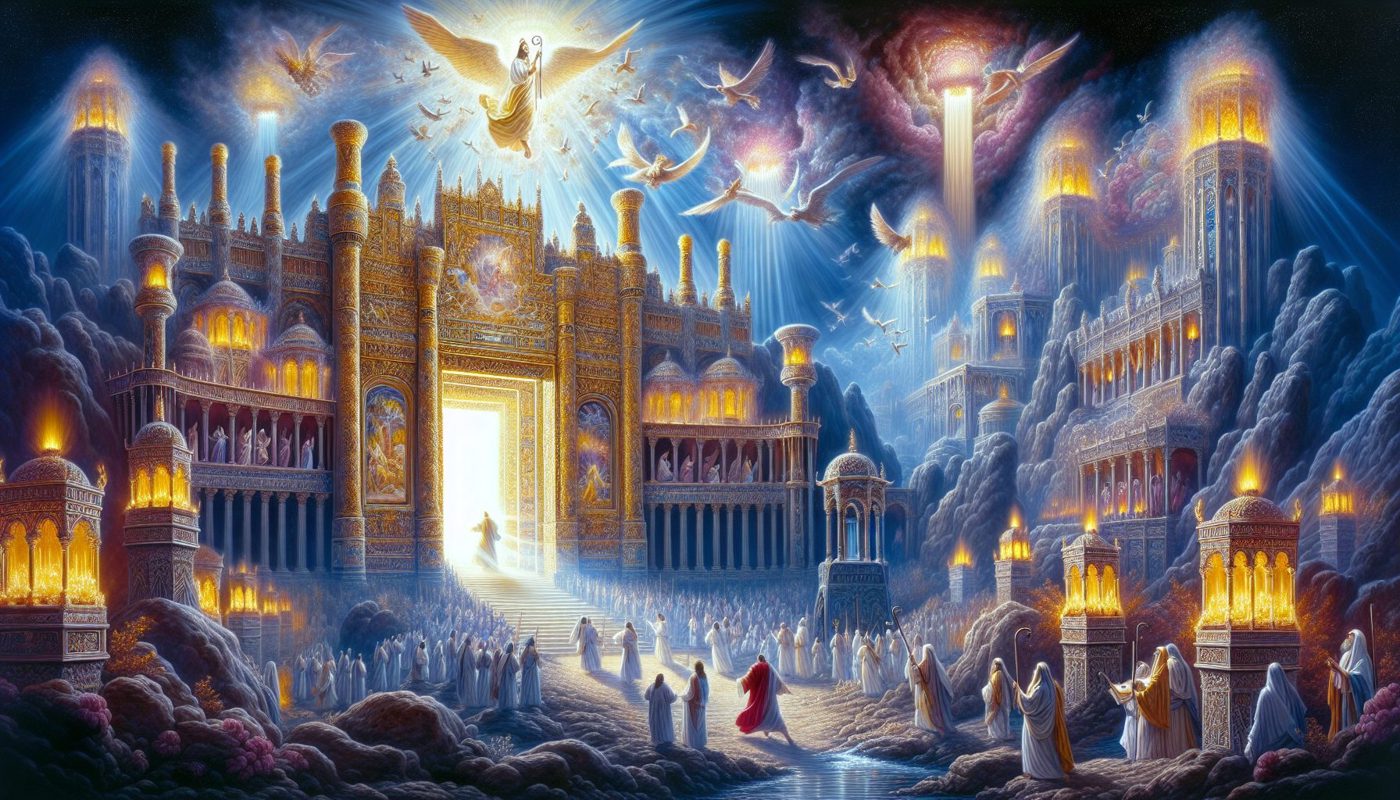
The chapter opens with a precise calendar for the eastern gate of the inner court. For six working days it remains shut. On the sabbath and on the day of the new moon it is opened. The gate is not a decoration; it controls access and movement. The Lord gives the rule directly, and the prince is the one who enters by the porch of that gate, stands by its post, and waits while the priests prepare his burnt offering and his peace offerings. He worships at the threshold, then goes out. The gate stays open only until evening.
The people of the land are not left outside. They worship at the door of that same gate on sabbaths and new moons. The prince does not block their view or their access. He stands in the gateway, but the people stand at the door. The arrangement is physical and visible. Everyone knows where to stand and when.
The offerings themselves are specified by number and kind. On the sabbath the prince brings six lambs without blemish and one ram without blemish. The grain offering for the ram is a full ephah; for the lambs it is whatever he is able to give, along with a hin of oil per ephah. On the new moon the offering changes: a young bull without blemish, six lambs, and a ram, all without blemish. The grain offering for the bull and the ram is an ephah each; for the lambs it is again according to his ability, with oil in the same proportion.
The prince’s movement in and out of the gate is fixed. He enters by the porch of the gate and leaves the same way. But when the people come for the appointed feasts, they do not turn back. The one who enters by the north gate must exit by the south gate; the one who enters by the south gate must exit by the north gate. They go straight ahead. The prince does not separate himself from them. When they go in, he goes in among them; when they go out, they go out together.
For the feasts and solemn assemblies, the grain offering is again an ephah for a bull, an ephah for a ram, and for the lambs whatever the prince is able to give, with oil. But if the prince wants to offer a freewill offering—a burnt offering or peace offerings—the eastern gate is opened for him. He prepares it as on the sabbath, then goes out, and after he leaves, the gate is shut. The gate is not left open for convenience; it is opened and closed on command.
Beyond the prince’s offerings, there is a daily obligation. A lamb a year old without blemish is to be prepared as a burnt offering to the Lord every morning. With it comes a grain offering of a sixth of an ephah and a third of a hin of oil to moisten the fine flour. This is a perpetual ordinance. The lamb, the grain, and the oil are brought morning by morning without fail.
The chapter then turns to property. The prince may give a gift to his sons, and it becomes their inheritance permanently. But if he gives a gift to a servant, it belongs to the servant only until the year of liberty, then it returns to the prince. The prince’s inheritance stays with his sons. More importantly, the prince is forbidden from taking the people’s inheritance. He cannot thrust them out of their possession. He must give to his sons from his own property, so that the people are not scattered, each from his own land.
The vision then shifts location. Ezekiel is brought through an entry at the side of the gate into the holy chambers for the priests, which face north. There, on the western side, is a place. The Lord tells him: this is where the priests boil the trespass offering and the sin offering, and where they bake the grain offering. They do this so that these offerings are not carried into the outer court and sanctify the people unintentionally. The holiness of the offerings is contained.
Finally, Ezekiel is brought into the outer court and made to pass by its four corners. In each corner there is a court—enclosed courts, forty cubits long and thirty broad, all of the same measure. Around each court is a wall, and under the walls are boiling places. The Lord explains: these are the boiling houses where the ministers of the house boil the sacrifice of the people. The entire temple complex, from the eastern gate to the corner kitchens, is arranged so that worship, sacrifice, and the handling of holy food happen in their proper places, at their proper times, by the proper people.
Comments
Comments 0
Read the discussion and add your voice.
Members only
Sign in to join the conversation
We keep comments tied to real accounts so the discussion stays clean and trustworthy.
No comments yet. Be the first to add one.