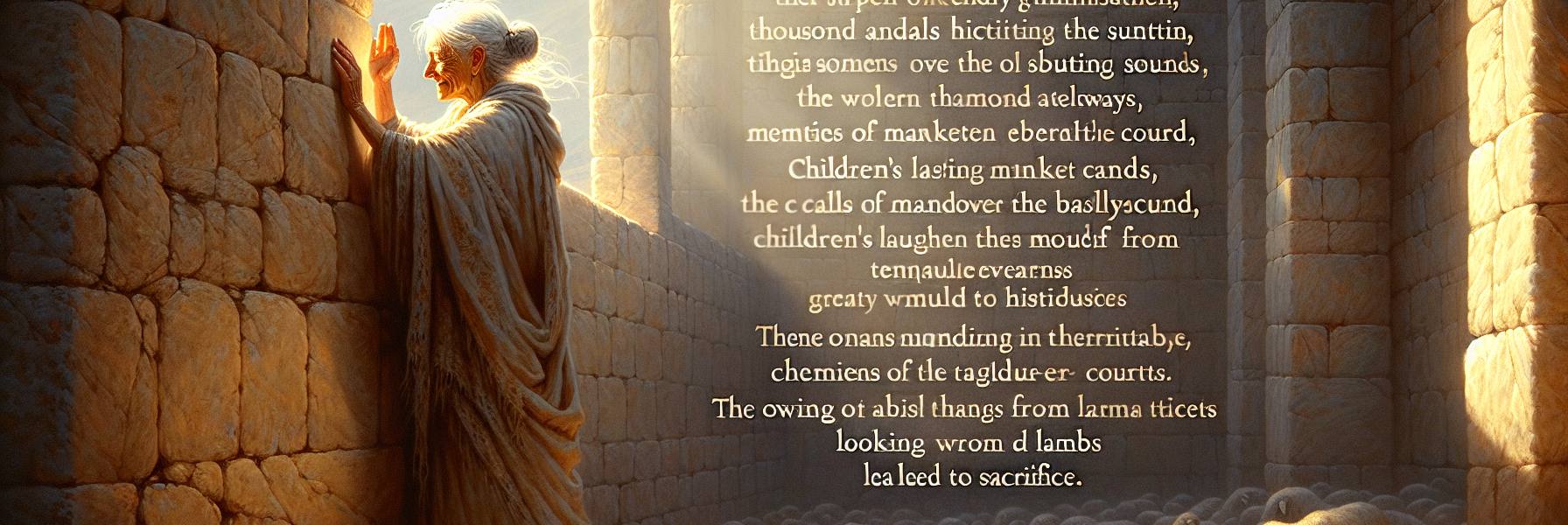

The stone remembers warmth. It shouldn’t, not anymore, but in the late afternoon when the slanting sun catches the western wall of what was once a great house, a residual heat bleeds from the limestone. Old Hannah presses her palm against it, eyes closed. She does not weep. The tears dried up weeks ago, a well sucked empty by a relentless sun.
She remembers the noise. That is the first thing that comes, not the faces, not the prayers, but the noise. The clatter of a thousand sandals on cobbles, the market vendors calling over the din, the laughter of children chasing through alleyways, the steady, rhythmic chant from the Temple courts, the lowing of sacrifice-bound lambs. A symphony of life, constant as a heartbeat. Now, there is only the wind. It has a different voice here. It doesn’t whistle; it sighs. It pulls through shattered windows and across abandoned rooftops with a long, low moan, like something dying slowly. It scours the streets, picking up little cyclones of dust and charred bits of tapestry, the last fragments of someone’s home.
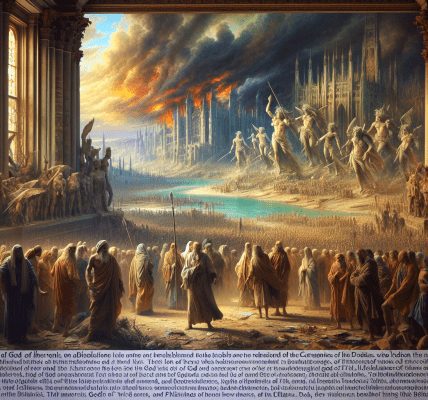
Hannah opens her eyes. From her vantage, she can see the blackened, skeletal remains of the great cedar roofs. Beyond, the Temple mount is a broken jawbone against the sky. The gold is gone, stripped away, leaving raw stone that looks naked and ashamed. The invaders took everything: the treasures, the young men, the future. What they left behind was this silence, and the old, the crippled, the useless. Like her.
She is the city. She knows this in her bones. Widowed, childless, she sits in the dust of her own inheritance. Her friends, the other nations, have all turned away. Some, like Egypt and Ammon, had made promises, had eaten at her table. Now they look past her, or worse, they mock. She hears the traders from the caravans that now bypass the city, their voices carrying on the still air. *Is this the city that was called perfect in beauty, the joy of the whole earth?* Their laughter is a dry, cruel thing.
At night, it is worse. The memory of feasts is a physical pain, a cramp in her stomach. She can almost smell the roasting meat, the saffron in the rice, the sweet wine. Now, she scavenges for chickweed and bitter herbs in the ruins, her hands filthy, her fine robes long ago traded for moldy bread. The priests, those who remain, stumble through the rubble. There is no incense to burn, no lambs to slaughter. They merely wander, their sacred vestments torn and gray with ash, their eyes vacant. They are ghosts performing no rites.
Her mind turns, against her will, to the why of it. It is not a question of strategy or failed alliances. It is a deeper, more personal betrayal. She had been loved, once. Cherished. The law had been a wedding gift, the prophets the steady voice of a concerned husband. And she had wandered. Oh, how she had wandered. Into the arms of other lovers—gods of stone and field, gods of power and fertility. She had courted empires for their protection, had mixed their pagan rites with sacred festival. She had thought herself clever, cosmopolitan. She had ignored the ache in the prophets’ throats as they warned, the desperation in their eyes.
Now, she sees it. The lovers she doted on have led her here, to this ditch. They offered no strength when the siege engines rolled against the walls. They were the first to be smashed by the conqueror’s hammer. All illusion has been burned away in the fires, leaving only the terrible, clarifying truth: she is alone.
A rat skitters over a pile of broken pottery. The sound is obscenely loud. Hannah watches it, too tired to shoo it away. This is her prince, her new companion. The enemy has laid his yoke upon her neck. She can feel its rough wood chafing, a weight that forces her gaze downward, onto the dust. Her strength is gone. She gave it all away, piece by piece, in a thousand little compromises, and now the cupboard is bare.
The worst of it, the thought that coils in her gut like a snake, is the silence from above. She lifts her face, cracked and smudged, to the empty sky. She cries out, but the cry is soundless, swallowed by the vast, indifferent blue. He has withdrawn his right hand in the day of battle. He has become like an enemy. He has set a trap for her feet, turned her back on her attackers. This is the unthinkable truth. The pain of the sword and famine is one thing. The pain of His absence is another universe of anguish.
She thinks of her children, the young men and women driven in chains down the road to Babylon. Their voices, singing the old songs by the rivers of a foreign land, are carried to her on this same mocking wind. They are gone. She is a vessel, utterly poured out.
The sun dips lower, painting the ruins in tones of blood and gold. The beauty of it is a final insult. Hannah does not move from the warm stone. The wind picks up, whispering through the valley. It carries the scent of rain, far away, on hills she will never see again. There are no words left, only the sigh, the moan, the heavy, unanswerable silence of a house left empty, its door torn from its hinges, swinging in the wind.