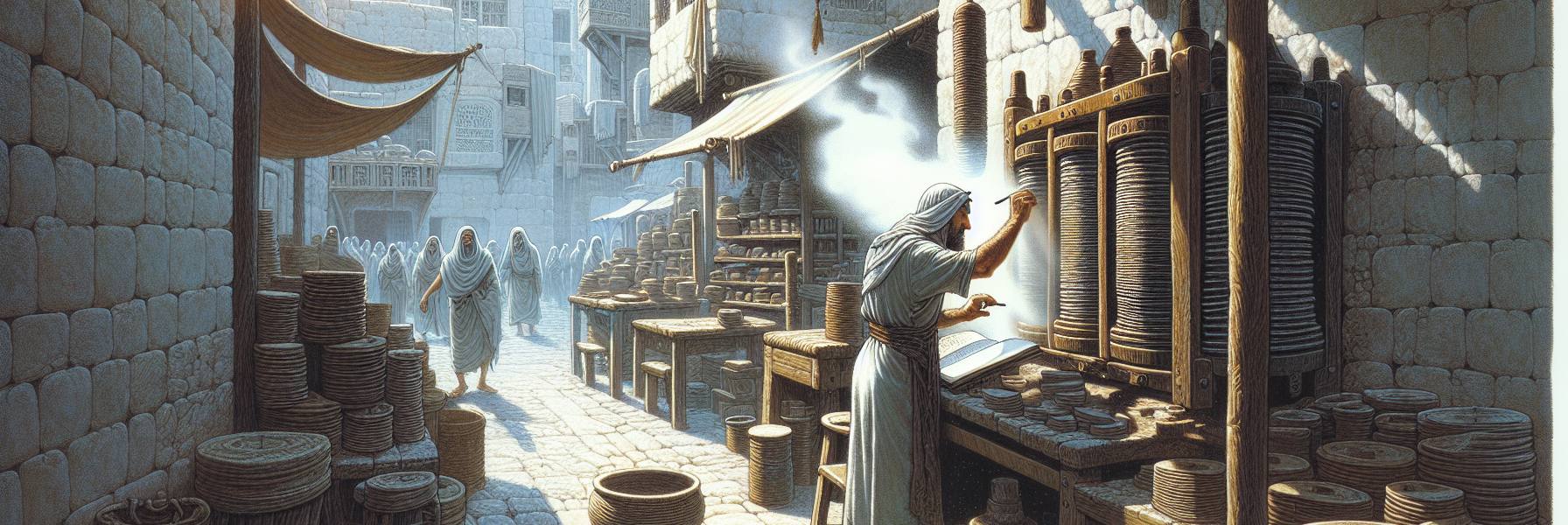

The heat in the lower city clung like a damp robe. Ezra the scribe felt it in the crease of his neck, in the tight space between his scrolls where the air grew still and heavy. From his small workspace, a cubby really, wedged between a potter’s stall and a wall bleached white by the sun, he could hear the commerce and chaos of Jerusalem. But the noise that preoccupied him was not the braying of donkeys or the haggling of merchants. It was the memory of words, sharp and sibilant, whispered just loud enough to be caught as he passed the olive press that morning.
*“He thinks his marks on parchment will protect him.”*
*“A man of letters, but who reads him?”*
*“The ledger is being balanced, Ezra. A different kind of ledger.”*
They were men of the gate, men with rings on their fingers and cold calculation in their eyes. He had crossed them, or rather, his fidelity had. A land dispute, a widow’s plea, a record of lineage that favored truth over convenience. A small thing, to him. A monumental provocation, to them.
The psalm he was copying today, the sixty-fourth, seemed to bleed into the parchment of its own accord. His quill hovered over the line: *“Hide me from the secret plots of the wicked, from the noisy crowd of evildoers.”* It was no longer ancient King David’s prayer. It was his own breath, caught in his throat. He could see them, in his mind’s eye, not as a generic mob, but as specific faces: Javan, with his too-calm smile, and Shemer, whose eyes never seemed to blink. They *whetted their tongues like swords*, indeed. Their words were not outbursts of rage, but precise, legalistic arrows. They *aimed bitter words like arrows, shooting from ambush at the blameless.* He was not blameless, no man was, but in this matter, his conscience was clear, and that, it seemed, was his greatest offense.
For days, a subtle pressure had been building. A supplier of parchment “suddenly” found his prices doubled. A client withdrew a commission, offering vague regrets. Rumors, soft as moth wings, brushed against his reputation: *Was he accurate? Was he… impartial?* It was a siege conducted in shadows and polite conversation. They took counsel together, secretively. They laid snares, saying, “Who will see them?” They searched out injustices, a twisted perversion of justice itself.
Ezra set down his quill, the ache in his heart a physical weight. The fear was not of a knife in a dark alley—that would be almost simpler. It was the erosion, the slow, public undoing, the death by a thousand paper cuts of reputation and livelihood. He prayed, but the words were dry chips in his mouth. He felt the target painted on his back, invisible to all but him and his accusers.
Then, on the third day, the feast of the new moon, something shifted.
He was at the Water Gate, listening to the reading of the Law, seeking solace in the rhythm of the words. He saw Javan and Shemer across the square, heads bent together, speaking intently to a magistrate, a man known for his love of silver. Ezra’s spirit sank. This was it. The public accusation, the manufactured charge, the end.
But as the magistrate listened, his face, usually so placid and greedy, began to change. A frown etched itself between his brows. He held up a hand, cutting Shemer off mid-sentence. He took a step back, looking from one man to the other with an expression of dawning, cold disgust. Ezra could not hear the words, but he saw the effect. Javan’s confident smile froze, then melted into confusion. Shemer took a step forward, gesturing, but the magistrate turned his shoulder sharply, a definitive, public dismissal.
Later, Ezra learned the fragments of the story. In their zeal to craft a perfect case against him, the two men had contradicted each other on a minor point of property law. A small thing. But the magistrate, perhaps fearing a trap for himself, or perhaps struck by a sudden, unbidden clarity, saw the inconsistency. He saw the *cunning* of it. And in that moment, as the Psalmist had sung, *God shot his arrow at them; they were wounded suddenly.* Their own tongues had turned against them. The secret plot was secret no more; it was laid bare in a sunlit square by their own sloppy malice.
The backlash was swift and humiliating. Others, who had been swayed by their whispers, now saw the mechanics of the scheme. *All mankind shall fear; they shall tell what God has brought about.* Not with thunder from heaven, but with a divine nudge of a mortal mind, a slip of a forked tongue. Their own counsel became their downfall. *They were made to stumble, their own tongues turned against them.* The same men who had whispered now found people whispering about them, pointing, their once-formidable influence crumbling to dust. *All who see them shall wag their heads.*
Walking home that evening, the same lower city felt different. The heat was still there, but it was just weather now, not an oppressive force. The sounds were just life, not a cacophony hiding threats. The relief that washed over Ezra was not the giddy joy of victory, but a deep, profound stillness. The righteous man had taken refuge in Him, and in His time, in His strange and subtle way, He had been just that: a refuge. A fortress not of stone, but of truth.
Back at his cubby, Ezra unrolled a fresh scrap of parchment. Not for a client. For himself. He took up his quill, not to copy, but to inscribe his own testimony beside the ancient one. He wrote of fear, of whispered arrows, and of the sudden, stunning silence that follows when God, in His wisdom, makes the deviousness of men echo in the empty chamber of their own failure. And he ended with the line that now tasted sweet as spring water on his tongue: *“Let the righteous rejoice in the Lord, and take refuge in him.”* The ink settled, dark and final. A human record of a very human deliverance.