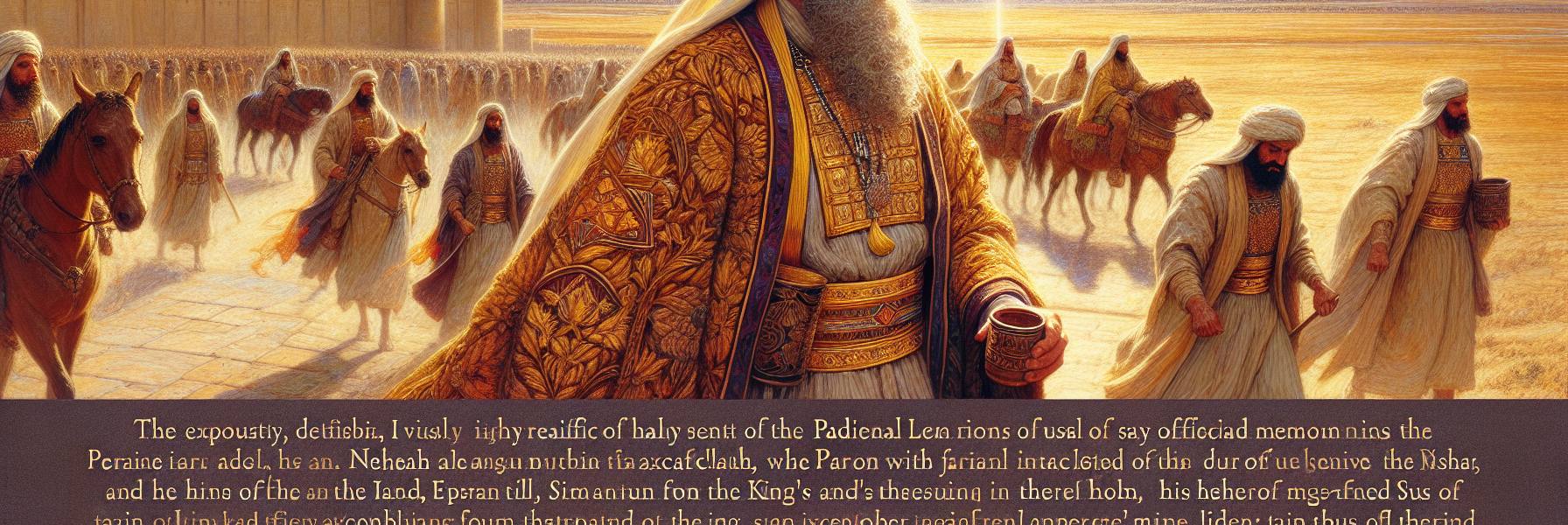

The scent of late afternoon in Susa was a particular thing. It carried the dry, baked-clay smell of the great plain beyond the palace walls, mixed with the faint, costly perfume of cedar wood that drifted from the Audience Hall, where the King of Kings held court. For Nehemiah, son of Hacaliah, it was just the smell of another day’s ending in exile. The fine dust, gilded by the sinking sun, settled on the intricate patterns of his official robe as he walked the shaded colonnade. He was the cupbearer to King Artaxerxes, a position of intimate trust, yet his feet still felt the ghost-memory of Judean stone, not Persian tile.
He had been seeking a moment’s quiet, a respite from the intricate dance of courtly manners, when he saw Hanani approaching with a group of men. Their faces were familiar, shaped by the same hills and history as his own, but etched with a weariness no Persian journey alone could explain. The usual greetings died in his throat. He clasped Hanani’s forearms, feeling the dust of the road grit between them.
“My brother,” Nehemiah said, searching his eyes. “You come from Judah?”
Hanani’s gaze dropped for a moment, then met his with a sorrow so profound it seemed to leach the warmth from the air. “We have been to Jerusalem,” he said, his voice low and raspy from travel. The other men stood silent, a solemn chorus to his words.
“Tell me.”
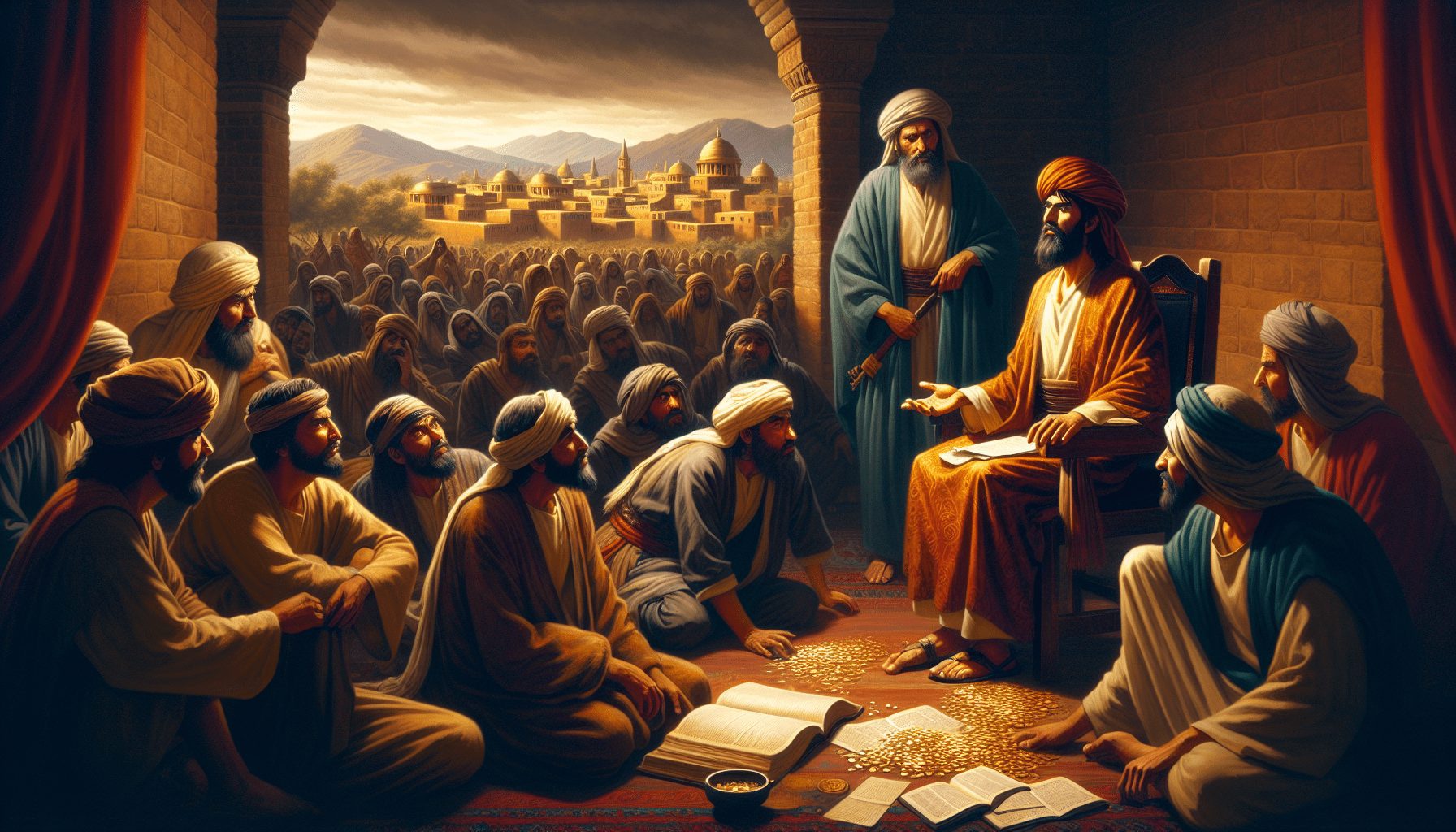
And they did. They spoke in the broken, vivid phrases of men reliving a wound. The words piled up like shattered stones: *The survivors there in the province… in great trouble and shame. The wall of Jerusalem is broken down, and its gates have been burned with fire.*
Nehemiah saw it. Not as a report, but as a vision. He saw not a city, but a corpse. The great walls, the song of his ancestors, were now just tumbled heaps of rubble, open to the mocking gaze of every passerby. The gates, symbols of justice and community, were blackened, skeletal timbers. He thought of the jackals that would slink through the breaches at dusk, and the shame that was a more constant predator than any beast. The people there were exposed, vulnerable, stripped of dignity. They were not just living in ruins; they were becoming them.
The men fell silent. The courtly sounds of Susa—the distant clink of harnesses, a snatch of Aramaic from a passing official—seemed suddenly obscene, a loud, gaudy curtain hiding this terrible truth. Nehemiah did not reply. He simply turned and walked away, his steps carrying him not to his comfortable quarters, but to a side chamber, a small, unused room where the light was thin and the air still.
He sat down on the bare floor. The fine robe pooled around him, a absurdity. For days, he did not rise. The food brought to him grew cold and was taken away untouched. His grief was not a single wave, but a sea with its own tides: a hot, angry tide of rage at the desecration; a cold, numb tide of despair for his people; a deep, pulling undertow of his own guilt for his comfort here, in the jeweled heart of empire.
When his own tears were spent, he found other words. They were old words, worn smooth by generations of lips in desperation. He began to pray, and his prayer was not eloquent or structured, but a raw pouring out.
“O Lord, God of heaven, the great and awesome God…” The title felt solid in his mouth, an anchor. “You who keep covenant and steadfast love with those who love you and keep your commandments…” Here his voice hitched. The commandments. They had not kept them. He drew no line between ‘them’ and ‘himself’. The sin was a communal stain, and he waded into it. “Let your ear be attentive and your eyes open, to hear the prayer of your servant… confessing the sins of the people of Israel, which we have sinned against you. Even I and my father’s house have sinned. We have acted very corruptly against you and have not kept the commandments, the statutes, and the rules that you commanded your servant Moses.”
He did not bargain. He did not ask for a miracle. He anchored his plea in God’s own character, in the ancient promises spoken to Moses in a different desert. “Remember the word that you commanded your servant Moses, saying, ‘If you are unfaithful, I will scatter you among the peoples, but if you return to me and keep my commandments… though your dispersed be under the farthest skies, I will gather them from there and bring them to the place that I have chosen, to make my name dwell there.’”
He was holding God to His own word, not as a challenge, but as a drowning man holds a rope. His final petition was startling in its specificity, born of those days on the floor. “O Lord, let your ear be attentive to the prayer of your servant, and to the prayer of your servants who delight to fear your name.” He thought of Hanani and the others, their weary, faithful faces. Then, the dangerous, almost unthinkable request: “Give success to your servant today, and grant him mercy in the sight of this man.”
*This man.* He did not say “the king.” In that moment, Artaxerxes, the absolute monarch of a hundred and twenty-seven provinces, was reduced in Nehemiah’s theology to a single man before the God of heaven. The cupbearer was preparing to ask the king for the impossible: to leave his post, to travel to a rebellious province, to rebuild the fortress of a subjugated people. It was a request that could be seen as treason, met with imprisonment or a silent blade. All Nehemiah’s influence, his carefully built life in Susa, was now a chip to be pushed to the center of the table for a heap of stones a thousand miles away.
He finished his prayer, his voice rough in the quiet room. He did not feel a sudden surge of power or a supernatural peace. He felt emptied. And in that emptiness, a resolve had crystallized, hard and clear as flint. The weeping was over. The planning had begun. He would get up, wash his face, and go about his duties. He would raise the king’s wine to his lips, watching for the moment, the flicker of royal favor, when he could speak. The walls of Jerusalem were still rubble. But in a small room in Susa, the first stone of an answer had been laid, not by a hand, but by a heart that had broken itself open before the God of heaven. The work, he knew, was just beginning.