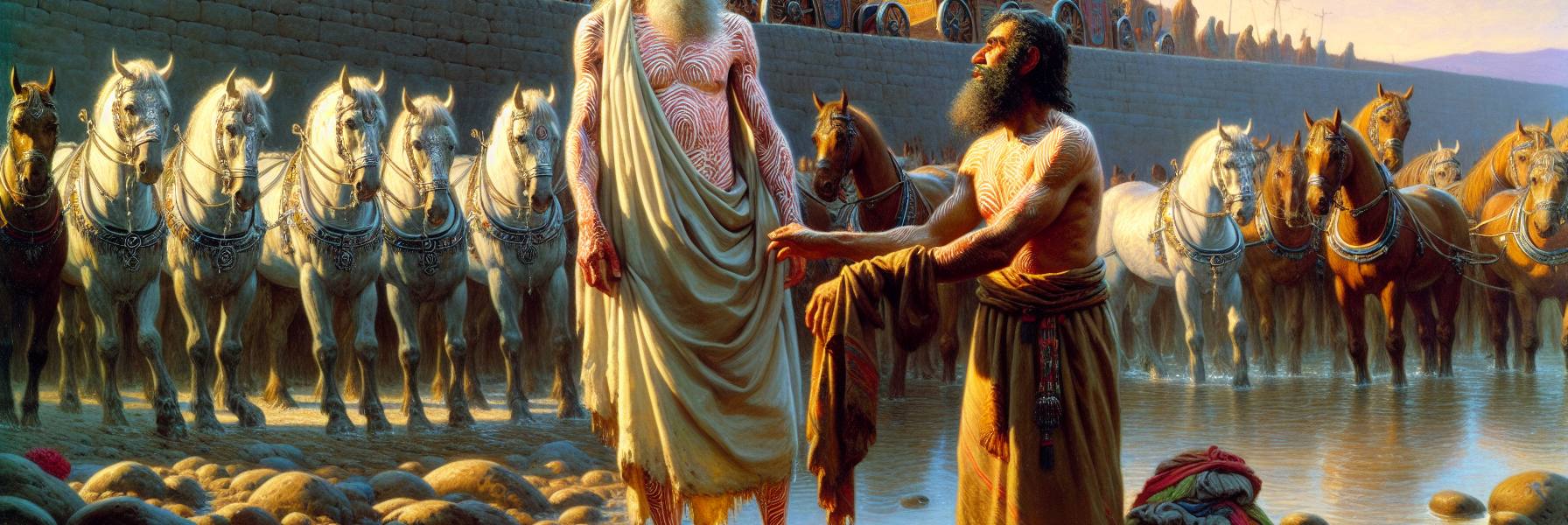

The river was little more than a muddy creek, and Naaman, commander of the armies of Aram, stood on its bank feeling like a fool.
He had come with horses and chariots, a cloud of dust announcing the arrival of a man of substance. The gifts—ten talents of silver, six thousand shekels of gold, ten sets of garments—were piled nearby, gleaming under the harsh sun. His skin, beneath the fine linen tunic, was a map of misery, the leprosy a pale, scaling continent that had slowly claimed his body. He had expected a spectacle. He had expected, at the very least, a prophet who would come out, wave his hand, call upon the name of his god, and cure the disease with some solemn drama.
Instead, a messenger—a mere servant—had delivered the insultingly simple instructions: “Go, wash in the Jordan seven times, and your flesh will be restored, and you shall be clean.”
Naaman’s face burned with a humiliation hotter than the fever that sometimes plagued him. He turned to his own servants, his voice a low growl. “Are not Abana and Pharpar, the rivers of Damascus, better than all the waters of Israel? Could I not wash in them and be clean?” He gestured at the sluggish, brown water before him, clogged with reeds. This was the cure? This puddle?
He was a man of action, of sieges and strategies. He knew how to break a city wall, how to deploy chariots in a narrow pass. This was nonsense. He pivoted, his cloak swirling, ready to order the caravan back north to Damascus. The entire journey was a farce.
It was his servants—the ones who traveled with him, who dressed him, who saw his skin flake onto his bedding—who dared to approach. One, an older man with a face weathered by decades of campaigns, spoke with the careful tone of one addressing a volcano. “My father,” he said, the term of deep respect softening the rebuke, “if the prophet had commanded you to do some great thing, would you not have done it? How much rather, then, when he says to you, ‘Wash, and be clean’?”
Naaman stopped. The truth of it was a cold blade cutting through his rage. He would have scaled a mountain. He would have fought a duel. He would have given half his wealth. The grandeur of the task would have matched the grandeur of his position. This was beneath him. That was the real wound.
He stood there, a statue of conflicted pride, watching a water-skimmer dart across the Jordan’s murky surface. The hope, which had carried him this far, was a tiny, stubborn ember. It was that, not his servants’ logic, that moved his feet. With a gesture of utter contempt, he waved his attendants back and walked down the bank alone, his boots sinking into the soft mud.
The first plunge was icy. The water smelled of earth and rot. He submerged himself, the current tugging at his clothes, and came up sputtering, his prized beard dripping filth. Nothing. His skin, where the leprosy marked it, felt no different. He looked at his hands. The patches were still there, pale and dead.
*Foolish,* he thought. *A fool’s errand.*
But he had begun. He would see it through. The second immersion, the third. Each time he rose, he scanned his arms, his wrists. Each time, the same. The fourth time, a strange detachment settled over him. The pride was washing away with the river mud. He was no longer the commander here. He was just a sick man, following a simple, ridiculous instruction.
The fifth time. The sixth. A kind of weary resignation. He had done all he could. He would return home, his disease intact, but perhaps with a quieter soul. He filled his lungs and went under a seventh time, holding himself down in the silent, brown world.
When he broke the surface, he wiped the water from his eyes and looked.
His flesh was like the flesh of a little child. Soft. Unmarked. Whole.
He stumbled to the bank and fell to his knees, not in prayer at first, but in sheer disbelief. He ran his hands over his arms, his face. He tore open the soaked tunic and looked at his chest, smooth and clean. The disease was simply… gone. It was not a gradual healing. It was a restoration. A new creation.
He dressed slowly, his mind racing. He returned to where his company waited, and they saw his face, saw the unspoken wonder there, before they even saw his skin. A cry went up, not a cheer of soldiers, but a gasp of awe.
Now Naaman returned to the prophet’s house, not with pride, but with a profound, trembling humility. This time, Elisha came out. Naaman stood before him, a different man. “Behold,” he said, his voice thick, “I know that there is no God in all the earth but in Israel.” He urged the prophet to accept the gifts, but Elisha refused, a firm, quiet denial that was more powerful than any acceptance.
Naaman’s theology, forged in that muddy water, was practical. “Your servant will henceforth offer neither burnt offering nor sacrifice to any god but the Lord,” he vowed. Yet a shadow crossed his face. His duty required him to accompany his king to the temple of Rimmon, and he would have to bow there. Would the Lord forgive this necessary political hypocrisy? Elisha’s reply was brief, almost dismissive: “Go in peace.” The grace was in the going, not in the perfect conditions.
The peace, however, was fractured by a covetous heart. Gehazi, Elisha’s servant, had watched the refusal of the treasures with a growing, acid resentment. *All that wealth, let go.* After Naaman’s party had left, Gehazi ran after them, weaving a lie about unexpected visitors for whom he needed a modest gift. Naaman, overflowing with gratitude, pressed upon him not one but two talents of silver, with two changes of garments.
Gehazi hid the loot and stood before Elisha, who asked where he had been. “Your servant went nowhere,” Gehazi said, the lie smooth on his tongue.
Elisha looked at him, and his eyes held the terrible clarity of the God he served. “Did not my heart go with you, when the man turned from his chariot to meet you?” The prophet’s voice was weary, etched with a deep sadness. “Is it a time to receive money and garments? Therefore, the leprosy of Naaman shall cling to you and to your descendants forever.”
Gehazi left his presence, his skin already turning white. The story ends there, with the echo of water and the creeping chill of a curse. The river’s gift, so freely given, met the covetous heart, and the disease found a new home. It was a stark footnote: the grace that heals is also the light that exposes, and the choices made in its wake have their own long, hard consequences.