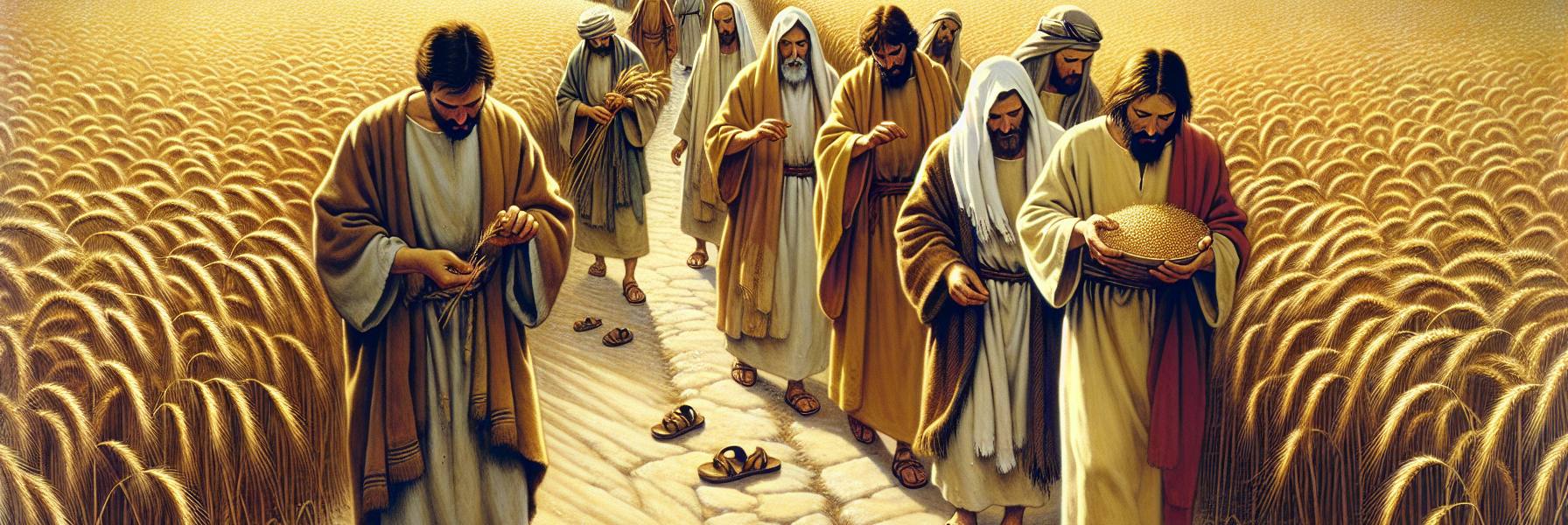

The dust of the path was fine as ground flour, coating sandals and ankles alike. It was a Sabbath, and the ache in Peter’s shoulders from a night of empty nets had been replaced by a duller, deeper hunger. Jesus walked ahead, not with the hurried pace of a rabbi late for teaching, but with an intent, observant stride. The disciples followed, a loose knot of men, through fields of grain that whispered in the faint morning breeze. The heads were full, golden, begging to be rubbed between the palms.
It was Andrew who did it first, almost without thinking. He reached out, snapped a few stalks, rubbed them, and blew the chaff away before popping the kernels into his mouth. A few others followed suit. It was permitted, everyone knew that—the Law allowed the hungry traveler to take from the edge of the field. But today, it was a provocation.
They came from the village, a small delegation of Pharisees, their robes too clean for the hour and the road. Peter saw them first, a dark clot on the path ahead. Their faces were set, not in anger, but in a kind of grim satisfaction, as if they’d finally caught a fish they’d been watching for weeks.
“Why,” their leader asked, his voice slicing the quiet, “are you doing what is not lawful on the Sabbath?”
The disciples froze, rough hands still clutching stalks. The accusation hung in the air, not about theft, but about timing. The act of rubbing grain between hands was, to them, work. Threshing. A violation.
Jesus didn’t turn to the disciples. He faced the Pharisees, and his eyes held a tiredness that seemed older than the hills around them. “Have you not read,” he said, his voice quiet but carrying, “what David did when he and his companions were hungry? He entered the house of God, took the consecrated bread, and ate it—bread lawful only for priests to eat. And he gave it to his companions.”
He paused, letting the old, disruptive story settle. A story not of meticulous rule-keeping, but of human need and a king’s audacity. “The Son of Man,” he said then, the title strange and weighted, “is Lord of the Sabbath.”
The words didn’t feel like a rebuttal. They felt like a rearrangement of the world. The Pharisees withdrew, their silence more violent than any argument.
The confrontation left a tension in the air that followed them into the synagogue at the next village. The room was cool, shadowy, thick with the smell of parchment and old wood. And there, in the center, was a man with a withered right hand. It hung at his side, pale and shrunken, a silent, living question.
Again, the watchful ones were there. The scribes and Pharisees. They weren’t speaking; they were waiting, studying Jesus like scholars examining a difficult text. Would he heal on the Sabbath? The law forbade work, and what was healing if not strenuous, deliberate work?
Jesus knew their thoughts. It was unnerving, how he did that. “Come and stand here,” he said to the man with the withered hand. The man came forward, his steps hesitant, his good hand clenched. All eyes were on that shriveled limb.
Then Jesus turned his gaze to the watchers. His question was for them. “I ask you,” he said, the words filling the still air, “which is lawful on the Sabbath: to do good or to do evil, to save life or to destroy it?”
He looked around at them all, one by one. Peter saw their faces: stony, resistant, but trapped by the terrible simplicity of the question. They offered no answer. Only a furious, brittle silence.
A deep sadness seemed to pass over Jesus’s face then, a sorrow mixed with a hardening resolve. “Stretch out your hand,” he said to the man.
The man trembled. He looked at his own useless hand, then at the ring of hostile faces, then back at Jesus. With a gasp of effort, he tried. And as he did, the flesh filled, the color returned, tendons flexed and strengthened. He stretched it out, whole, palm open before the entire assembly.
Instead of awe, a murderous rage filled the room. It was a cold, collective fury. The Pharisees stormed out, not in defeat, but in council, plotting with the partisans of Herod what they might do to him. The Sabbath peace was shattered.
Not long after, in the darkness before dawn, Jesus went up onto a mountain to pray. He spent the night there, alone with the wind and the stars. When morning finally bleached the sky, he called his disciples to him. From that worn, diverse group, he chose twelve, naming them apostles: Simon, whom he named Peter, and Andrew; James and John; Philip and Bartholomew; Matthew and Thomas; James son of Alphaeus, and Simon called the Zealot; Judas son of James, and Judas Iscariot.
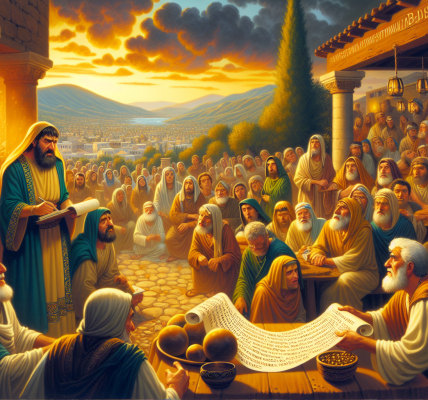
They came down from the mountain together, this newly formed core, and stood on a level place. A great crowd had gathered, a multitude from Judea, Jerusalem, and the coast of Tyre and Sidon. They came to hear, and to be healed. The air was thick with the murmur of sickness and hope. People pressed in, trying just to touch him, for power was coming from him, healing them all.
And then, looking at his disciples, with the sea of humanity spread out below, he began to speak. It wasn’t a sermon from a raised pulpit. He was among them, his voice steady and clear.
“Blessed are you who are poor,” he said, and the words landed strangely on ears accustomed to blessings for the rich and the righteous. “For yours is the kingdom of God. Blessed are you who hunger now, for you will be satisfied. Blessed are you who weep now, for you will laugh.”
It was an inversion. A proclamation of a kingdom that operated on a different axis. Peter listened, the fisherman, the man of bluster and impulse, feeling both recognized and utterly undone.
Then Jesus turned his gaze, and his tone deepened, not with anger, but with a dreadful clarity. “But woe to you who are rich, for you have already received your comfort. Woe to you who are well fed now, for you will go hungry. Woe to you who laugh now, for you will mourn and weep.”
It was a chilling balance. Not a curse, but a stark unveiling of consequence, the natural end of roads chosen.
He kept going, weaving a new reality. “Love your enemies,” he said. The crowd must have thought they misheard. “Do good to those who hate you, bless those who curse you, pray for those who mistreat you.” He spoke of turning the other cheek, of giving your tunic when your cloak is taken. “Do to others as you would have them do to you.”
This was not the wisdom of the world. This was the foolish, terrifying logic of a different creation. It asked for a heart stretched to breaking.
“Why do you call me, ‘Lord, Lord,’” he asked, his voice now sharp as a plowshare, “and not do what I say?” He told them of two builders. One dug deep, laying a foundation on rock. The other built hastily on the ground without one. The rain came, the torrents struck. The house on rock stood. The other fell, and its collapse was total.
The words finished. The crowd stood silent, the healings momentarily forgotten. He had offered them no political manifesto, no list of new rituals. He had given them a portrait of a heart fully alive to God, a heart that loves without limit, gives without calculation, and builds upon the unshakeable truth of his words. The path was clear. It was narrow, counterintuitive, and cost everything. And as they descended back into the world of Roman taxes and Pharisaic scrutiny, the echo of those blessings and woes clung to them, a new and disquieting melody for a world grown old and tired.