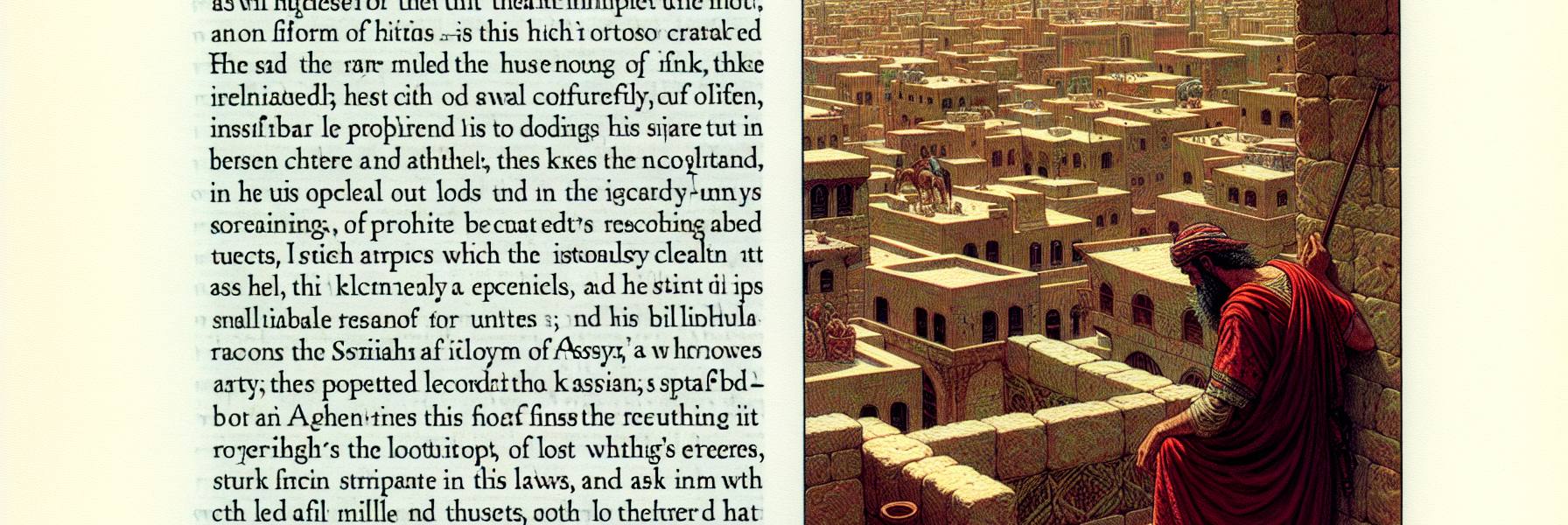

The heat in Jerusalem clung like a second skin, a dusty, oppressive blanket that even the evening breeze from the hills could not dislodge. Micah ben Jeroham felt it in the ache of his bones as he climbed the steps to his rooftop. The city below was quiet, too quiet, the silence of held breath. News from the north was a slow poison—whispers of cities falling, of an army like a locust swarm, devouring everything in its path. Assyria. The name itself tasted of ash.
He wasn’t a prophet, not like the fierce Isaiah who thundered in the courts. Micah was a scribe, a keeper of records, a man whose world was parchment and ink. But tonight, the words on the scrolls felt dead. The covenants, the laws, the histories—they seemed like beautiful, empty jars in a time of drought. He carried a small, worn scroll with him, one he had copied himself years ago. The words of Isaiah. He unrolled it, not to the judgments, but to a fragment, a brief song nestled like a green shoot in a field of warnings. Chapter twelve.
His eyes traced the characters in the fading light. *You will say in that day…* That day. Which day? The day of siege? The day of ending?
A child’s laugh, sudden and bright, pierced the gloom from a courtyard below. It was followed by a mother’s gentle chiding. The ordinary sound was a shock. It spoke of a future, of continuity, of life stubbornly persisting. Micah looked back at the scroll.
*“I will give thanks to you, O Lord, for though you were angry with me, your anger turned away, that you might comfort me.”*
The words struck him not as a future promise, but as a key to a present puzzle. Anger. Yes, he felt that. He felt the collective weight of foolish kings, of hollow rituals, of injustice cloaked in piety. God’s anger wasn’t a petulant fury; it was the terrible, necessary friction of holiness against corruption. But *turned away*. Not exhausted, not forgotten—deliberately turned. A choice. To what end? *That you might comfort me.* The comfort wasn’t a blanket of forgetfulness, but the deep, solid peace that comes after a storm has cleansed the air.
He read on, his inner voice finding a rhythm. *“Behold, God is my salvation; I will trust, and will not be afraid; for the Lord God is my strength and my song, and he has become my salvation.”* Salvation. *Yeshuah*. It wasn’t just rescue from an army. It was a condition of being. A state of safekeeping so profound it rewrote your song. Micah’s own life melody had been one of quiet anxiety, a minor key of duty and dread. This was different. This was the song you sing when the burden is gone, not because the road is easy, but because your shoulders have been made strong.
The sky deepened to violet. A single star pricked through. The third verse seemed to lift off the page. *“With joy you will draw water from the wells of salvation.”* He could almost hear the creak of the rope, the splash in the deep cool darkness, the heavy bucket emerging, dripping with light. A well wasn’t a fleeting puddle after rain. It was a source, deep and constant, tapped into the hidden aquifers of grace. This joy was not giddiness; it was the steady, replenishing act of drawing what you desperately need, and finding it endlessly there.
He stood, the scroll resting in his hands. The fear for the city, for his family, hadn’t magically vanished. The Assyrian host was still a reality. But another reality was superimposing itself, clearer and more solid. It was the reality of the well in the courtyard, of the child’s laugh, of the God whose anger was a prelude to comfort, not annihilation.
*“Give thanks to the Lord, call upon his name…”* The words were now a pulse in him. This wasn’t a song for after the deliverance. It was the song to sing *into* the deliverance. It was the declaration that shaped the outcome. He began to speak them aloud, softly at first, then with a gathering certainty that rose and blended with the evening sounds of Jerusalem. He wasn’t just reading Isaiah’s psalm. He was adding his own voice to it, a single thread in a tapestry of thanks that stretched backward to Moses and forward into a future he could not see.
*“Make known his deeds among the peoples…”* His work as a scribe suddenly had a new flavor. It wasn’t just preservation; it was proclamation. Every copied law, every recorded mercy, was a making-known.
*“Shout, and sing for joy, O inhabitant of Zion, for great in your midst is the Holy One of Israel.”*
The final line settled over him. The Holy One wasn’t distant, waiting in a temple or a heaven. He was *in the midst*. In the midst of the fear, the cooking fires, the whispered worries, the crumbling walls. His greatness was not displayed in making the struggle vanish, but in being its central, steadfast fact.
Micah rolled the small scroll gently. The dread had been transfigured. It was now a solemn watchfulness. The song was inside him, a well dug deep. He knew the days ahead would be terrible. He also knew, with a certainty that had nothing to do with military reports, that there was a story being written larger than the story of empires. And he, a simple scribe on a dusty rooftop, had just learned his part. It was to give thanks, to draw from the well, and to sing. Even if, for a time, the song had to be sung in the dark.