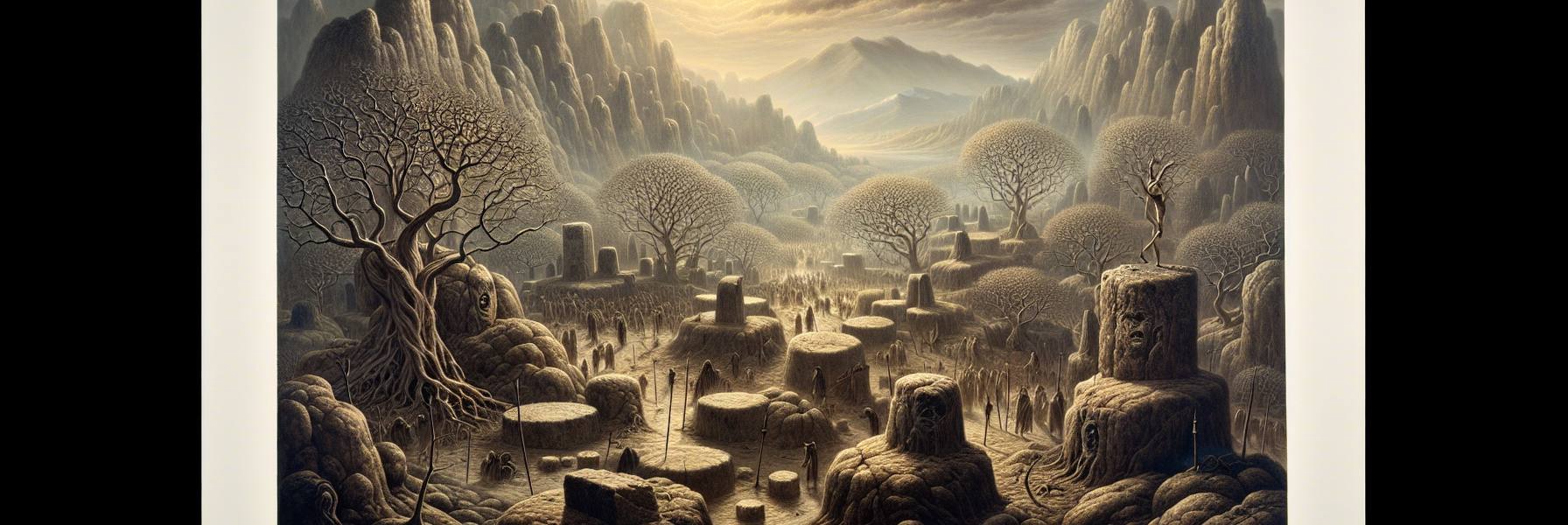

The dawn that broke over the mountains of Israel was a pale, sickly thing. It offered no warmth, only a thin, grey light that seemed to bleed into the valleys, revealing not beauty but a profound and ancient sickness. From my place on the rocky spine of the hill country, looking toward the east, I could see them—the high places.
They were not grand temples. They were quieter, more insidious things. Groves of twisted terebinth trees, cleared circles around crude altars of uncut stone, dark stains upon the rock that even the rains could not wash away. Here and there, the morning sun caught the gleam of a silvered Asherah pole, or the blank, accusing eye of a weather-worn idol, some local Baal with a chipped smile. The air, usually crisp with the scent of pine and earth, carried a faint, stale odor of old incense and neglect.
My name is Elior. I am a potter from what was once the village of Beth-Eloth, north of Jerusalem. I had come up to these hills not to worship, but to gather a particular red clay for my work. But that morning, the clay was forgotten. A heaviness had settled in my chest, a dread as tangible as the dew on the thorn bushes.
It began with a sound—not a thunderclap, but a deep, subterranean groan, as if the bones of the earth were shifting in a restless sleep. The birds fell silent all at once. Then, a tremor, gentle at first, a shudder that made the pebbles at my feet dance. I dropped to my knees, hands flat on the shuddering ground.
The voice that came then was not in my ears, but in the very substance of my being. It filled the air and the rock and the pit of my stomach. It was a sound of lament and of terrible, focused fire.
***”Son of man, set your face toward the mountains of Israel, and prophesy against them.”***
I could not see the speaker, but the mountains themselves seemed to lean in to listen. The words rolled through the valleys like boulders.
***”Thus says the Lord God to the mountains and the hills, to the ravines and the valleys: Behold, I, I myself will bring a sword upon you, and I will destroy your high places. Your altars shall be made desolate, and your incense altars shall be broken.”***
And as the words were spoken, so it began. It was not an army that appeared over the ridge—not at first. It was the landscape itself turning judge and executioner. From the highest peak, the one crowned with a particularly vile altar of Molech, a crack split the sky. A spear of blinding white fire, not lightning but something purer and more fierce, descended. It did not strike the idol. It struck the mountain just below it.
The peak did not explode. It *slid*. With a roar that swallowed all other sound, an entire face of the mountain sheared away, a slow, cascading river of rock and dust and uprooted trees. It poured down into the valley, and when the cloud of debris began to settle, the high place was gone. Simply gone. Where the altar had stood was raw, scorched earth.
All across the ranges, the judgment fell. A great wind, hotter than the desert sirocco, shrieked through the ravines. It found the Asherah poles and snapped them like dry reeds, their silver plating twisting into meaningless shreds. It scoured the carved idols, not smashing them dramatically, but erasing their features—eyes, mouths, the symbols of power—wearing them down to smooth, anonymous stones in moments.
But the silence that followed the wind was worse. It was the silence of aftermath. And the voice came again, lower now, heavy with a grief that was millennia deep.
***”And the slain shall fall in your midst, and you shall know that I am the Lord.”***
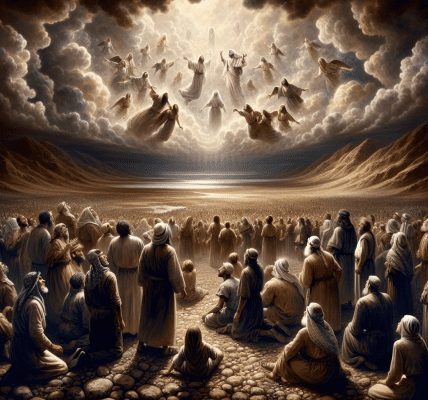
They came then, the people. From caves and hidden shrines and the few fortified holds in the hills, they stumbled out. Men and women who had offered their incense and their whispers here, who had sought fruitfulness from stones and comfort from dead wood. They saw their sanctuaries rendered into gravel. They wailed, tearing their clothes, but their cries were not of repentance. They were the shrieks of children whose toys have been shattered.
And they began to fall. Not by sword or spear, but by the very weight of the revelation. A man clutched his chest and crumpled before his former idol, now a lump of rubble. A woman swayed, her eyes rolling back, and fell softly among the shards of her household gods. They fell not from an external blow, but from an internal collapse—the horror of seeing the absolute nothingness they had worshiped, and in that nothingness, perceiving the awful, living reality of what they had rejected.
I lay prostrate, my face pressed into the dirt, weeping uncontrollably. The voice spoke a final word, not to the mountains, but through them, a whisper that echoed in the new, scarred silence.
***”Yet I will leave a remnant. A scattering, so that among the nations you will remember me, and how you were broken for your idolatrous hearts… and you shall know that I am the Lord.”***
The sun climbed higher, now a clear, indifferent gold. The mountains stood, wounded, transformed. The high places were voids. The air was clean, scrubbed of incense, carrying only the smell of crushed rock and a distant, lingering ozone.
I rose on unsteady legs. My clay jar was shattered. I would not be a potter today. I was a witness. I turned my back on the mountains and began the long walk down, a remnant of one, the words *You shall know that I am the Lord* beating in my skull with every step, not as a threat, but as the only terrible, solid truth left in a world that had just been stripped utterly bare.