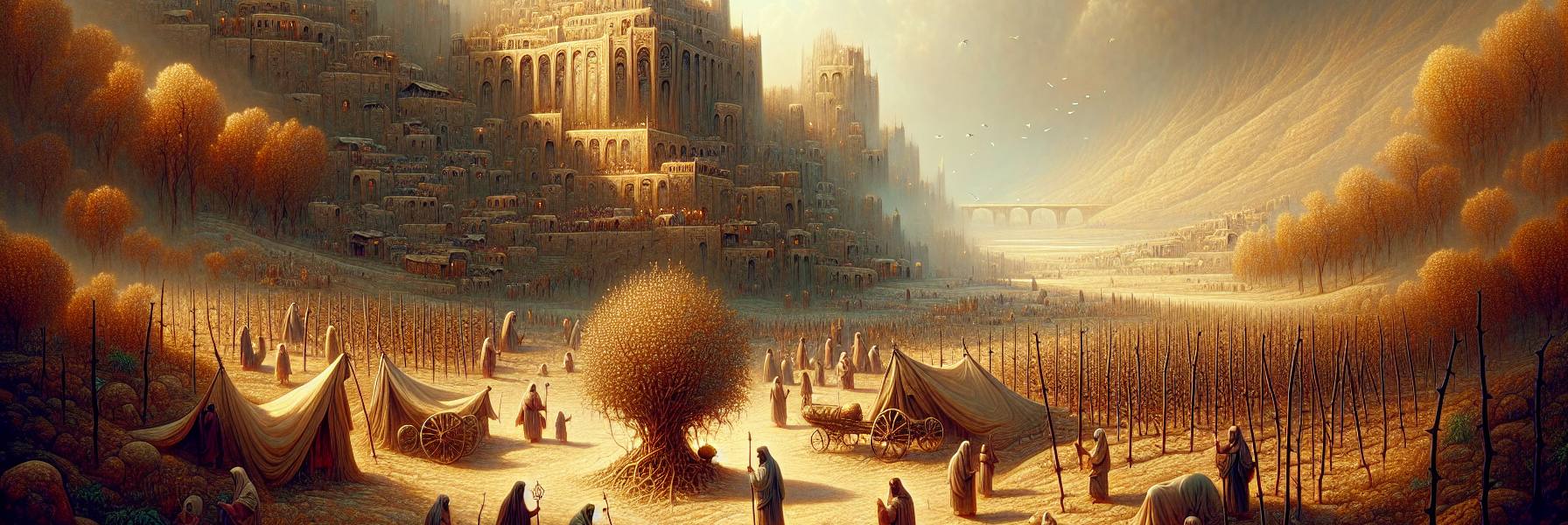

The heat that autumn was a physical presence. It lay over the land of Judah like a dusty blanket, heavy and suffocating, pressing down on the ruins of Jerusalem and the scattered settlements where the poor, the vinedressers, and the plowmen eked out a living under Babylonian oversight. At Mizpah, a sense of fragile order persisted, a thin green shoot in a cracked earth. This was due to one man: Gedaliah son of Ahikam.
People said you could find him not in a throne room, but near the old gate, listening. His face, worn by exile and responsibility, was patient. He believed the prophet Jeremiah: submit to Babylon, tend the vines, pray, and wait for the Lord’s mercy. To him, Mizpah was not a capital of a conquered province, but a sanctuary. A place to breathe again.
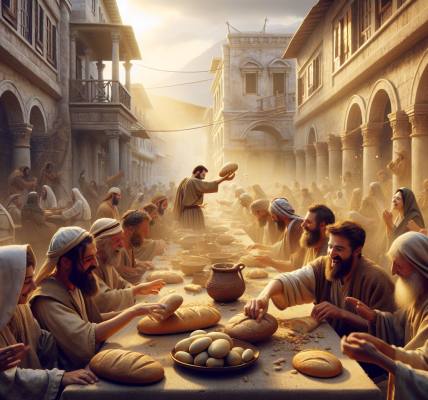
Into this strained peace came Ishmael, son of Nethaniah. He arrived with ten men, their robes travel-stained, their eyes missing nothing. They were of the royal blood, a fact that sat on Ishmael like an ill-fitting crown. He ate at Gedaliah’s table, dipping his bread into the same bowl, speaking words that tasted of loyalty. But his heart was a cellar where bitter wine fermented. To him, Gedaliah was not a protector, but a collaborator. A man who had made peace with the very empire that had shattered the temple, the city, the lineage of David. The fire of a dead king, Zedekiah, whose sons Ishmael had seen slaughtered, still smoked in his belly.
Gedaliah was warned. Johanan, a sturdy captain of the remnant forces, came to him privately, his voice low and urgent. “Do you not know,” he pleaded, “that Baalis, the king of the Ammonites, has sent Ishmael to take your life?” Gedaliah looked out over the courtyard where women were grinding grain. He saw not intrigue, but the hard-won rhythm of survival. “You are speaking falsely about Ishmael,” he said, the gentle finality of a man who chooses trust because the alternative is untenable.
The seventh month arrived, the month of Tishri. The heat had broken slightly, carrying the smell of dry thyme and anticipation. Pilgrims came—eighty men from Shechem, Shiloh, and Samaria. Their beards were shaved, their clothes torn, and grain offerings were in their hands, old ritual cuts on their bodies. They were mourning the destruction of the Temple, walking to its ruins in Jerusalem. Their faces were maps of a sorrow too deep for words.
Ishmael saw them coming up the road to Mizpah. He went out to meet them, weeping as he went, a perfect mirror of their grief. “Come,” he said, his voice thick with shared anguish, “come to Gedaliah.” They followed him, weary and trusting, into the town. Not to the house, but into the central courtyard, a wide, sun-baked space.
What happened next was not a battle; it was a slaughter. A sudden, violent rupture of the peace Gedaliah had nurtured. Ishmael and his ten men turned on Gedaliah as they sat at table, striking down the governor and the Judean and Chaldean soldiers with him. The sound was not of war, but of butchery—a brief, terrible cacophony that died into a ringing silence. Then, Ishmael turned to the pilgrims. He had them herded into the central cistern, a great, deep pit meant for water. It was dry now, a gaping mouth in the earth. He killed seventy of them there, their offerings scattering, their blood soaking into the dust at the bottom. Ten survived only by pleading, “We have hidden stores of wheat, barley, oil, and honey in the fields.” So he stayed his hand, not from mercy, but for logistics.
Mizpah was now a tomb. The stillness was absolute, broken only by flies. Ishmael took the rest of the people captive—the king’s daughters, the small populace Gedaliah had overseen—and began moving them east, toward the territory of Ammon, his patron. He moved with the haste of a thief, the deed done, the prize secured.
But the land has ears. News, carried on the breath of a shepherd boy or the frantic flight of a woman who hid among the terebinths, traveled faster than a man with captives. It reached Johanan and the captains of the forces. Their grief was instant and volcanic, then it hardened into a cold, determined rage. They gathered every man who could carry a sword and pursued.
They found them by the great pools at Gibeon, a place of ancient, still waters. The captives, seeing Johanan’s company, gave a ragged cry of hope. Ishmael’s ten men melted away into the rocky hills, but Ishmael himself, with a few loyalists, broke free and fled toward Ammon, leaving the people behind.
The people stood there, by the quiet pools—the women, the children, the survivors from Mizpah. They turned and looked back the way they had come, toward the shattered town. Then they looked at Johanan, their deliverer. But there was no triumph in his face, only a profound and weary fear. “Ishmael has murdered Gedaliah,” he said, “the man the king of Babylon appointed. And the Chaldeans will hear of it. They will come, and they will not ask who held the knife. They will see a revolt. And they will wipe this remnant of Judah from the earth.”
A wind picked up, stirring the surface of the pools, breaking the reflection of a terrified people. They were free from Ishmael’s sword, yet now stood on a precipice far more terrifying. The story ends not with a battle, but with a terrified huddle of refugees, staring into an uncertain, fearful future. The violence had passed, but its echo would summon a storm. They had survived the knife, but now faced the wrath of an empire, all because of the treachery of one bitter man, and the trust of one good one. The vine Gedaliah tended had been cut at the root. Now, only the wilderness remained.