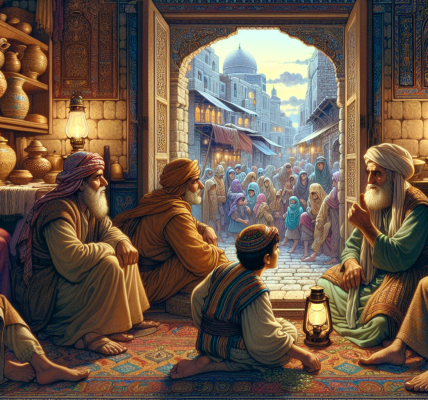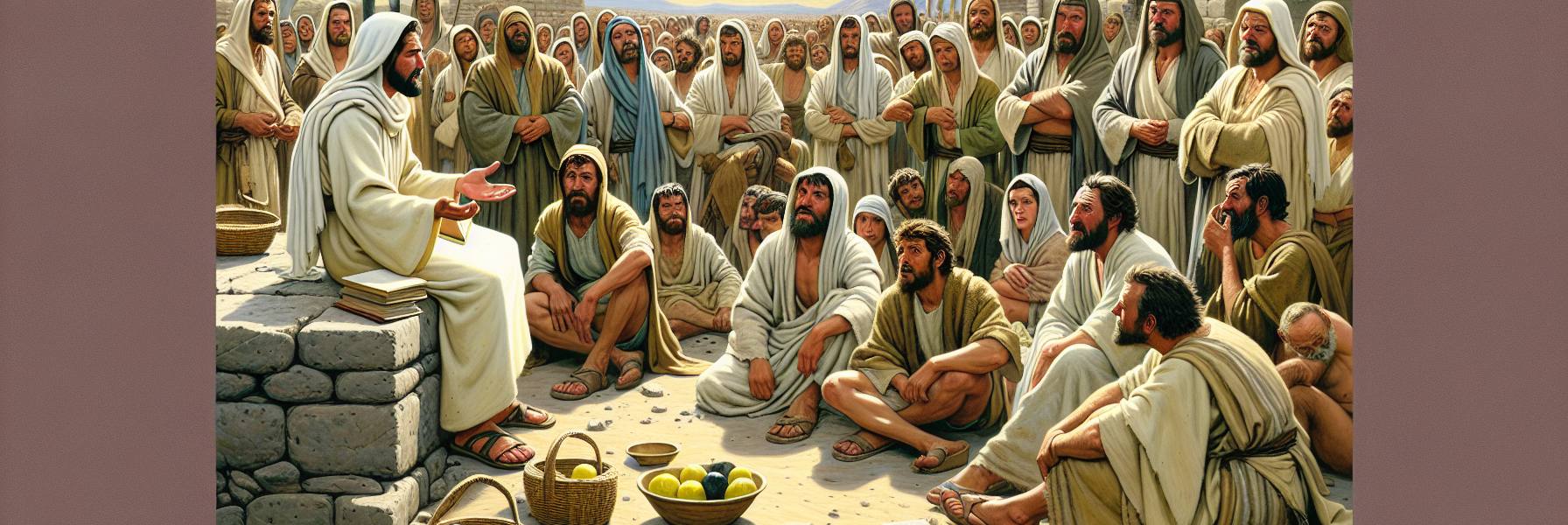

The sun was a white blister in the sky, pressing down on the dust of the road and the crowd gathered around the teacher. I was there, not because I was a follower, not yet anyway, but because my cousin Levi had dragged me along, muttering about the whispers from Jerusalem. The air smelled of hot earth and donkey, and the usual collection of hopeful faces, curious onlookers, and a knot of men in finer linen robes who did not look hopeful at all. Their faces were set, like stone.
The teacher, Jesus, was sitting on a low wall, looking more weary than triumphant. The men in fine robes—scribes and Pharisees, Levi told me—had just finished their latest complaint, their words sharp and precise. *This man welcomes sinners,* they’d said, *and even eats with them.* It was an accusation, not an observation.
Jesus didn’t argue. He just looked at them, then let his gaze sweep over the rest of us—the shepherds smelling of wool and dung, the women with hard eyes from the market, the tax collector leaning against a tree trying to look invisible. A faint smile touched his lips, but it was a sad one.
“Tell me,” he began, his voice cutting through the thick air without effort. “Suppose one of you has a hundred sheep, and you lose one of them.” He nodded toward a shepherd at the edge of the crowd, a man named Old Jakov with gnarled hands. “What does he do? Does he not leave the ninety-nine in the open country and go after the lost one until he finds it?”
Old Jakov grunted, a dry, practical sound. Of course you would. Anyone with sense would.
Jesus went on, painting the picture with simple words that felt like memories. The rough climb into the ravines where a foolish lamb might tumble. The fading light. The sound of a faint, terrified bleat from a thorn thicket. The relief, so physical it aches in the shoulders, of lifting the muddy, trembling creature onto your neck. “And when he finds it,” Jesus said, his voice lifting, “he calls his friends and neighbors together. ‘Rejoice with me!’ he says. ‘I have found my lost sheep!’”
He paused, letting the familiar joy of a small salvation settle over us. Then he looked straight at the stone-faced men. “I tell you, there will be more rejoicing in heaven over one sinner who repents than over ninety-nine righteous persons who do not need to repent.”
The words hung there. The “righteous persons” did not look rejoiced. They looked carved.
He didn’t stop. “Or what about a woman with ten silver coins?” Now he looked at Martha, the baker’s widow, who was known to count her coppers twice. “If she loses one, does she not light a lamp, sweep the entire house, and search carefully until she finds it?” We could almost hear the scrape of the broom in the dirt, see the frantic dance of lamplight in the dark corners, feel the gritty dust in the throat. “And when she finds it,” he said, and Martha, without thinking, nodded fiercely, “she calls her friends. ‘Rejoice with me! I have found my lost coin!’”
Again, that pivot, his eyes holding a terrible, beautiful gravity. “In the same way, I tell you, there is joy in the presence of the angels of God over one sinner who repents.”
But it was the third story that undid something in the air. He started differently, slower, like a man beginning a tale he’d carried for a long time.
“There was a man who had two sons.”
A common enough beginning. But his tone made it a covenant, a wound.
He spoke of the younger son, restless, seeing his life as a prison of waiting. The demand for the inheritance—a request like a slap, wishing his father dead. And the father, whose response was silence and compliance. He divided the property. We felt the weight of those bags of silver, the unspoken grief.
The boy’s journey was told without glamour. The distant country was not adventure; it was anonymity. The wild living was just a blur of noise that left him hollow. Then the famine. The descent was slow, then terrifyingly fast. A citizen of that country, a man of hollow eyes, sent him to feed pigs. Jesus described the pods the pigs ate with a detail that was both clinical and devastating—the hard, curved husks, the sour smell. “And no one gave him anything.”
That line fell like a stone. It was the core of his hell. Not the hunger, but the utter, absolute indifference of the world.
Then, the awakening. “He came to his senses.” Not in a flash of light, but in the stench of the pigsty, a slow, sick clarity. His father’s hired men had food to spare. The words of his speech—*I have sinned against heaven and against you. I am no longer worthy to be called your son; make me like one of your hired men*—they sounded rehearsed, a brittle script for survival. He turned and headed home, a man walking toward a hoped-for mercy so small it was just a corner of a field and a bowl of lentils.
But the father.
Jesus’s voice changed. The rhythm broke.
“But while he was still a long way off, his father saw him.”
He didn’t say the father was waiting. He said the father *saw him*, which meant he was looking, day after day, his eyes wearing a path in the road. And when he saw the speckslow, shuffling figure—a figure everyone else would have mistaken for a beggar—he knew. He knew the shape of that walk, even broken.
“And he was filled with compassion.”
The word wasn’t pity. It was a gut-deep, physical upheaval. The father didn’t stand with dignified welcome. He did something undignified, shocking. He hitched up his robes. He ran. An old man, running, his sandals kicking up dust, his chest heaving.
He reached his son, and before the boy could finish his broken speech, the father threw his arms around him and kissed him. The smell of the road and the pigs and despair must have been overwhelming. He just held him.
The son stammered out his prepared words, but the father wasn’t listening. He was shouting to his servants, his voice cracking with a wild, unseemly joy. “Quick! Bring the best robe! Put a ring on his finger! Sandals for his feet! Kill the fattened calf! Let’s have a feast and celebrate! For this son of mine was dead and is alive again; he was lost and is found!”
And so they began to celebrate. The music, Jesus said, must have carried.
Then he turned to the other son. The one who had stayed. The one in the field, who heard the sound of celebration as he came in from a hard day’s work. His questions to a servant were tight, controlled. The answer—*Your brother has come, and your father has killed the fattened calf*—hit him like a physical blow.
He refused to go in.
Again, the father left the feast. He went out to him. He pleaded.
The older son’s words exploded, years of bitter accounting tumbling out. “All these years I’ve been slaving for you! I never disobeyed your orders! Yet you never gave me even a young goat so I could celebrate with my friends! But when this son of yours who has devoured your property with prostitutes comes home, you kill the fattened calf for him!”
He didn’t say “my brother.” He said “this son of yours.”
The father’s reply was soft, aching. “My son, you are always with me. Everything I have is yours. But we had to celebrate and be glad.” He repeated it, the bedrock truth of the story. “Because this brother of yours was dead and is alive again; he was lost and is found.”
Jesus stopped. He didn’t look at the Pharisees. He didn’t look at the sinners. He just looked at the ground between his feet, as if the story itself lay there, complete and waiting.
The crowd was utterly silent. The feast in the story seemed to echo in the quiet. I saw the older brother, still outside, arms crossed, the music from the house washing over him, a man starving at a banquet of his own making. I saw the younger son, washed and robed, the ring heavy on his finger, wondering if it was all a dream. And I saw the father, standing in the space between the house and the field, torn in two by a love that refused to choose.
The sun was lower now. The scribes and Pharisees said nothing. Some had turned away, their robes swishing in the dust. Others stood, their expressions unreadable. But near me, a tax collector named Zacchaeus let out a breath he seemed to have held for years, and it sounded like the beginning of a prayer. And Old Jakov the shepherd just nodded slowly, as if he’d finally understood something about the nature of the flock, and the relentless, searching heart of the one who owns it.