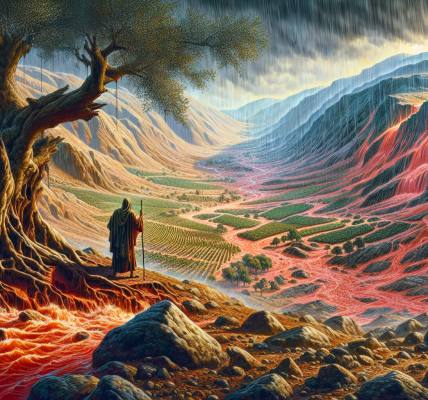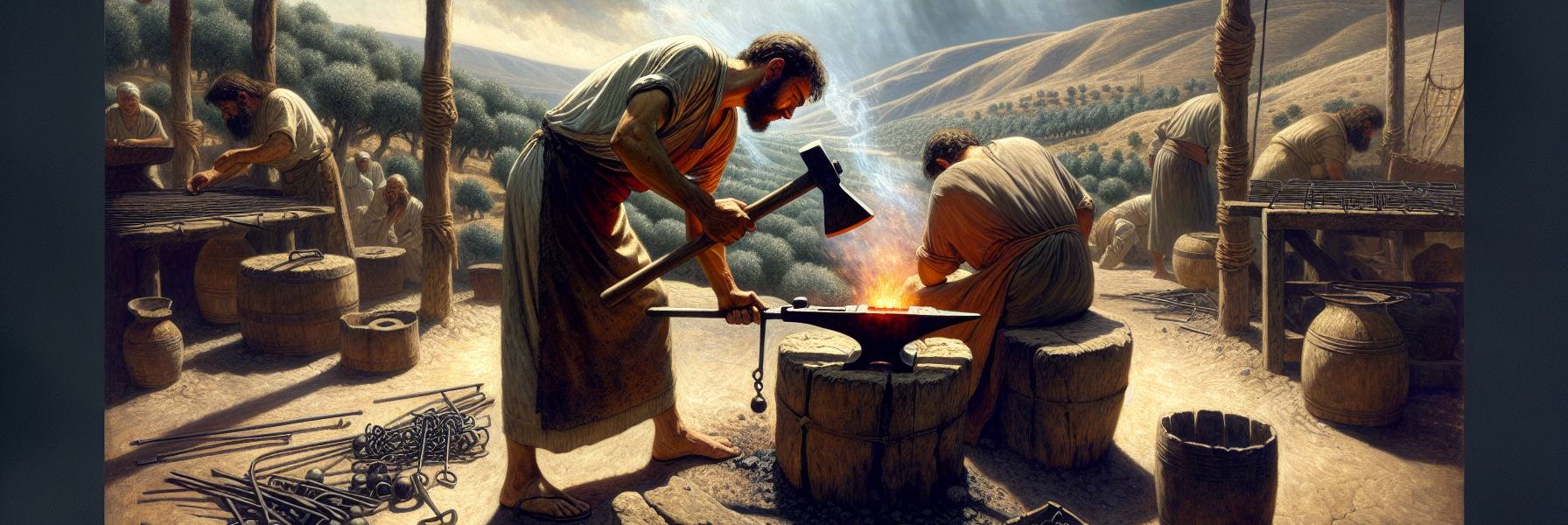

The heat was a living thing in the valley that day. It rose from the pale, cracked earth in shimmering waves, making the olive trees on the ridge seem to tremble like mirages. Micah, his tunic sticking to his back with sweat, worked the bellows of his father’s forge, the charcoal heart of the fire flaring with each gasp of air. The smell of hot metal and dust was a familiar cloak.
His mind, however, was on the shadow in the corner of the workshop—a simple wooden idol, a household god his father kept for “good fortune,” its face worn smooth by years of anxious rubbing. Micah hated it. A new feeling, this hatred; it had grown in him like a thorn since the words of the old prophet, Zechariah, had begun circulating in the village. Words about a fountain opened for sin and uncleanness. Words about cutting off the names of the idols from the land, so that even their parents would forget them.
“Boy! Pay mind!” His father’s voice was sharp over the clang of hammer on iron. “You’ll overheat it.”
Micah nodded, blinking away sweat. It was then he saw the stranger approaching up the road. Not a trader; he carried no pack. Not a soldier; he wore the simple, travel-stained wool of a shepherd, though he carried no staff. There was a weary certainty in his gait, a solitude that seemed to push the heavy air ahead of him. He paused at the forge’s open front, his eyes moving from the glowing plowshare to the shadowed idol, then to Micah’s face.
“Water?” the stranger asked, his voice gravelly with dust.
Micah fetched a ladle. The man drank deeply, water tracing lines through the grime on his neck. His hands were scarred, old wounds across the wrists that looked too precise for a shepherd’s accident.
“You are far from any flock,” Micah’s father said, not looking up from his work.
“The flock is scattered,” the man replied, his gaze lingering again on the idol. “A time is coming, smith, when men like you will be ashamed of the work of your hands. That thing you keep for luck… you will thrust it aside, call it a lie you were told in your youth.”
The father grunted, a sound of dismissal. But Micah felt a chill despite the forge’s heat. “Is it the Day of the Lord you speak of?” he ventured.
The stranger turned his deep-set eyes on him. “A day of refining. Not of spectacle, but of truth. A day when prophecy itself will be stripped bare.” He set the ladle down. “If a man dares to prophesy then, his own father and mother will say to him, ‘You shall not live, for you speak lies in the name of the Lord.’ And they themselves, the ones who gave him life, will pierce him through.”
The image was horrifying, intimate. Not an army from a foreign power, but a knife in the hand of a father, a mother’s tear-streaked face turned to stone. The stranger continued, his voice low. “The prophets will be terrified of their own visions. They will wear a rough cloak no more, but will say, ‘I am no prophet, I am a tiller of the soil; this callus is from the yoke, not from penning scrolls.’”
Micah’s father laughed, a short, harsh bark. “So the charlatans will finally be silenced. Good.”
But the stranger was looking at his own scarred hands. “And if one is asked, ‘What are these wounds between your hands?’ he will answer, ‘Those I received in the house of my friends.’”
Silence fell, broken only by the hiss of hot metal in the quenching trough. The words hung in the smoky air, a riddle of profound and terrible affection. *The house of my friends.*
Then, as if a spell had broken, the stranger nodded his thanks and moved on, continuing up the road toward the hills. Micah watched him go until he was a speck against the bleached sky.
The years turned. Micah’s father died, and in clearing the workshop, Micah took the old idol and, without ceremony, burned it in the very forge where it had been watched over. The feeling was not of triumph, but of a deep, clean excision, like lancing a wound. The prophet’s words were unfolding in a quiet, relentless way.
Then came the darker years—war, rumour, a Roman heel on the land’s neck. And one terrible spring, news came to Micah, now an old man himself, of a teacher from Nazareth. He’d been executed outside the city walls. The details were fragmented, whispered: a rigged trial, a cowardly governor, a crowd howling for blood. And his followers, scattered like sheep.
But later, other whispers began. Of an empty tomb. Of sightings. Of a wound that did not decay. And Micah, sitting in the cool of his rebuilt workshop, remembered the dusty shepherd with the scarred hands.
He understood then. The fountain wasn’t a metaphor for a ritual bath. It was the life that poured from those wounds, received in the house of friends who became, for a night, betrayers. The refining fire had come, not as an empire’s sword, but as a cross on a hill. The false prophets were indeed being silenced, not by law, but by the overwhelming, gut-wrenching reality of a sacrifice that made all other claims to truth seem like tinny echoes.
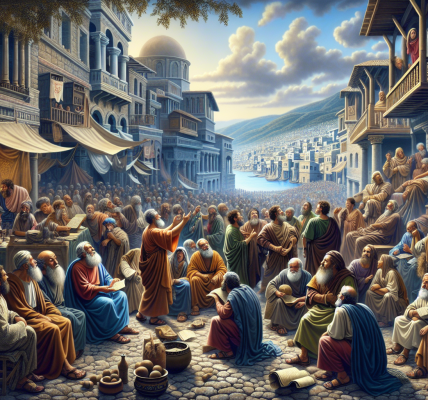
One evening, a traveling preacher came through the village, speaking of this crucified and risen shepherd. When he finished, a man in the crowd, known for his wild-eyed predictions, stood up as if to add his own revelation. But his words faltered. He looked at his own hands, clean and soft, and then around at the faces of his neighbours, his own family among them, their eyes now wary, discerning. He closed his mouth, shook his head, and mumbled, “I… I am a farmer. Forget I spoke.” He melted back into the crowd.
Micah saw it and knew. The chapter was not just a prediction. It was a description of a new world being born in agony and glory. The idols were gone, yes. But more importantly, the very currency of falsehood had been debased. Truth now had a name, and a face, and scars. And it was a truth so costly, so loving, that it made every cheaper imitation wither in the light. The refining had begun, and it began with a wound in the house of a friend.