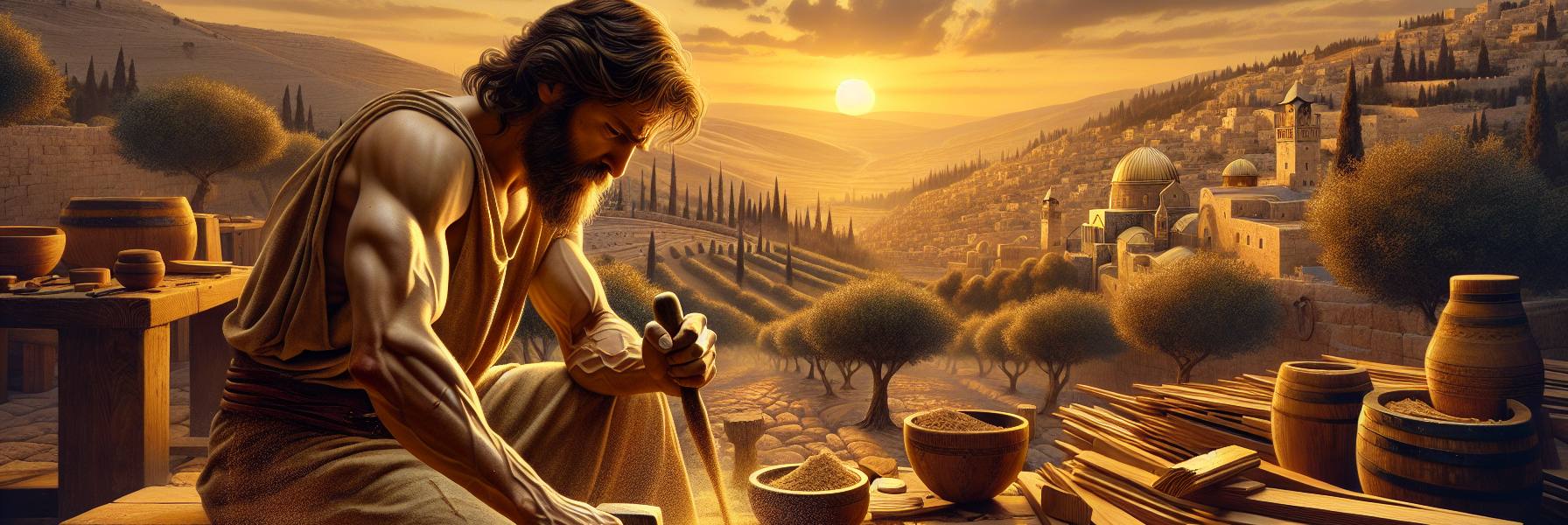

The dust of Jerusalem held the heat long after the sun had dipped behind the western hills. It was a fine, gold-tinged dust that settled on the sandals of the market-goers and powdered the leaves of the olive trees in the terraced gardens. In the lower city, in a quarter where the sounds of mallets and saws were as common as the cries of vendors, a man named Elazar wiped the sweat from his brow with the back of a forearm corded with muscle and scarred from a lifetime of honest mistakes.
His workshop was a cave of fragrance—cedar from Lebanon, acacia from the south, the pale, sweet-smelling olive wood from the groves near Bethany. The shavings at his feet curled like wood-smoke, and the air tasted of resin. At fifty, Elazar moved with the deliberate, economical grace of a man who knew the grain and heart of things. He was fitting a joint for a new olive press, his hands—broad, with nails perpetually edged in dirt—guiding the chisel with a touch both firm and tender.
He was a man who feared the Lord. It was not a fear of cringing terror, but the deep, orienting awe a man feels standing in the Temple court, or holding his firstborn child, or contemplating the vast, star-scattered bowl of the night sky over Judea. It was a fear that ordered his steps, that made him measure twice and cut once, not just with wood, but with his words. It was a reverence that sat in his quietness, in the way he would pause, mid-task, to listen to the distant call of the Levites from the Temple mount, his head tilted like a man recognizing a familiar melody.
His blessing was not in great wealth, though he was never in need. It was in the eating of the labor of his hands. Each evening, as the last of the copper light bled from the sky, he would wash the dust from his arms in a stone basin, the water turning a milky brown. He would enter his home, a sturdy house of stone he had helped his own father build, and the smell of baking bread would wrap around him like a welcome. His wife, Michal, would turn from the hearth, her face lined from smiling, from squinting into the sun in their small garden plot, from years of care. There was a steadiness in her eyes, a warmth that was the heart of the home.
“The bread is almost ready,” she would say, and her voice was the sound of contentment.
They would sit at the wooden table his grandfather had made. The bread was coarse, barley bread, but it was warm from the oven and tasted of the earth and the rain and the work of their own hands. The olives were from their own tree, the cheese from a cousin’s goat. As they ate, the simplicity of the meal felt like a feast. It was the profound satisfaction of a day spent in purposeful toil, of a hunger honestly earned and met. This was his happy state. This was his prosperity.
And his children. Like olive plants around his table. The phrase came to Elazar’s mind as he watched them in the flickering lamplight. His son, Obed, fourteen and all limbs and earnestness, talking excitedly about a new knot he’d learned to tie. His daughter, Tirzah, younger, with her mother’s thoughtful eyes, carefully placing a sprig of rosemary in a clay pot on the windowsill. They were not yet full-grown trees, these two. They were young shoots, tender but resilient, drawing life from the same good soil of their parents’ faithfulness. They grew in the protected, sunlit space of a home where the Lord was honored. He saw in them a future—a spreading of branches, a deepening of roots. They were his continuation, the living, breathing promise that his reverence would echo into another generation.
Later, when the children slept and the city sounds had softened to a murmur, Elazar would sit with Michal on the flat roof. From here they could see the dark, imposing silhouette of the Temple, lit by perpetual fire. The peace of those moments was thick and sweet. He would think of the years behind him—the struggles, the seasons of drought, the year the fever took his youngest and the grief had been a physical weight. Yet through it all, like a strong thread woven through a fabric, was the constant, sustaining presence of the Holy One. He had known goodness. He had known mercy.
He prayed then, not with elaborate words, but with the quiet exhale of a grateful heart. He prayed for his children, that they would know this fear, this awe, that they would taste the goodness of their own labor. He prayed for Jerusalem, for the peace of her stones and the safety of her people. “May you see the good of Jerusalem all the days of your life,” the psalmist wrote. For Elazar, this was not just a political hope. It was personal. Jerusalem’s peace was his peace; her security meant his grandchildren would play in these same streets, under this same wide sky.
And the final blessing, the one that stretched into the unseen future: “Yes, may you see your children’s children.” He could almost picture it. An old man, even older than he was now, sitting in this same spot, his hands gnarled and quiet on his lap. In the courtyard below, the laughter of little ones—Obed’s children, Tirzah’s children—a joyful noise like the sound of many waters. And upon this gathered, growing family, the profound and quiet shalom of God.
The night breeze carried the scent of jasmine from a nearby wall. Michal’s hand found his, rough palm against rough palm, a familiar and perfect fit. The fear of the Lord was the root, deep and unseen. And this—this contentment, this fruit of the vine and the olive, this circle of love and promise under the watchful stars of Zion—this was the blessed, flourishing tree.