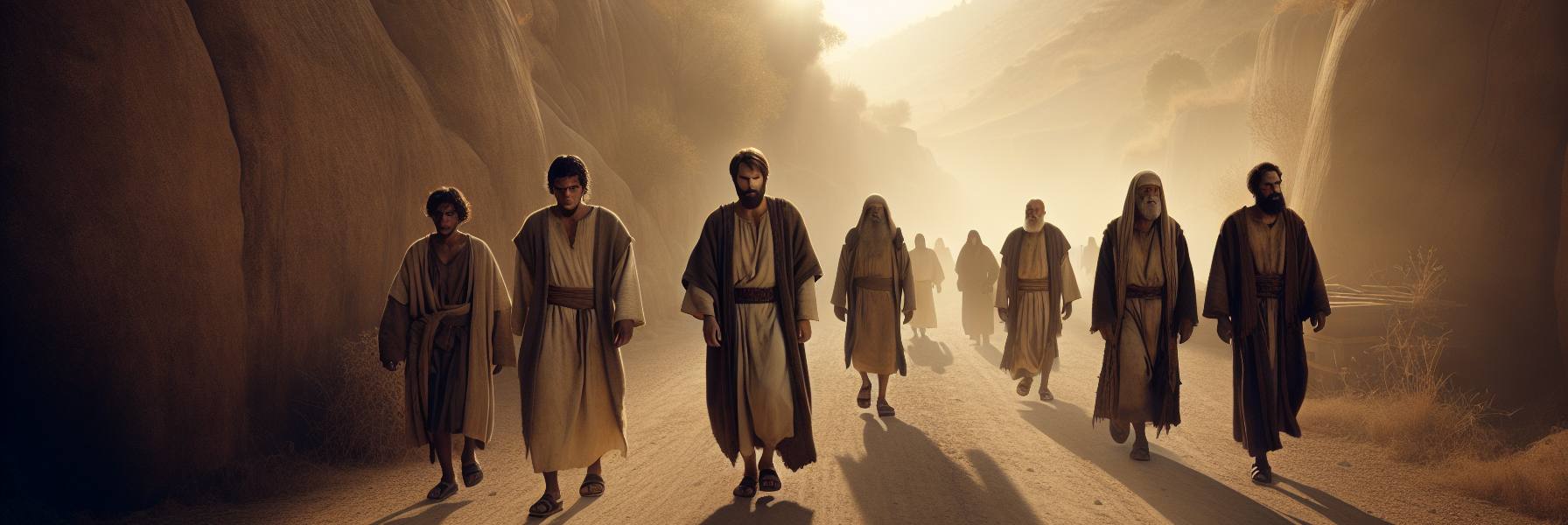

The dust of the road was a fine, golden haze in the late afternoon sun, settling on our sandals and the hem of our robes as we trudged back toward Capernaum. A weariness clung to us, deeper than the physical ache of miles walked. The conversation had started hours ago, born from a petty argument between Jacob and Simon over who had carried the water skin the longest stretch. It had festered, swelling into a silent competition that polluted the air around us.
We were walking behind him, as usual, but he seemed to sense the discord. He slowed his pace, letting us catch up, his shadow stretching long before us. The silence among us was heavy, thick with unspoken pride.
It was Thomas, ever the blunt one, who finally gave the tension voice. “Rabbi,” he said, the word rough. “Who then is greatest in the kingdom of heaven?”
The question hung there, ugly and revealing. We all felt the shame of it, but we also leaned in, ears straining. We’d seen the crowds, felt the surge of his authority. We were mapping a new government in our minds, jostling for positions in a cabinet of the coming age.
He didn’t answer immediately. He stopped walking altogether and turned, his eyes moving over our faces—hot, eager, foolish faces. Then he looked past us, toward the village gate where a cluster of women were gathered, children playing at their feet. He called to one of them, a woman named Miriam whom we knew from the synagogue. She hesitated, then gently urged a small boy forward, a child of four or five with serious eyes and a thumb near his mouth.
The boy came, sandals scuffing the dust. Jesus knelt, bringing himself to the child’s level. He placed a hand on the small shoulder, and the boy, emboldened, leaned into him. The sight was disarming. We were men discussing greatness, and here was a child, property in the eyes of the law, a being of no account.
“Truly I tell you,” he said, his voice clear and carrying, “unless you change and become like little children, you will never enter the kingdom of heaven.” He paused, letting the inversion sink in. Entry, not precedence, was the first and shocking concern. “Therefore,” he continued, drawing the child closer, “whoever takes the lowly position of this child is the greatest in the kingdom.”
He stood then, but kept his hand on the boy’s head. “And whoever welcomes one such child in my name welcomes me.” The statement was staggering in its simplicity. Our political calculations crumbled to dust. The economy of his kingdom ran on a currency of humility, of welcome extended to the insignificant.
The lesson, however, was only beginning. His tone grew grave, the warmth for the child hardening into a fierce, protective fire. “If anyone causes one of these little ones—those who believe in me—to stumble, it would be better for them to have a large millstone hung around their neck and to be drowned in the depths of the sea.”
A collective shudder went through us. The image was violent, final. The sea was Chaos, the abyss. Better to be given to primordial chaos than to stand guilty of this. He spoke then of the world’s stumbling blocks as inevitable, but woe to the one through whom they come. His language became drastic, surgical. “If your hand or your foot causes you to stumble,” he said, his gaze sharp as a flint blade, “cut it off and throw it away. It is better for you to enter life maimed or crippled than to have two hands or two feet and be thrown into eternal fire.”
This was no gentle metaphor. It was a demand for ruthless spiritual honesty. What cherished ambition, what prized grievance of mine was a foot guiding me toward a precipice? The afternoon sun felt suddenly cold.
Seeing our stricken faces, he shifted, but the weight remained. “See that you do not despise one of these little ones,” he said, returning to the child beside him. “For I tell you that their angels in heaven always see the face of my Father.”
The concept was beyond us—heaven’s court, the angels of the humble standing in the very presence of the Almighty, a continuous audience for those we overlooked. The child, bored now, wandered back to his mother, utterly unaware of the cosmic diplomacy conducted on his behalf.
Then he told us a story. It was a shepherd’s story, for many of us knew sheep. “What do you think?” he asked. “If a man owns a hundred sheep, and one of them wanders away, will he not leave the ninety-nine on the hills and go to look for the one that wandered off?” Of course he would. Any shepherd worth his staff would. The ninety-nine were safe, in the fold, accounted for. But the one… the one was in the brambles, hearing the howl of wolves in the gathering dark. The shepherd’s heart would be with the one.
“And if he finds it,” Jesus said, his eyes seeing that lonely, frightened creature in some distant ravine, “truly I tell you, he is happier about that one sheep than about the ninety-nine that did not wander off.” He let the arithmetic of heaven settle upon us. It was an economy of singular, relentless love. “In the same way,” he concluded, the words soft but indelible, “your Father in heaven is not willing that any of these little ones should perish.”
The walk resumed, the shadows longer now. Peter, always trying to synthesize, to codify, broke the silence. “Lord, how many times shall I forgive my brother or sister who sins against me? Up to seven times?”
We nodded. Seven was a holy number, a number of completeness. Surely that was lavish, divine even.
Jesus looked at Peter, and there was a sadness in his smile. “I tell you, not seven times, but seventy-seven times.” It was an algorithm of infinity. Forgiveness was not a ledger to be balanced, but a posture to be inhabited.
To make it plain, he told one last story as the walls of Capernaum rose before us in the twilight. It was a story of kings and debtors. A servant, he said, owed his king ten thousand talents. A sum beyond fantasy, equal to the treasury of a province. The debt was called, and the man, facing slavery for himself and his family, fell on his face. ‘Be patient,’ he begged, ‘and I will pay back everything.’ The king, moved with pity, did the unthinkable. He forgave the debt. He released him. The parchment of obligation was nullified.
That servant, walking away dizzy with grace, then found a fellow servant who owed him a hundred denarii—a modest sum, a few months’ wages. He seized him, throttled him. ‘Pay back what you owe me!’ he demanded. The man pleaded with the same words he himself had just used: ‘Be patient, and I will pay you back.’ But the first servant refused. He had him thrown into debtor’s prison.
The other servants saw it. They were greatly distressed, and they went and told their master everything.
The king’s summons was terrible. ‘You wicked servant,’ he said. ‘I canceled all that debt of yours because you begged me. Shouldn’t you have had mercy on your fellow servant just as I had on you?’ In his anger, the king handed the man over to the jailers to be tortured, until he should pay back all he owed.
Jesus finished the story just as we reached the house where we would eat. The smell of bread baking was in the air, a scent of comfort and home. But his final words chilled us to the bone, a solemn seal upon all he had said that day.
“This,” he said, pausing at the threshold, his voice low, “is how my heavenly Father will treat each of you unless you forgive your brother or sister from your heart.”
We filed inside, no longer arguing about greatness. The child’s face, the shepherd’s quest, the unimaginable debt forgiven and then cruelly reclaimed—these images swirled in the dim room. We took our places on the floor, passing the bread in silence. The lesson was not a set of rules. It was a mirror, and in it we saw ourselves: proud, calculating, clutching at grievances, while all around us, unseen, the angels of the little ones gazed upon the face of the Father. And from that fathomless depth of divine regard, a question echoed in the quiet of our own hearts: How could we do anything less?