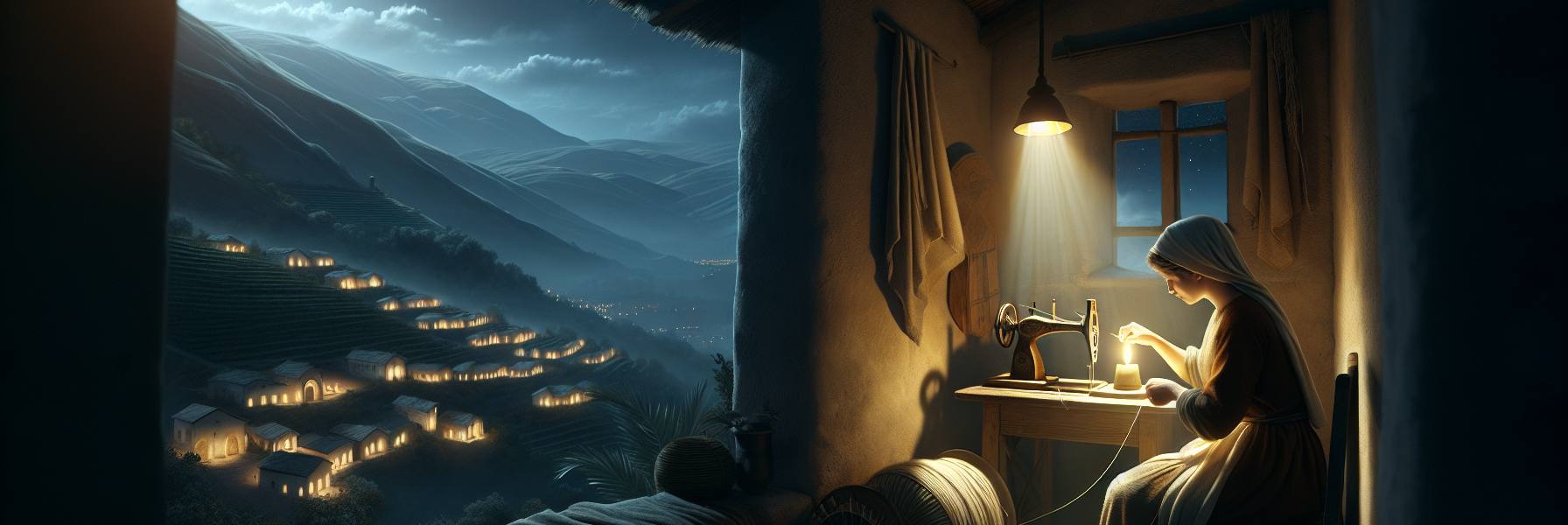

The lamplight was the last to die each night in her small house on the ridge. It would gutter and fight the darkness long after the village below had surrendered to sleep, a tiny, persistent star against the vast black of the hills. Inside, by that light, her hands were never still. The *shush-shush* of the spindle was the rhythm of the house, a sound more constant than her own breath.
Her name was Michal, though few used it anymore. To most, she was simply “the widow of Jether,” or, with a softer tone, “the mother of Lemuel.” Jether had been a good man, a keeper of vineyards on a distant estate, taken by a fever when Lemuel was still a boy with knees perpetually skinned from tumbling on the stone streets. What he left behind was not poverty, but a precariousness that required a different kind of strength. It required a woman to become a fortress.
The Proverb they would one day write about a woman of valour—*eshet chayil*—would not begin with poetry. It began in the cold, grey hour before dawn, when Michal rose from her pallet, her bones protesting the chill of the clay floor. She pulled her cloak tight and knelt by the hearth, blowing on last night’s embers until a timid flame caught the new kindling. The fire’s light revealed her face: not young, etched with lines of sun and concentration, but her eyes were the colour of polished cedar, watchful and warm.
Before the sun had gilded the highest olive trees, she had already walked to the small plot of land behind her house. It was not a field, but a stubborn scrap of earth she had coaxed into fertility. Here were her vineyards, a few precious rows of vines she tended herself, pruning with a careful, knowing hand. Beyond them, herbs grew in ordered clusters—mint, thyme, hyssop—their scents rising as her hem brushed their leaves. She inspected the wool-flax plants, their stalks straight and strong. This was her economy. This was her domain.
The morning market was her council chamber. She went down into the town not with the air of a beggar, but of a merchant. The woven belts and tunics she brought, dyed with madder root and walnut husk to deep reds and browns, were known for their tight weave and durability. She traded them not for scraps, but for value. Once, with a keen eye that had assessed the yield of the distant hills, she had bartered three fine cloaks for a young, strong ewe. Her neighbours had clucked their tongues. But Michal had seen the lamb it would bear, and the wool, and the milk. Now, a small flock nibbled contentedly in a penned corner of her ridge, their wool thick and clean.
Her strength was not just in transaction, but in transformation. In the afternoon light that streamed through the high window, she would sit at the loom. The warp was her certainty; the weft was her creativity. She worked not only with the wool of her own sheep, but with linen, fine and smooth, traded from a merchant who passed through twice a year. Her hands, capable and strong from grinding grain and digging earth, were astonishingly gentle with the thread. She made not just serviceable cloth, but beautiful things. The tapestries for their own bed were rich with colour. The sashes she wove for Lemuel had patterns of cunning complexity, signs of a household that cared for dignity.
And she did not hide within her walls. When the cold rains came and a family in the lower village found their roof shattered by a fallen branch, it was Michal who organized the women. She arrived with a skin of wine, a bag of meal, and a calm directive energy. Her own hands helped lift the new beams. She was not afraid of the snow, the proverb would say, for her household was clothed in scarlet—in double-layered wool, dyed and weather-proofed. But the deeper truth was that she was not afraid of *need*—in others or in herself—because she met it with prepared hands.
Her true masterpiece, however, was her son. Lemuel. She remembered the weight of him as a child in her arms, and the heavier weight of raising him alone. Her teaching was not a formal lecture. It was in the way she spoke to the grain merchant, firm but fair. It was in the shared silence as they watched a spider spin its web, a lesson in patience and craft. It was in the words she poured into him in the lamplight, words that were not her own, but those of a mother and a father, of a tradition she fiercely guarded.
“Do not give your strength to women, Lemuel,” she would say, her voice low and serious, “nor your ways to that which destroys kings. It is not for kings to drink wine, or for rulers to crave strong drink, lest they drink and forget what has been decreed, and pervert the rights of all the afflicted.” She spoke of kings and rulers because she wanted him to see himself as one, ruler of his own passions, sovereign of his own character. She taught him to speak up for those who could not speak, for the rights of all who are destitute. To judge righteously, and defend the poor and needy.
He watched her. He saw how she extended her hand to the needy, how her own lamp did not go out at night. He saw the dignity in her labour, and the love in her discipline. And it shaped him more than any sword-play or rhetoric ever could.
The years turned. One evening, Lemuel, now a man with a beard beginning to show threads of his father’s auburn, sat with her as she worked. The loom was quiet. She was mending a small tear in a well-worn tunic, her stitches so fine they were nearly invisible. He had been to the city, had seen the grand ladies with their cosmetics and idle chatter. He looked at his mother’s hands, scarred from the spindle, strong from the grindstone, gentle with the needle.
“Mother,” he said, his voice thick with an emotion he couldn’t name. “Many women have done excellently, but you surpass them all.”
Michal paused her stitching. She did not look up immediately, but a slight softening touched the line of her shoulders.
“Charm is deceitful,” she replied quietly, as if to the cloth in her hands. “And beauty is vain.” She finally met his gaze, and in her cedar-brown eyes he saw a lifetime of dawns and lamplights, of calculated risks and steadfast love. “But a woman who fears the Lord is to be praised. Give her of the fruit of her hands…” She let the sentence hang, unfinished, and returned to her mending.
He understood. The fruit was not just the wool, the linen, the full storehouse. The fruit was *him*. The man he had become. The legacy of integrity that would outlive her. The proverb he would one day recite, the words that would etch her essence into the memory of a people, began in that moment, in the quiet recognition between a son and a mother in the lasting lamplight.
And outside, the first birds began to stir, heralding another day she would meet, not with anxiety, but with the steady, capable hands of a woman who has built her world from the ground up, whose own works, in the very living of them, would praise her in the gates.