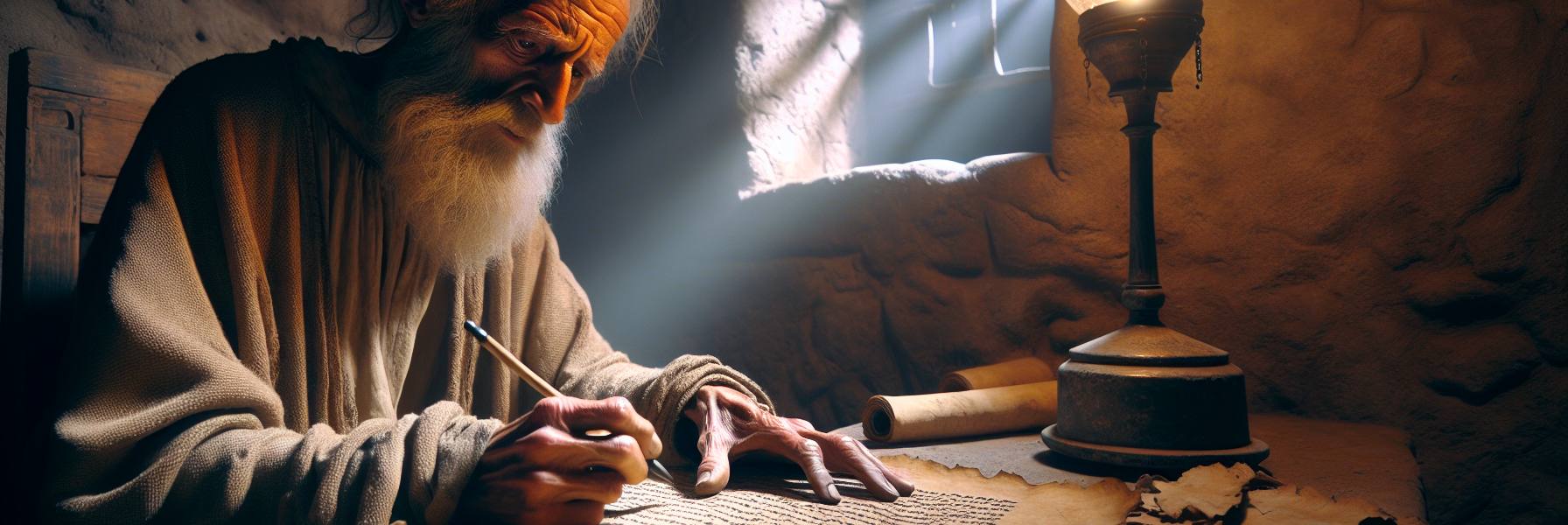

The lamplight was guttering again, pooling weak and yellow over the parchment. Silas dipped his stylus, the scratch of it against the wax tablet the only sound in the small, close room. From the street below came a distant swell of laughter, too loud, too sharp, edged with a kind of desperation he was coming to recognize. He paused, listening. It was the third watch of the night, a time for sleep, or for quiet prayer. Not for that.
He was an old man now, his bones ached with the damp that seeped up from the stones, and his eyes strained in the poor light. But the task kept him awake. The letter from Paul lay beside him, the papyrus worn soft at the creases from handling. He knew its contents almost by heart, but he read it again, the words settling into him with a cold, familiar weight.
*But understand this, that in the last days there will come times of difficulty…*
Times of difficulty. The phrase was too neat, too clean. Silas let his gaze drift from the page, out to the small window where a sliver of murky sky was visible. He thought of last market day. He’d gone to buy a little oil and had seen Lucius, a man who used to sit with eager attention in the back of the house assembly. Lucius was at the stall of a silversmith, not buying, but talking—his hands moving in elaborate, practiced arcs. A small crowd had gathered. He was speaking of a “new freedom in the Spirit,” a “grace that transcends the old, harsh laws.” He spoke of prosperity as a sign of divine favor, his own new ring flashing as he gestured. A woman beside Silas had whispered, her voice full of longing, “He makes it sound so… easy.”
Silas had turned away, a stone of grief in his throat. That was not difficulty; that was a slow, sweet poison. Paul’s list echoed in his memory: *lovers of self, lovers of money, proud, arrogant, abusive, disobedient to their parents, ungrateful, unholy, heartless, implacable, slanderous, without self-control, brutal, not loving good, treacherous, reckless, swollen with conceit, lovers of pleasure rather than lovers of God…* It was not a prophecy of far-off monsters. It was a portrait of the street outside, a mirror held up to the heart’s gradual decay. It was Lucius, his voice smooth as oil. It was the landlord who had raised the rent with a shrug of indifference. It was the fever of novelty that now infected even the fellowship, where stirring oratory was prized over sound teaching.
He remembered Paul, in another lifetime, in a Macedonian prison. They had sung hymns through the night, their backs raw from the rods, their spirits inexplicably light. That was a clear, clean difficulty. You knew the enemy then. He wore a uniform. Now, the enemy wore a brother’s face, spoke with a teacher’s voice, and offered a comfort that wore away truth like water on stone.
*Having the appearance of godliness, but denying its power.*
The lamp flickered violently, and Silas started. He reached to trim the wick, his fingers clumsy. Denying its power. That was the heart of it, wasn’t it? It was the reduction of the faith to a philosophy, a social club, a system of ethics stripped of the terrifying, life-altering reality of the risen Christ. It was a godliness of style, not of substance. It sought approval, not transformation. It wanted a crown without a cross.
A wave of loneliness, vast and cold, washed over him. He felt the last of his own generation slipping away. Paul was gone, martyred in Rome. Peter, too. Most of the others were scattered or silent. He was a relic, holding to old stories in a new world that had no time for them. The temptation to soften the edges, to make the message more palatable, whispered to him too. It would be easier. He might even draw a crowd like Lucius.
His hand went back to the worn letter. His eyes found the anchor, the turn in the text.
*You, however, have followed my teaching, my conduct, my aim in life, my faith, my patience, my love, my steadfastness…*
He wasn’t alone. Timothy was out there, in Ephesus, likely staring at his own guttering lamp, feeling the same pressure, the same isolation. Paul was speaking to him, through time and beyond the grave. He was connecting their suffering, making it a shared thread in the tapestry.
And then, the old, sure foundation:
*From childhood you have been acquainted with the sacred writings…*
Silas looked at the Hebrew scrolls carefully arranged on a shelf. He thought of his mother, her voice steady in the firelight, telling the stories of Abraham and Moses and David. Stories of failure and redemption, of a God who was holy and yet covenanted. That was the difference. It wasn’t a system. It was a story. It was a person. The sacred writings, Paul insisted, were able to make one wise for salvation. But they did so through faith in Christ Jesus. The story found its climax, its meaning, its very breath, in Him.
The final words of the chapter steadied his hand: *All Scripture is breathed out by God… that the man of God may be complete, equipped for every good work.*
The laughter from the street had died away. In its place was the deep silence of the hour before dawn. The difficulty was real. It was in the air they breathed, a spirit of the age. It would get worse. Paul promised that.
But the equipment was also real. Not in novel arguments, not in charismatic flourish, but in the ancient, breathed-out Word. It was the tool for repair in a broken time. The lamp steadied, burning a little clearer now. Silas took up his stylus again. He would write to the few who remained true. He would remind them of the stories. He would point, again and again, to Christ. The work was not glamorous. It would not draw a crowd. It was the patient, unspectacular work of a scribe in a dark room, trimming the wick, and handing on the light, one careful word at a time. The dawn, when it came, would find him at his task.