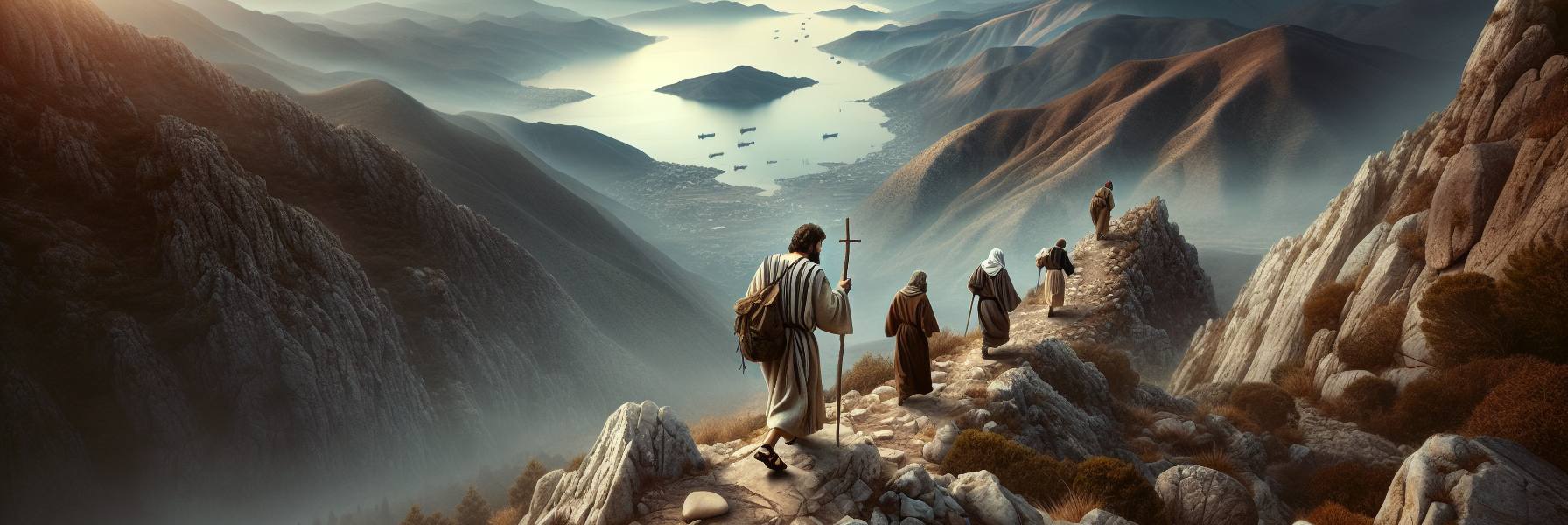

The memory of that morning began with the smell of dew on stone and the ache of a steep climb. Peter’s breath came in ragged clouds, his sandals scraping against the flinty path as he followed Jesus up the slope. James and John were behind him, their usual whispered arguments silenced by the incline. Jesus moved ahead, not with the hurry of a man fleeing something, but with the intent of a man going to a specific appointment. The higher they climbed, the thinner the air became, and the world below—the fishing boats on the Sea of Galilee like wood shavings, the villages smudges of grey smoke—seemed to recede into a different reality.
They stopped on a high shoulder of rock, the mountain’s silence profound, broken only by the sigh of the wind through scant, twisted pines. Jesus had asked them to come with him to pray, and so they settled themselves, the cool of the stone seeping through their robes. Peter, ever practical, felt the weariness in his limbs and the dryness in his throat. He watched Jesus. It was a thing he often did. There was a stillness to his teacher in prayer that was unlike anything Peter had known. It wasn’t the repetitive muttering of the Pharisees, nor the dramatic prostrations of the zealots. It was a profound and quiet communion, his face turned upward, absorbing the last of the sun’s weak warmth.
Peter must have dozed. The fatigue, the altitude—it pulled him under. He was jerked awake not by a sound, but by a change in the very quality of the light. It was no longer the flat grey of a Palestinian morning. It was a light that had source and substance, a liquid, clarifying brilliance that poured from the person of Jesus. Peter scrambled back, his hand finding James’s shoulder, his mouth agape.
Jesus was transfigured before them. That was the only word, though it felt too small. His face shone like the sun itself, not to burn, but to illuminate, to reveal. His clothes became a white so intense it hurt to look upon, a white no fuller on earth could bleach, a white that seemed woven from light itself. It was him, and yet it was more of him, as if a veil had been pulled back not from his form, but from his nature.
And then, as if the light had coalesced into substance, two figures were there with him. Peter didn’t need an introduction. He knew. One had the bearing of a lawgiver, face etched with the stern grace of Sinai, and the other the fierce, vulnerable fire of a prophet who had contested kings and seen the chariots of heaven. Moses and Elijah. They were speaking with him. Their conversation was not for the disciples’ ears, but Peter caught fragments, like pieces of a vast melody: “Exodus… Jerusalem… fulfillment.”
A terror, sweet and paralyzing, held the three disciples. This was no dream. The rock was hard beneath them, the wind still bit. Yet here was the Law and the Prophets, conversing with the living Word as old friends discuss a long-planned work. Peter, his heart pounding against his ribs, felt the human need to do something, to mark the moment, to be useful. The awe spilled out of him as practicality.
“Lord,” he heard himself say, his voice strange in the luminous air, “it is good for us to be here. If you wish, I will make three shelters here—one for you, one for Moses, and one for Elijah.”
Even as he said it, he knew it was foolish. What were booths of branches against this? But it was all he had to offer. He was still speaking, the words trailing into silence, when the bright cloud came. It was not a weather phenomenon. It moved with purpose, enveloping them, a cloud that did not obscure but intensified the light, a palpable presence of holiness. And from within it, a Voice spoke. It was a sound that bypassed the ear and vibrated in the marrow of the bone, a sound of absolute authority that was also, inexplicably, absolute love.
“This is my Son, whom I love; with him I am well pleased. Listen to him.”
The words were not new. Peter had heard them at the Jordan. But here, on the mountain, in the presence of the foundational pillars of their faith, they landed with cataclysmic weight. *Listen to him.* Not just to Moses now. Not just to the prophets. To *him*. The disciples fell face down on the ground, utterly overcome, the weight of the glory pressing them into the dust.
Then, a touch. A familiar hand on Peter’s shoulder. The light was gone, the cloud vanished, the towering figures of Moses and Elijah nowhere to be seen. The air was just air again, cold and thin.
“Get up,” Jesus said, his voice ordinary, wonderfully, mercifully ordinary. “Don’t be afraid.”
They lifted their heads. It was just Jesus. Just Jesus, in his everyday tunic, his face kind and etched with a concern for their terror. They rose on unsteady legs, the world swimming back into focus. As they began the descent, the sun now properly above the horizon, Jesus turned to them. The mountain’s secret was still thick upon them.
“Don’t tell anyone what you have seen,” he instructed, his tone leaving no room for debate, “until the Son of Man has been raised from the dead.”
The phrase hung in the air. Raised from the dead. It connected to nothing in their understanding. It was a splash of cold water after the vision of light. They walked in silence, each man wrestling with the collision of glory and mystery, until finally, unable to contain it, they whispered the question that had nagged since the Baptist’s death: “Why then do the teachers of the law say that Elijah must come first?”
Jesus nodded, as if he’d been waiting for the question. “To be sure, Elijah comes and will restore all things.” He walked a few more steps, his sandals crunching on the gravel. “But I tell you, Elijah has already come, and they did not recognize him, but have done to him everything they wished.” He looked at them, and in his eyes was a deep, sorrowful knowledge. “In the same way, the Son of Man is going to suffer at their hands.”
Then they understood. He was talking about John. The wild prophet of the Jordan, beheaded in a palace for a dance. *That* was the Elijah who was to come. And if the forerunner met such an end, what did it mean for the one who came after? The dazzling light on the mountain now cast a long, somber shadow ahead of them.
They reached the valley floor, the noise and smell of the crowd rushing to meet them—the shouting, the dust, the press of human need. A man broke from the throng, dragging a boy whose body was locked in a violent, thrashing fit, mouth foaming. The disciples who had stayed behind looked helpless, defeated. The father’s voice was raw with despair. “Lord, have mercy on my son… I brought him to your disciples, but they could not heal him.”
Jesus’s sigh seemed to carry the weariness of all the world. “You unbelieving and perverse generation,” he said, the words sharp with a holy frustration. “How long shall I stay with you? How long shall I put up with you? Bring the boy here.”
As the boy was brought, he convulsed terribly, falling to the ground, rolling in the dust. Jesus knelt, his knees in the dirt beside the thrashing form. He looked not at the demon, but at the father. “How long has he been like this?”
“From childhood,” the man wept. “It has often thrown him into fire or water to kill him. But if you can do anything, take pity on us and help us.”
“‘If you can’?” Jesus repeated, and his tone was not unkind, but it was a refracting lens, turning the man’s desperate plea back on itself. “Everything is possible for one who believes.”
The father’s cry was immediate, a gush from a broken heart: “I do believe; help me overcome my unbelief!”
It was the truest prayer Peter had ever heard. Jesus, without ceremony, rebuked the impure spirit. “You deaf and mute spirit,” he commanded, “I command you, come out of him and never enter him again.”
The scream that tore from the boy was not his own. Then he lay still, so still the crowd thought him dead. But Jesus took his hand, and with the same gentle firmness with which he had lifted Peter from the mountain dust, he lifted the boy to his feet. The child stood, whole, quiet, his eyes clear. He walked over to his father, who clutched him, sobbing into his hair.
Later, in the relative quiet of a house in Capernaum, the defeated disciples came to Jesus privately. “Why couldn’t we drive it out?”
Jesus looked at them, these men who had seen the Transfigured glory just hours before, yet who had faltered before a single, stubborn evil in the valley.
“Because you have so little faith,” he said, not as condemnation, but as diagnosis. “Truly I tell you, if you have faith as small as a mustard seed, you can say to this mountain, ‘Move from here to there,’ and it will move. Nothing will be impossible for you.” He paused, letting the staggering promise settle. “But this kind,” he added, glancing toward the door where the boy and his father had gone, “does not go out except by prayer and fasting.”
The day was not done. As they gathered themselves, Peter was approached by collectors of the two-drachma temple tax. His mind, still reeling from mountain-tops and demonic screams, fumbled for an answer. He went to Jesus, who was sitting near the doorway, watching the street.
“Jesus,” Peter said, “do you pay the temple tax?”
Jesus answered with a question that was really a lesson. “What do you think, Simon? From whom do the kings of the earth collect duty and taxes—from their own children or from others?”
“From others,” Peter replied, confused.
“Then the children are exempt,” Jesus said, a subtle, revolutionary claim hanging in the air. He was the Son of the King to whom the Temple pointed. He owed no tax. Yet he looked at Peter, his eyes softening. “But so that we may not cause offense, go to the lake and throw out your line. Take the first fish you catch; open its mouth and you will find a four-drachma coin. Take it and give it to them for my tax and yours.”
Peter, the fisherman, walked back to the familiar waters, the order echoing in his mind. A coin, in a fish’s mouth. It was a miracle of quiet, domestic precision, a world away from the shattering glory of the mountain, yet born of the same authority. As he cast his line into the deepening twilight, he understood, in a way he could not yet articulate, that the one who shone with the uncreated light was also the one who provided the coin for the tax, who healed the broken boy, and who would, incomprehensibly, walk toward the suffering he had foretold. The mountain and the valley were held together in the same hands.