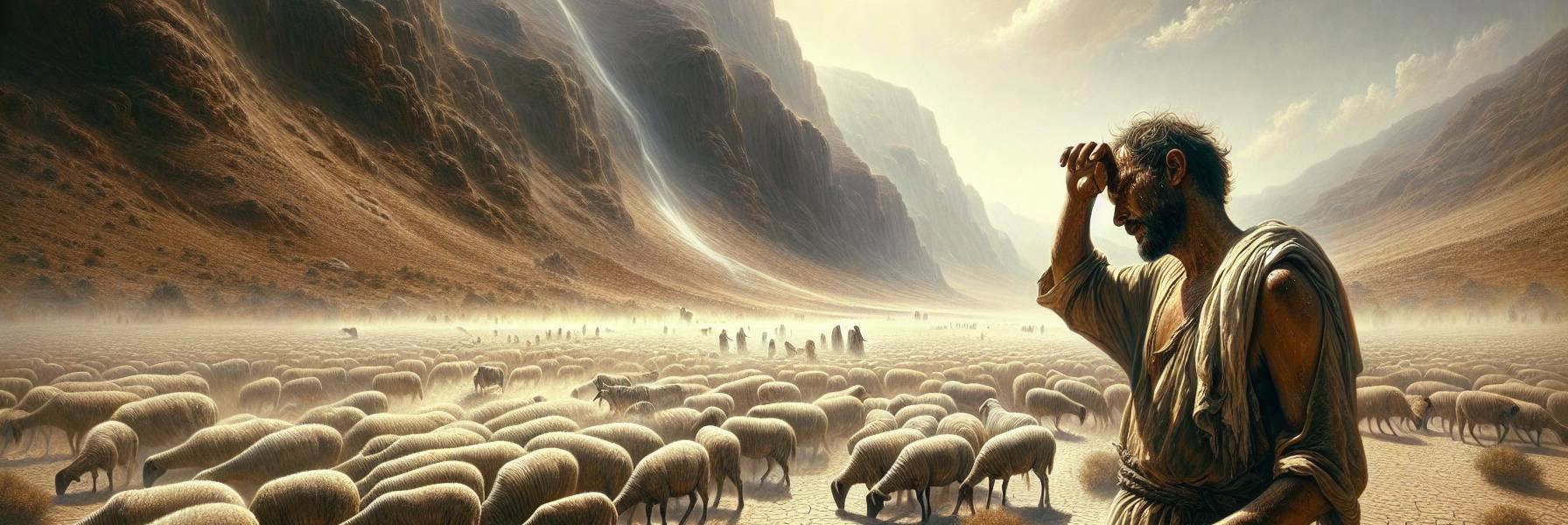

The heat in Tekoa was a dry, persistent thing. It didn’t press down so much as it seeped up from the pale, cracked earth, shimmering over the rocky hills where the sheep found scant purchase. Amos wiped the grit from his forehead with the back of a sun-leathered hand. The smell of dust and thyme, of sheep wool and his own sweat, was the smell of home. But a different scent rode the wind today, blowing in from the north—a scent of char, distant and faint.
He’d been south, among the flocks, when the words first began to form, not as sound but as a cold, solid weight behind his breastbone. They were not his words. He was a shepherd, a dresser of sycamore figs. His speech was of weather and predators, of market prices and the mending of walls. Yet the Voice had come, clear as the trumpet blast from the watchtower, turning his world on its axis.
Now, standing on the rise looking toward the road that led to Bethel and Samaria, the weight was unbearable. He had to speak. But how do you explain the inexplicable? How do you make a people drunk on prosperity hear a funeral dirge?
“Listen,” he whispered to the empty air, rehearsing the terrible logic he had been given. “Listen, you people of Israel, the whole family I brought up out of Egypt.”
The words felt clumsy on his tongue. They were not polished priestly phrases. They were the plain, hard questions of a man who understood cause and effect.
“Do two walk together unless they have agreed to meet?” he murmured. It was simple. You didn’t find a shepherd and a merchant sharing the road by accident. There was a purpose, a shared destination.
“Does a lion roar in the thicket when it has no prey?” The memory of that sound, heard once in the ravines near Carmel, shot a tremor through him. A lion’s roar was not for amusement; it was the sound of the hunt secured, of flesh about to be torn.
“Does a bird swoop down onto a snare from the ground when there is no bait set for it?” He’d seen it happen—the foolish partridge, enticed by the grain, tripping the noose. The trap didn’t spring without cause.
The analogies piled up in his mind, a relentless cascade: the snare springing, the trumpet blaring warning, the calamity in a city that did not come by chance. Each was a link in a chain of ironclad reasoning. And at the end of the chain was the roaring Lion.
“The Lord God has spoken,” the thought was a pressure behind his eyes. “Who can but prophesy?”
That was the heart of it. This was not a choice. It was like hearing the watchman’s horn from the city wall and not crying out. You were compelled. The Lion had roared. Who could claim they did not fear? The Lord had spoken. Who could stay silent?
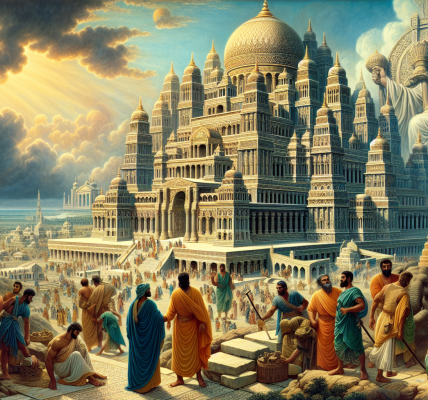
He began the journey north, his shepherd’s staff in hand. The verdant hills of Judah gave way to the richer, more cultivated lands of Israel. The difference was palpable. Where his home was austere, this was opulent. Vineyards sprawled where forests once stood. He passed great houses of dressed stone, their winter and summer houses adorned with ivory inlay, just as the rumors said. The air hummed with commerce, with the chatter of markets, with the sound of harps from open windows. It smelled of incense, fine oil, and roasted meat.
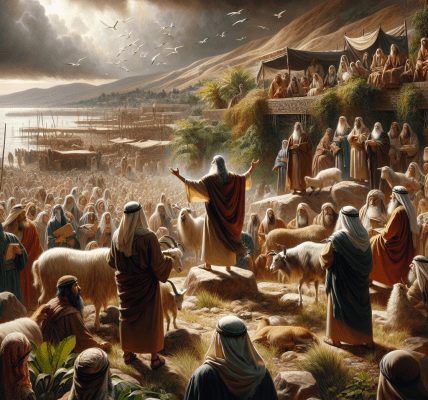
He reached Bethel, the king’s sanctuary, the temple of the kingdom. It thronged with people in fine linen. The sacrifices were plentiful, the smoke thick. The priests moved with solemn ritual. But Amos’s stomach turned. It was an empty theatre. They worshipped, but their hearts pursued other gods. They offered lambs, but their hands were stained with the injustice done to the poor, whose garments they took in pledge, whose bodies they sold for the price of a pair of sandals.
He found his place, not within the sacred precincts, but at the gate, where the people flowed. And when he opened his mouth, the words that came were not gentle.
“You who oppress the innocent and crush the needy,” his voice, roughened by the wilderness, cut through the market’s din. “You store up violence and robbery in your fortified palaces.”
A crowd gathered, a mix of curiosity and contempt. Who was this rustic, this southerner, to speak so?
“Therefore,” Amos declared, the weight of the divine logic giving his words a crushing force, “thus says the Lord: ‘An enemy shall surround the land. He will strip your strength from you, and your fortresses will be plundered.’”
He used their own proverbs against them, the smooth, comfortable sayings. “As the shepherd rescues from the mouth of the lion two leg bones or a piece of an ear, so shall the people of Israel be rescued.” He let the image hang—not a triumphant salvation, but a pathetic, mangled remnant. A mere scrap of what once was.
The faces hardened. A priest of Bethel, his robes clean and his face smooth, pushed to the front. “Seer!” he spat the title like an insult. “Go, flee away to the land of Judah. Earn your bread there, and prophesy there. But never again prophesy at Bethel, for it is the king’s sanctuary, and it is a temple of the kingdom.”
Amos met the priest’s eyes. There was no anger in him, only a vast, sorrowful certainty. “I was no prophet, nor a prophet’s son,” he said, his voice dropping, almost conversational against the priest’s fury. “I was a herdsman and a dresser of sycamore figs. But the Lord took me from following the flock, and the Lord said to me, ‘Go, prophesy to my people Israel.’”
He paused, letting the divine calling hang in the air, irreducible and undeniable.
“Now therefore hear the word of the Lord,” he continued, his gaze sweeping over the crowd of well-dressed, complacent faces. “Your wife shall become a prostitute in the city. Your sons and your daughters shall fall by the sword. Your land shall be divided up with a measuring line. You yourself shall die in an unclean land. And Israel shall surely go into exile away from its land.”
The silence that followed was brittle. The images were too specific, too domestic, too terrible. It wasn’t a vague threat. It was a detailed foreclosure. The God they claimed to worship in their ornate rituals was the same God who had brought them from Egypt, and who now, with the same sovereign power, was calling them to account. They had forgotten the covenant. They had broken the agreement of the walk. The Lion, whom they had pretended to tame with their festivals, was roaring. And the trap, baited with their own injustice, was about to spring.
Amos turned, the message delivered. The scent of char on the northern wind was stronger now. He walked back toward the barren hills of home, the shepherd carrying a burden no flock could ever equal. The words echoed behind him in the prosperous city, a seed of terrible truth planted in soil that preferred the comforting lie. The logic of heaven had been stated. The consequences would follow, as surely as the dawn follows the watchman’s cry.