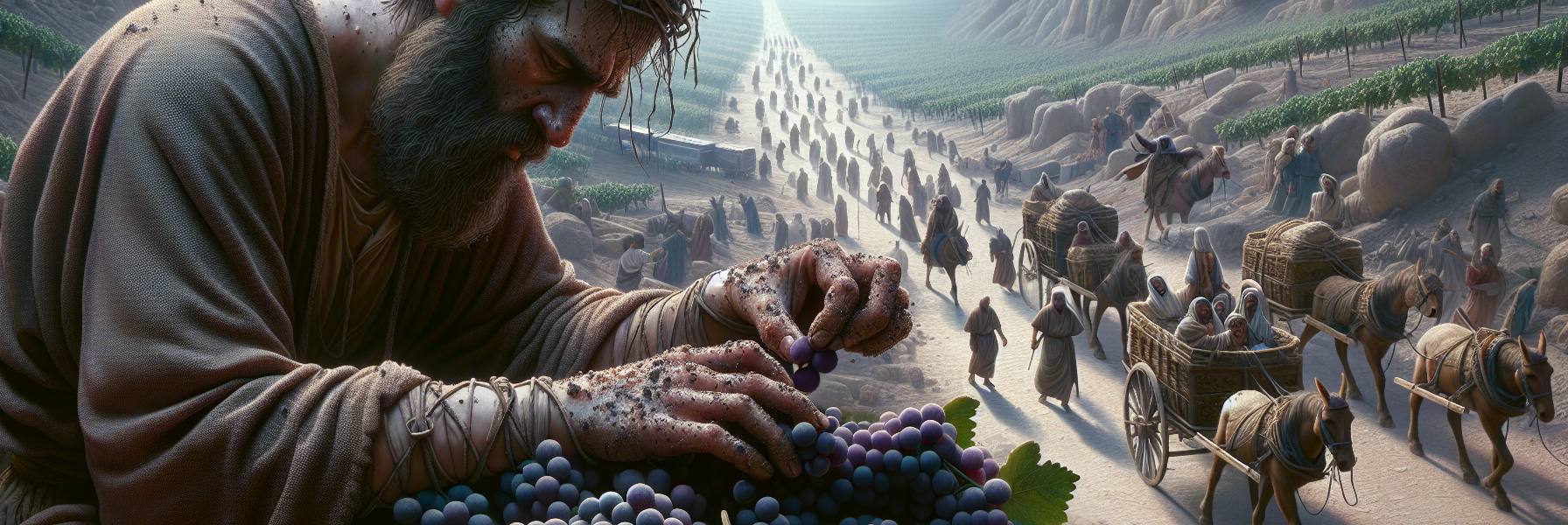

The heat in the vineyard was a physical weight. It pressed down on Anathoth’s shoulders as he worked, a dry, woolen cloak he could not shed. The grapes, fat and purpling, should have been a promise. But as his fingers brushed the dusty clusters, he felt nothing. No anticipation of the harvest feast, no pride in the taut skin of the fruit. Just the grit under his nails and the taste of the air—a metallic tang, like distant smoke.
He straightened, wiping his brow with a sleeve already stiff with salt and sweat. From his little plot on the hill, he could see the road to Jerusalem. It was busy. Always busy now. Merchants with their laden mules, officials in litters carried at a brisk trot, soldiers in small, clanking groups. A constant flow toward the city gates. He used to wonder at it all, the pulse of the kingdom. Now he just watched, a hollow place growing where his wonder used to be.
It was the talk that had done it. The talk in the market, at the well, even here among the vines. It wasn’t just gossip anymore; it was a kind of fever. Old Nahum, his neighbor, had sold a parcel of land to a Babylonian trade official. The price was absurdly high. “A shrewd deal,” Nahum had crowed, his eyes bright. But Anathoth had seen the contract. The clauses were a nest of vipers, written in a looping script that promised one thing and meant another. When he’d mumbled a caution, Nahum had clapped him on the back. “You worry like an old woman, Anathoth! Everyone does it. It’s just how things are done now.”
*Just how things are done.* The words echoed as he looked toward the city. A city built on lies. Not the grand, theatrical lies of idols and foreign altars—though there was plenty of that, too—but small, daily lies. The false weights in the marketplace, the smiling assurances that hid a dagger of intent, the promises between brothers that evaporated like morning dew. They were all skilled in wrongdoing, he thought. An entire people, practicing deceit as a second tongue.
He thought of his own son, Shelemiah. Bright-eyed, quick with numbers. Just last week, he’d caught him swapping a good baking stone for a cracked one, palming the difference from their neighbor’s boy. “But Abba,” he’d protested, “Eli did it to me last month!” There was no shame in his face. Only a cunning logic. The betrayal went marrow-deep, from brother to brother, a spreading stain.
A sudden, fierce longing seized him. Not for water, though his throat was parched. Not for rest, though his bones ached. He wished for a lodging place in the wilderness. A crude shelter, miles from any road. To be away from this. From the relentless, smiling corruption. To be where the only voice was the wind and the only deceit was the mirage on the sand, a simple, honest trick of the light.
He bent back to the vines, his movements slow. A prophet lived here in Anathoth. A cousin of his, Jeremiah. People muttered about him. They called him a doom-monger, a traitor for speaking of submission to Babylon. Anathoth had heard him once, at the town gate. His voice wasn’t fiery; it was weary, etched with a grief that seemed to age him from the inside out. He’d spoken of mourning, of a wailing that rose from the pastures. Anathoth hadn’t understood it then. He understood it now. It wasn’t about foreign armies. It was about what was already dead. The trust. The faithfulness. The *knowing* of God. It was all gone, rotting from within like a gourd left in the sun.
The sun began its slow descent, bleeding orange across the western hills. The beauty of it was a rebuke. *Thus says the Lord,* he could almost hear his cousin’s voice on the breeze, *Let not the wise man boast in his wisdom, let not the mighty man boast in his might, let not the rich man boast in his riches…* Anathoth owned little. He was neither wise nor mighty. What was there to boast in? His straight rows? His un-watered wine?
The answer came, unbidden and bitter. There was one thing. He understood the sickness. He could name the hollow in his own chest. That was his knowledge. To understand *this*: that steadfast love and faithfulness had perished. To know the justice and righteousness that once walked the hills of Judah were now ghosts. That was his bleak, unsharable boast.
He gathered his tools. Down in the town, lamps were being lit. He could hear the faint sound of laughter, a lute playing a lively tune. A feast, perhaps. They would be eating and drinking, telling clever stories that hinged on a cheat, making plans that circumvented the law. Tomorrow, they would rise early and run eagerly in the way of evil.
He did not go down. He sat on a flat stone at the edge of his vineyard, watching the darkness gather in the valleys first. It looked like a rising flood. A great, silent mourning. Not for the dead, but for the living. For a people who had forgotten the shape of their own souls. The Lord was refining them, Jeremiah said. Testing them. But what was left to test? They were stubborn rebels, a bronze-and-iron heart. The scum of silver, the dross left in the crucible after the true metal had burned away.
A cold night wind stirred, whispering through the dry leaves. It carried a scent from the city—roasting meat, incense, the dank smell of crowded humanity. And underneath it, fainter, the smell of ash. Anathoth pulled his cloak tight. The lament was not just the prophet’s song. It was the song of the land itself. It was in the tired soil, the suspicious glance, the fractured word. The mourning women were already here, he realized. They were in every silent hearth, in every betrayed trust, in his own weary heart.
He looked up at the stars, sharp and cold in the deepening black. Somewhere, far to the north, a power was stirring. A distant, disciplined thunder. It would come. But the greater tragedy was not what would come, but what was already gone. The knowledge of God. Swept away, not by a foreign army, but by a thousand daily, willing choices.
Anathoth stood, his joints protesting. He walked slowly toward his small, dark house. There would be no lamp lit inside. He would sit in the darkness, and listen. And in the quiet, he feared he would finally hear it—the sound his cousin spoke of. The sound of a whole people, learning too late the price of a lie, wailing over the mountains and the health of the pasture, wailing because *all* was silent. The silence of an abandoned throne, and the terrible, echoing silence of a heart that had long since stopped listening.