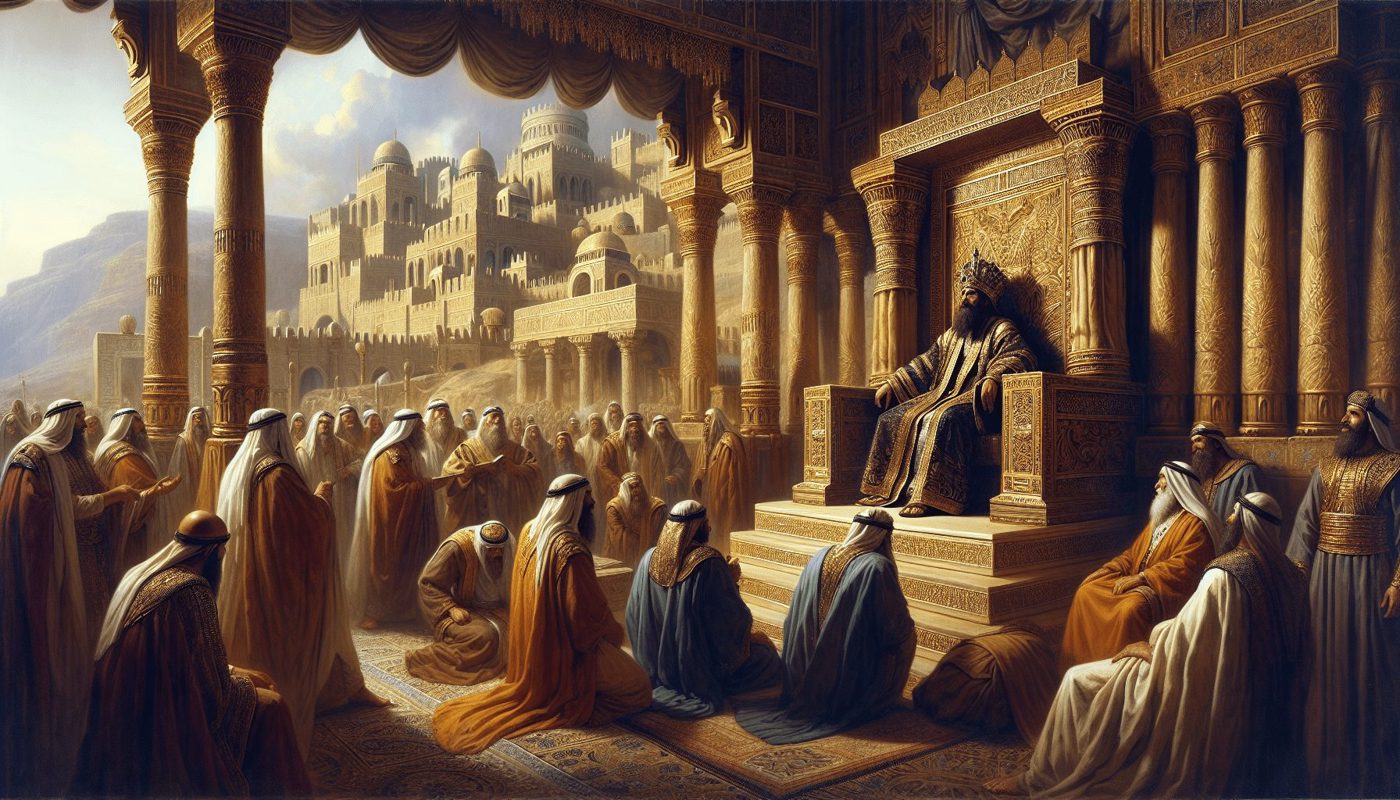
Abijam reigned three years in Jerusalem. The chapter says his heart was not perfect with the Lord his God, as the heart of David his father. It does not list his specific sins, only that he walked in all the sins of his father Rehoboam. Yet for David's sake, the Lord gave him a lamp in Jerusalem—a son to sit on the throne and a city to stand.
The text notes war between Abijam and Jeroboam, just as there had been war between Rehoboam and Jeroboam. No battles are described. The chapter moves quickly to Abijam's death and burial in the city of David, and Asa his son reigned in his place.
Asa began to reign in the twentieth year of Jeroboam king of Israel. He reigned forty-one years in Jerusalem. His mother's name was Maacah the daughter of Abishalom—the same woman named as Abijam's mother. The chapter does not explain how the same woman could be mother to both kings, but it records that Asa removed her from being queen because she had made an abominable image for an Asherah.
Asa did what was right in the eyes of the Lord, as David his father had done. He put away the sodomites from the land and removed all the idols that his fathers had made. He cut down Maacah's image and burned it at the brook Kidron. The high places, however, were not taken away. Nevertheless, the chapter says Asa's heart was perfect with the Lord all his days.
Asa brought into the house of the Lord the things his father had dedicated and the things he himself had dedicated—silver, gold, and vessels. The temple treasury received what had been set apart, but the high places remained standing. The chapter does not say why Asa left them, only that his heart was not divided.
War continued between Asa and Baasha king of Israel all their days. Baasha built Ramah to block movement in and out of Judah. Asa responded by taking all the silver and gold left in the treasuries of the Lord's house and the king's house and sending them to Ben-hadad king of Syria, who lived in Damascus. Asa reminded Ben-hadad of the league between their fathers and sent a present of silver and gold, asking him to break his league with Baasha.
Ben-hadad listened to Asa. He sent the captains of his armies against the cities of Israel, striking Ijon, Dan, Abel-beth-maacah, all Chinneroth, and all the land of Naphtali. When Baasha heard this, he stopped building Ramah and withdrew to Tirzah. Asa then proclaimed a levy in Judah—no one was exempt—and the people carried away the stones and timber of Ramah. Asa used them to build Geba of Benjamin and Mizpah.
The chapter records Asa's might, the cities he built, and the note that in his old age he was diseased in his feet. It does not say whether the disease was connected to his actions. He slept with his fathers and was buried in the city of David. Jehoshaphat his son reigned in his place.
The chapter then turns to the northern kingdom. Nadab son of Jeroboam reigned over Israel in the second year of Asa. He reigned two years and did evil in the sight of the Lord, walking in his father's sin. Baasha son of Ahijah, of the house of Issachar, conspired against him and struck him at Gibbethon, a Philistine town under siege by Israel. Baasha killed Nadab in the third year of Asa and reigned in his place.
As soon as Baasha became king, he struck down the entire house of Jeroboam. He left no one breathing, fulfilling the word the Lord spoke through Ahijah the Shilonite. The destruction came because of Jeroboam's sins and the sins he caused Israel to commit, provoking the Lord to anger. Baasha reigned twenty-four years in Tirzah, but he walked in the way of Jeroboam and in his sin.
The chapter offers no commentary on Asa's use of temple gold to hire a Syrian king. It simply reports the act. The high places remained. The war continued. The line of David held the throne, but the kingdom was not whole.
Comments
Comments 0
Read the discussion and add your voice.
Members only
Sign in to join the conversation
We keep comments tied to real accounts so the discussion stays clean and trustworthy.
No comments yet. Be the first to add one.