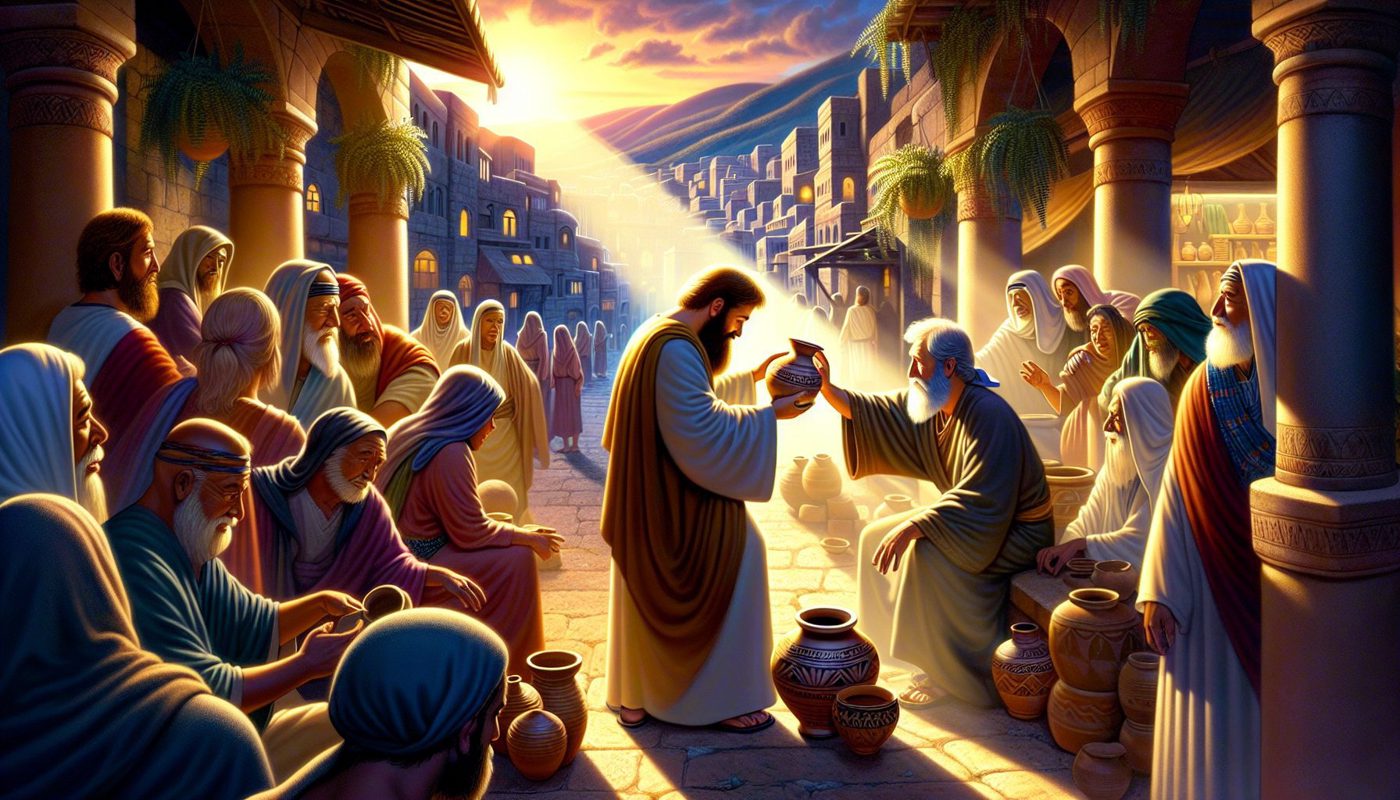
The Lord did not send Jeremiah to speak this word in the temple courtyard. He sent him first to a potter, then to the valley of Ben Hinnom, at the entrance of the Potsherd Gate. The prophet was told to buy an earthenware bottle and take with him some of the elders of the people and some of the senior priests. These leaders followed without knowing what would happen next. The Lord had already determined the scene and the object.
When Jeremiah reached the valley, he was to proclaim the words the Lord gave him. Those words began with a command to hear—not just to the people of Jerusalem, but to the kings of Judah as well. The Lord of hosts, the God of Israel, said He would bring evil upon that place so severe that everyone who heard of it would feel their ears tingle. The phrasing was deliberate: not a vague threat, but a specific, physical reaction to the horror of what was coming.
The reason for this judgment was laid out plainly. The people had forsaken the Lord. They had estranged the place by burning incense to gods they did not know—gods unknown to them, to their fathers, and to the kings of Judah. Worse, they had filled that same valley with the blood of the innocent. They had built the high places of Baal to burn their sons in the fire as burnt offerings. The Lord stated clearly that He had never commanded such a thing, never spoken it, and that it had never entered His mind.
Because of these acts, the Lord declared that the days were coming when this place would no longer be called Topheth or the valley of the son of Hinnom. It would be called the valley of Slaughter. The name itself would become a memorial of what happened there, not of child sacrifice to a false god, but of the judgment that followed.
The Lord said He would make void the counsel of Judah and Jerusalem in that same place. He would cause them to fall by the sword before their enemies, and their dead bodies would become food for the birds of the sky and the beasts of the earth. The city itself would become an object of astonishment and hissing—everyone who passed by would be horrified at the plagues that had struck it.
The most unbearable detail came next. In the siege and distress caused by their enemies, the Lord said He would cause them to eat the flesh of their sons and daughters, and each one would eat the flesh of his friend. This was not hyperbole. It was the stated consequence of a people who had burned their own children to a god that did not exist.
Then the Lord gave Jeremiah the physical act. In the sight of the men who had accompanied him, Jeremiah was to break the bottle. He was to say that the Lord of hosts would break this people and this city just as a potter's vessel is broken—so completely that it could not be made whole again. The dead would be buried in Topheth until there was no room left to bury. The houses of Jerusalem and the houses of the kings of Judah would become defiled like Topheth, because on their roofs the people had burned incense to the whole host of heaven and poured out drink offerings to other gods.
Jeremiah did not linger in the valley. He went from Topheth, where the Lord had sent him to prophesy, and stood in the court of the Lord's house. There he spoke to all the people. He repeated the message: the Lord of hosts, the God of Israel, would bring upon this city and all its towns every evil He had pronounced against it. The reason was not complicated. They had made their neck stiff so that they would not hear His words.
The jar was already broken. The leaders had watched it shatter. The question was whether anyone would listen before the city itself was shattered the same way.
Comments
Comments 0
Read the discussion and add your voice.
Members only
Sign in to join the conversation
We keep comments tied to real accounts so the discussion stays clean and trustworthy.
No comments yet. Be the first to add one.